

< Back to Performance Development
By Johnny Liu, CEO at Dowway Vehicle | Updated: February 27, 2026
The braking system keeps drivers safe, stabilizes handling, and ensures a smooth ride. Drawing on years of hands-on engineering, I wrote this guide to walk you through the entire brake development lifecycle—from basic metrics to what’s coming next on the horizon.
- 📌 Key Takeaways
- 2.1 Stopping Power (Braking Efficiency)
- 2.2 Braking Stability
- 2.3 Braking Comfort
- 2.4 Braking Durability
- 3.1 Target Setting
- 3.2 System Architecture Design
- 3.3 Component Selection
- 3.4 Simulation & Optimization
- 3.5 Testing & Validation
- 4.1 Brakeforce Distribution
- 4.2 Electronic Control
- 4.3 Thermal Management
- 4.4 EV Brake Coordination
- 4.5 New Materials
📌 Key Takeaways
- Safety & Stability First: Modern brake design demands a precise balance of stopping power, control, comfort, and wear resistance.
- Electric Vehicle Nuances: EVs need smooth, invisible handoffs between electric motor regeneration and physical brake pads to maximize battery range.
- New Tech: The industry is moving fast toward Electronic Brakeforce Distribution (EBD), active cooling, and Brake-by-Wire (BBW) systems.
- Strict Testing: Engineering teams build better brakes using digital twin software combined with rigorous physical track testing.
1. The Realities of Modern Brake Performance
The car industry is changing fast. We have heavier, faster, and smarter electric vehicles on the road today. Because of this, brakes must do a lot more than they used to.
Older brake designs struggle with electric vehicles (EVs). EVs need to recover energy smoothly at low speeds and handle high voltage. On top of that, self-driving features like Autonomous Emergency Braking (AEB) mean brakes must react quickly and work seamlessly with other car computers.
The main goal is simple: make sure the car stops quickly, smoothly, and reliably on any road and in any weather. At the same time, we have to keep the pedal feeling natural, control the noise, and catch as much energy as possible without causing the car to pull to one side or overheat the pads.
2. Core Evaluation Indicators
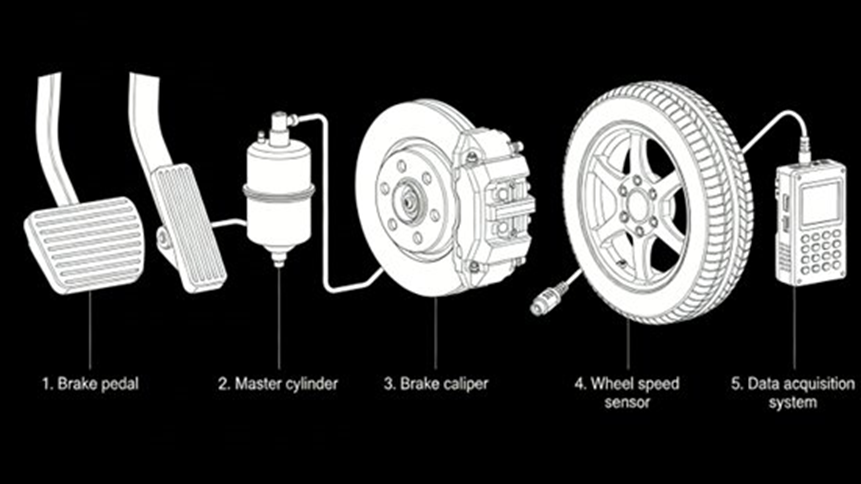
Engineers measure brake quality using exact numbers. The main metrics look at stopping power, stability, comfort, and how long the parts last. You have to balance all these pieces during design.
2.1 Stopping Power (Braking Efficiency)
This is the foundation. It measures how well the vehicle slows down or stops.
- Braking Distance: The main metric. Speed, vehicle weight, tire grip, and system speed change this number. Standard GB 7258-2012 says an empty passenger car going 100km/h must stop within 38 meters and hit a deceleration rate of 5.9m/s² or higher.
- Braking Deceleration: We look at average and maximum rates. This shows how hard the brakes bite. Passenger cars generally need a maximum rate of 8m/s² or more.
- Braking Time: The total clock from hitting the pedal to a dead stop. Great systems do this in 2.5 seconds or less from 100km/h.
2.2 Braking Stability
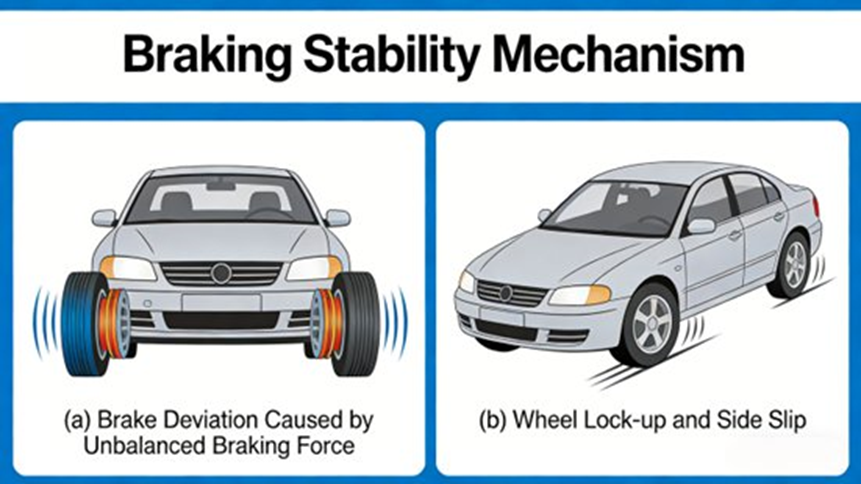
This means keeping the car straight and steering well while braking.
- Braking Deviation: When the car pulls to one side. We allow up to 80mm of drift per 100m of stopping distance. Bad alignment, bent suspension, or uneven brake force cause this.
- Wheel Lock-up: If the wheels stop spinning entirely, you lose steering and the car might slide. Anti-lock Braking Systems (ABS) fix this by pulsing the pressure.
- Steering Ability Retention: Drivers must still be able to turn the wheel and dodge things during a panic stop.
2.3 Braking Comfort
This covers how the stop feels to the people inside.
- Pedal Feel: Travel distance (100-150mm) and force (under 400N for cars). The pedal should press smoothly, not feel like stepping on a brick or a sponge.
- Brake Noise: We keep squeals and grinding under 70dB.
- Braking Smoothness: Slowing down shouldn’t jerk the passengers forward. EVs specifically need a completely seamless shift between motor braking and pad braking.
2.4 Braking Durability
Parts must survive heat and time.
- Thermal Fade: Brakes get incredibly hot on long downhill runs—sometimes over 600°C. A good system keeps at least 80% of its stopping power even when it gets that hot.
- Wear Life: Pads and rotors must last a set number of miles (usually 50,000km or more) without wearing down past safe limits.
- Weather Resistance: The whole setup needs to survive freezing cold, extreme heat, dust, and rain without leaking fluid or ruining the computers.
3. The Development Process
We follow a strict loop: Set Goals → Design the Architecture → Build Components → Simulate → Test → Refine.
3.1 Target Setting
We set targets matching the type of car and the law (like GB 7258 or FMVSS 135). Fast cars focus on heat management. EVs need energy recovery rates of 20% or higher.
3.2 System Architecture Design
- Brakeforce Distribution: We balance the front and rear brakes based on the car’s weight. This maximizes grip and keeps the car straight.
- Brake Lines: We use split circuits. If one pipe breaks, the other still gives you at least 30% stopping power.
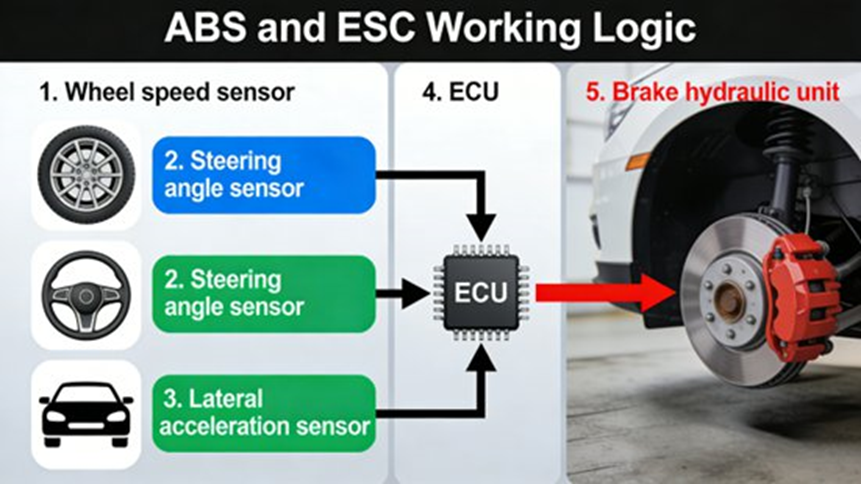
- Electronic Control: We place the sensors and map out the ABS, EBD, Electronic Stability Control (ESC), and AEB logic.
3.3 Component Selection
- Discs/Drums: High-end cars use carbon-ceramic rotors because they handle heat well and weigh less.
- Friction Pads: Materials must balance grip, wear, and noise (usually a 0.35-0.45 friction coefficient).
- Brake Fluid & ECUs: Computers must react in 10 milliseconds or less using DOT4 or DOT5.1 fluid.
3.4 Simulation & Optimization
We test everything on computers first to save money and catch flaws early.
- Vehicle Dynamics: Programs like ADAMS or Carsim predict stopping distance.
- Hydraulic Simulation: AMESim checks the pedal feel and fluid pressure.
- Thermal Analysis: ANSYS and ABAQUS map out the heat so we can design better cooling vents.
3.5 Testing & Validation
We test in three stages:
- Parts: Checking wear, heat limits, and pressure seals.
- Benches: Testing fluid response and computer logic on a test rig.
- Whole Vehicle: Taking the car to the track to verify stopping distance, heat fade, and EV motor coordination.
4. Key Technologies Driving Performance
4.1 Brakeforce Distribution
Older cars used simple mechanical valves. Now, Electronic Brakeforce Distribution (EBD) calculates the best ratio on the fly. For EVs, EBD mixes motor regeneration and physical brakes to get the most battery range possible.
4.2 Electronic Control
- ABS: Pulses the brakes 10-20 times a second to prevent skids.
- ESC: Uses steering sensors to brake single wheels and stop spin-outs.
- AEB: Uses cameras to brake the car for you if a crash is about to happen.
4.3 Thermal Management
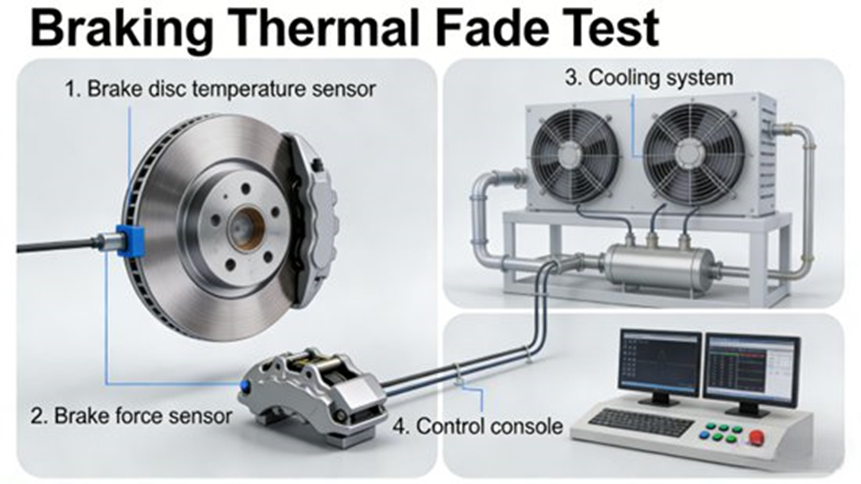
We cool brakes using vented rotors, cooling fins, and better metals. Heavy trucks or race cars sometimes use forced air or liquid cooling systems.
4.4 EV Brake Coordination
The computer mixes motor braking and pad braking based on how hard you press the pedal and the battery charge. The trick is making the handover completely invisible to the driver so the car doesn’t jerk. The system also has a mechanical backup just in case the electrical side fails.
4.5 New Materials
We are replacing heavy cast iron with carbon-ceramic or aluminum rotors. We also moved away from asbestos pads to safer organic, semi-metallic, or ceramic compounds.
5. Essential Testing Tools
| Simulation Tool | Application Scenario | Core Function |
| Carsim / ADAMS | Vehicle Dynamics | Calculates stopping distance and stability. |
| AMESim | Hydraulic Systems | Simulates fluid pressure and pedal feel. |
| MATLAB / Simulink | Electronic Control | Maps out ABS and AEB logic. |
| ANSYS / ABAQUS | Thermal & Structural | Checks heat spread and part stress. |
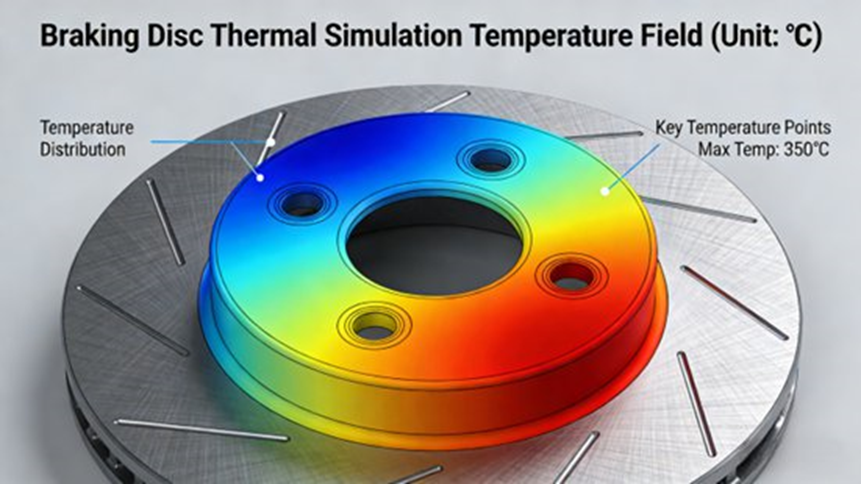
Physical testing relies on test benches, whole-vehicle speed sensors, and weather chambers to test for extreme climates.
6. Future Trends in Braking
- Smart Upgrades: Tech like V2X (Vehicle-to-Everything) lets brakes react to danger you can’t even see yet. AI will adjust the pedal to fit your personal driving style.
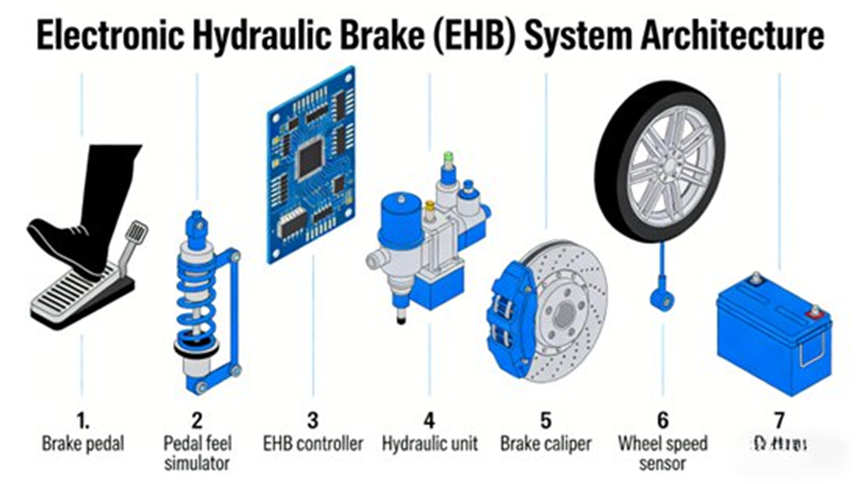
- Brake-by-Wire (BBW): This replaces fluid lines with electrical wires. It drops reaction times to 5 milliseconds, saves weight, and fits perfectly with self-driving cars.
- Deep Integration: Brakes will soon tie directly into steering and battery computers to form a single safety net.
- Green Designs: Car companies want lighter parts and less brake dust to meet strict environmental laws.
7. Final Thoughts
Building great brakes is a massive engineering puzzle. Teams have to nail down the core metrics, run strict tests, and adopt fresh tools like Brake-by-Wire. Doing this right keeps drivers safe, comfortable, and confident on the road.
8. Frequently Asked Questions (FAQ)
Q1: Do bigger or performance brakes actually reduce stopping distance?
Answer: Brake size alone doesn’t always shorten stopping distances on the street. For daily drivers, tire grip and ABS matter most. Large brakes handle high heat and repeat stops without failing. On the first hard stop, tires usually lock up before the brakes hit their limit. Bigger brakes rock on the track, but you absolutely need sticky tires to get shorter stops.
Q2: What is brake fade, and why does it matter?
Answer: Brake fade happens when pads, rotors, or fluid get too hot from heavy use, like driving down a mountain. The heat lowers friction and boils the fluid, making it hard to stop. Upgrading to parts that shed heat quickly and keeping fresh fluid in the lines stops this from happening.
Q3: How does brake pad and rotor quality change things?
Answer: Better materials handle heat better. High-end pads grip harder when hot. Upgraded rotors with vents or slots shed heat faster and won’t warp under heavy loads. Together, they give you a reliable stop every time. But again, you need good tires to transfer that grip to the road.
Q4: How often should I change brake fluid?
Answer: Brake fluid pushes the pistons when you step on the pedal. Over time, it absorbs water from the air. This lowers its boiling point and makes fade more likely. Mechanics suggest changing it every 2 to 3 years for daily driving, and much more often if you hit the track. This keeps the pedal feeling firm.
Q5: Do brake upgrades make sense for street driving, or only for track use?Answer: You get perks in both situations, but the reasons differ. On the street, better pads give you a firmer pedal, less fade on hills, and less dust on your wheels. On the track, upgrades are absolute lifesavers. Stock brakes just can’t handle track heat and will fail quickly. If you commute, maintain your stock setup and buy great tires. If you push your car hard, upgrade the brakes.
