

< Back to Performance Development
By Johnny Liu, CEO at Dowway Vehicle
Published: March 2, 2026
💡 Key Takeaways
- Definition: A vehicle restraint system controls occupant movement during a crash (inside the car) or stops moving vehicles to protect infrastructure (on highways and loading docks).
- In-Vehicle Safety: The system relies on the tight coordination between pre-tensioned seat belts, multi-stage airbags, and a rigid cabin. Together, seat belts and airbags cut fatality rates by over 50%.
- Testing & Compliance: Global standards like C-NCAP (2024), Euro NCAP (2026), and IIHS demand strict crash test performance using finite element analysis (FEA) and highly sensor-equipped dummies.
- Future Trends: Manufacturers focus on integrated die-casting and CFRP. AI-driven deployments drop response times to 15 milliseconds, while cloud systems from companies like Huawei link active and passive safety.
- Industrial Scope: Beyond cars, these systems stop off-road highway crashes (guardrails) and prevent industrial warehouse accidents (loading dock hooks).
The Last Line of Defense
As the CEO of Dowway Vehicle, I watch the rapid changes in auto safety closely. Active safety systems focus on preventing collisions using Advanced Driver Assistance Systems (ADAS). However, we cannot avoid every accident. This is where passive safety—specifically the vehicle restraint system—steps in to save lives. It acts as the core defense mechanism determining the severity of crash injuries.
Global safety regulations keep getting stricter. At the same time, the massive shift toward electric vehicles introduces entirely new engineering hurdles. Understanding how vehicle restraint systems work with overall structural safety has never mattered more.
Part I: In-Vehicle Restraint Systems & Passive Safety
What is an In-Vehicle Restraint System?
Inside a passenger car, a vehicle restraint system is a network of parts designed to control how people move during a crash. Its main job is to stop occupants from hitting hard interior surfaces (secondary collisions). It also distributes crash forces across the strongest parts of the human body.
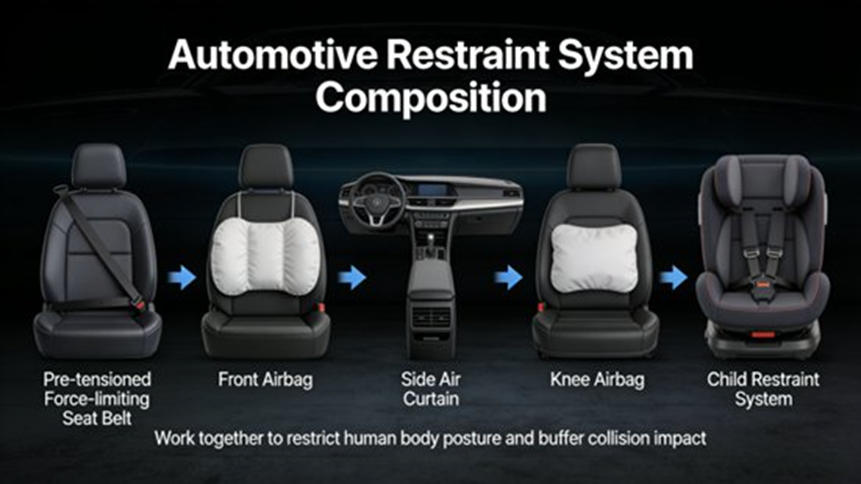
- Seat Belt Systems: These form the foundation of passenger safety. Plastic surgeon Claire L. Straith and C.J. Strickland first pushed for their use in the 1930s. Today’s standard relies on pre-tensioned, force-limiting belts. Within 20 milliseconds of an impact, pyrotechnic or motor-driven pre-tensioners pull the belt back 10-15cm to remove slack. A torsion bar force-limiter then controls the tension, keeping chest forces within human tolerance (≤6kN). Premium cars now use dual-stage systems that adjust tension based on how hard the crash is.
- Airbag Systems: Airbags work hand-in-hand with seat belts. They deploy in just 0.03 seconds to form a soft barrier. Data shows that pairing airbags with seat belts cuts passenger fatality rates by more than 50%. Modern cars go far beyond front airbags. They include side airbags, head curtains, knee airbags, and even central airbags to stop passengers from hitting each other.
- Child Restraint Systems (CRS): Engineers tailor CRS for a child’s unique anatomy. These systems use rigid ISOFIX connections to lock child seats in place. Safety evaluators now heavily weigh the adaptability and performance of CRS in their final scoring.
The Physics of Safety: Interaction with Body Structure
A vehicle restraint system cannot work properly without a strong body structure supporting it. Passive safety is all about reducing collision injuries through energy balance.
- The Energy Absorption Zone: Front, rear, and side crumple zones absorb over 80% of total collision energy. They use thin-wall structures that fold in a specific, controlled way to keep brute force away from the cabin.
- The Rigid Passenger Compartment: Occupants need a “safety fortress” so the restraint system has room to operate. Automakers forge critical pillars (A, B, C) and floor longitudinal beams from hot-formed steel. This steel boasts yield strengths exceeding 1500MPa and tensile strengths over 1800MPa. Audi, for instance, uses laser welding to increase joint strength by 30%. In motorsports, smart energy management lets drivers walk away from 200km/h crashes—a scenario famously shown in Han Han’s racing movie Pegasus.
Beyond the Cabin: Pedestrian Protection
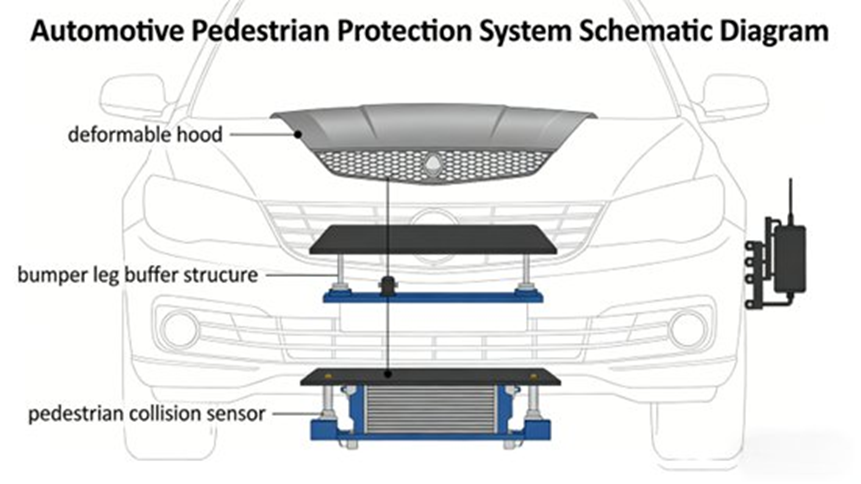
Modern passive safety also looks outside the vehicle to protect pedestrians and vulnerable road users. Engineers build deformable hoods lined with buffer foam. During a crash, the hood sinks and folds to absorb head impacts. Front bumpers feature hidden leg buffers to stop bone fractures and prevent pedestrians from slipping under the car. High-end models even use collision sensors that automatically pop up the hood milliseconds after impact to create extra cushioning space.
Advanced Technologies and EV-Specific Challenges
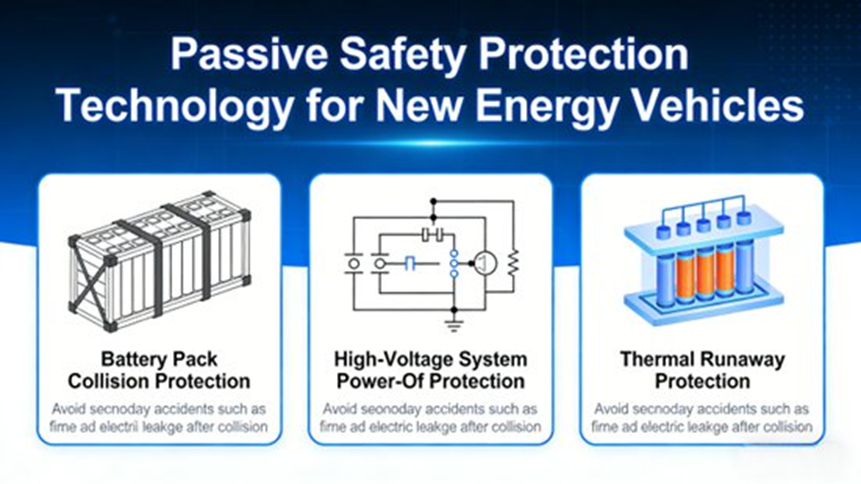
Modern restraint systems rely on extreme precision, smart materials, and new approaches for electric cars:
- Smart Airbag Triggering: The Electronic Control Unit (ECU) reads data from multiple crash sensors in milliseconds. Multi-sensor fusion stops airbags from firing by mistake. Meanwhile, adaptive inflation changes the airbag’s speed and volume based on the passenger’s size and the crash severity.
- Better Materials: Manufacturers use Carbon Fiber Reinforced Polymers (CFRP) to cut weight. CFRP is one-quarter the weight of steel but 3-5 times stronger. It reduces weight by 30% and boosts energy absorption by 40%. Car brands also apply anti-corrosion processes (like Audi’s 12-year anti-rust guarantee) to keep the metal strong over time.
- EV-Specific Safety: Electric vehicles demand unique passive safety designs. Automakers house battery packs in high-strength shells surrounded by dedicated crash beams. When a crash happens, the ECU cuts high-voltage power in milliseconds. Built-in thermal runaway protection stops fires before they start.
Development, Testing, and Evaluation
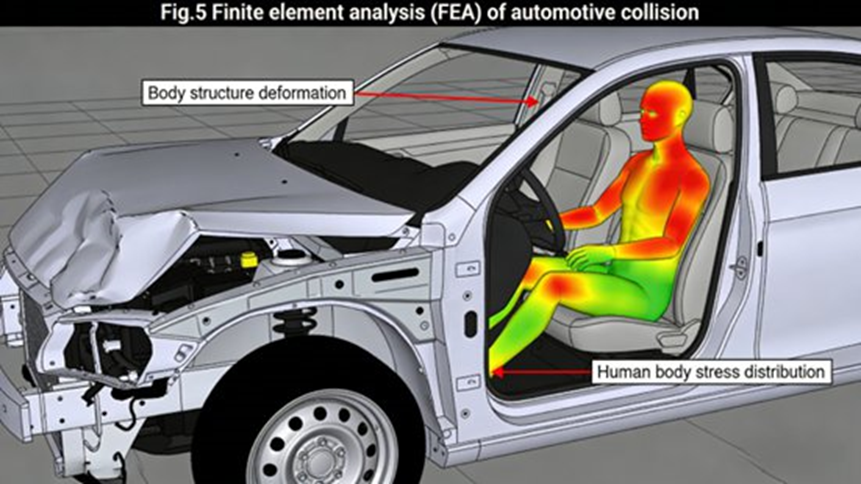
Engineers build these systems through a strict process governed by global rules.
- Virtual Simulation (FEA): Teams use CAD and Finite Element Analysis (FEA) software like LS-DYNA or ABAQUS. They simulate crashes with over 90% accuracy, cutting costs and mapping out energy transfer paths early in the design phase.
- Prototyping: Teams build 1-3 physical prototype vehicles to ensure the seat belts, airbags, and metal structures fit and work together properly.
- Real-World Crash Tests: General Motors pioneered real-world testing in 1934, and it remains the gold standard today. Automakers run tests at highly specific speeds: 50-55km/h for frontal barrier crashes, 32km/h for side pole impacts, and 40-50km/h for rear whiplash tests. Companies run massive crash labs. Audi’s lab, for example, holds 56 high-tech dummies. Each dummy packs over 100 sensors and costs as much as a luxury car.
- Global Evaluation Systems:
- C-NCAP (China): The 2024 version bases 60% of its score on occupant protection, adding pedestrian safety (25%) and active safety (15%) to the mix. By late 2021, C-NCAP had already run 1,470 tests across 490 different car models.
- Euro NCAP: The upcoming 2026 version ranks as the strictest yet. It grades cars on four pillars: safe driving, crash avoidance, crash protection, and post-crash safety.
- IIHS (USA): This group focuses on real-world, high-fatality setups. They run the brutal 25% small overlap test (64.37km/h) and demand roof strength tests where the car roof must hold 4 times the vehicle’s weight.
The Future of Vehicle Restraint Systems
As technology moves forward, we see a few clear paths for passive safety:
- Smarter Production & Materials: The industry is shifting toward integrated die-casting to build stronger, lighter frames with fewer parts. At the same time, companies expect to hit a 30% recycling rate for carbon fiber by 2030.
- Cloud & Active Synergy: Tech giants like Huawei and Tencent are building cloud-linked safety networks. Soon, active ADAS systems will talk to passive systems, pre-tightening belts and adjusting seats right before a crash happens.
- Intelligent Personalization: Next-generation smart airbags will read your exact body shape and deploy in a staggering 15 milliseconds to give you “one person, one protection.”
- Protecting the Vulnerable: We will see finely tuned restraint designs for the elderly to stop seatbelt bruising, plus smarter exterior designs to shield cyclists and children on the road.
Part II: FAQ – The Broader Scope of Vehicle Restraint Systems
Most people hear “vehicle restraint system” and think of passenger protection. However, the term covers a much wider range of traffic infrastructure and industrial operations. Here are the five top questions people ask about these external systems:
1️⃣ What is an external Vehicle Restraint System?
Outside the car, it is a mechanical setup built to control a moving vehicle. It protects people, structures, or daily operations.
- On highways: These include guardrails, crash barriers, wire ropes, and crash cushions that redirect or stop cars drifting off the road.
- At loading docks: These are mechanical or powered locks that hold a truck or trailer tight to the dock. They stop dangerous, unwanted movement like trailer creep.
2️⃣ Why do we need these external systems?
- Road Safety: They cut down the severity of off-road crashes. By keeping cars on the pavement, they protect drivers and shield hazards near the road.
- Loading Dock Safety: They stop common warehouse accidents. Preventing forklift tip-overs and sudden dock separation saves workers from serious injuries and stops massive product loss.
3️⃣ What types of external systems exist?
- Highway Systems: Steel or concrete guardrails, tensioned wire ropes, and frontal impact crash cushions.
- Loading Dock Systems: Mechanical hook restraints that grab the rear impact guard, powered hydraulic/electric restraints, and physical wheel chocks.
4️⃣ How do these external systems actually work?
- Road infrastructure absorbs kinetic energy. Engineers install them based on strict calculations covering traffic speed, vehicle weight, and road shape.
- Loading dock systems physically lock the trailer to the building. They usually connect to red and green communication lights. This ensures forklift drivers only enter the trailer when the vehicle is 100% locked down.
5️⃣ How do regulators test these systems?
- Traffic Restraints: European roadside systems must pass EN 1317 standards. This requires full-scale crash tests to prove they can hold specific containment levels.
- Dock Restraints: Industrial products must meet strict OSHA guidelines and local safety codes. Engineers test them for raw structural strength and check how well they communicate with digital dock controls.
Final Thoughts
Whether it softens the blow of a 50km/h frontal crash inside a cabin, guides a swerving truck back onto the highway, or locks down a heavy trailer at a warehouse, the vehicle restraint system stands as the bedrock of modern safety engineering.
The auto industry keeps pushing the limits using high-strength steel, smart sensors, and tough global tests. Looking ahead, we will see AI adjusting airbags to fit your exact body size, integrated die-cast frames, and active systems talking directly to passive ones. We are building a future where every space, from the fast lane to the loading dock, is fundamentally safer.
