


< Back to Vehicle Design & Engineering Hub
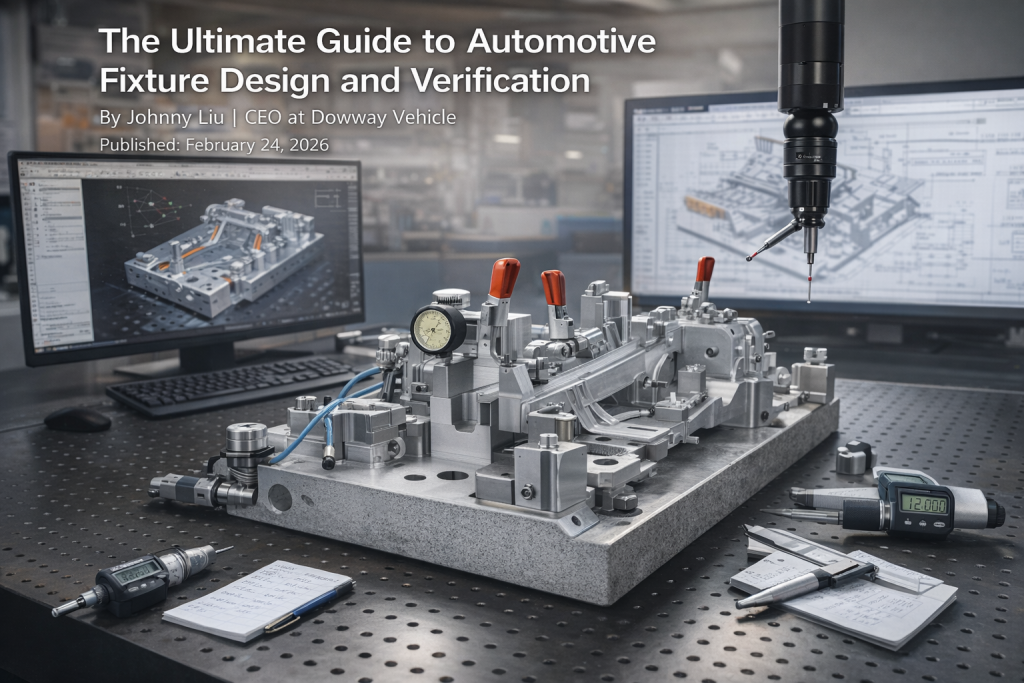
By Johnny Liu | CEO at Dowway Vehicle Published: February 24, 2026
Author’s Note: At Dowway Vehicle, I have watched tooling systems make or break production lines. Margins are tight right now, and precision is unforgiving. You need strict, objective engineering standards to survive. This guide breaks down the actual principles, workflows, and exact verification metrics we use to build reliable automotive fixtures from the ground up.
- 1. Introduction: The Role of Fixtures in Automotive Manufacturing
- 2. Foundations and Core Principles of Automotive Fixture Design
- 3. The 5-Step Core Workflow for Automotive Fixture Design
- 4. Key Technologies in Automotive Fixture Design
- 5. Detailed Fixture Verification Methods
- 6. Frequently Asked Questions (FAQ)
- 7. Final Thoughts on Fixture Engineering
1. Introduction: The Role of Fixtures in Automotive Manufacturing
Automotive fixtures hold everything together. We use these tools during machining (turning, milling, drilling), welding, assembly, and inspection. If the design works and the verification is solid, you get accurate dimensions, consistent assembly, and efficient production. Bad fixtures ruin parts.
As the industry shifts toward lighter materials, smart manufacturing, and rapid EV iterations, parts are getting harder to make. Tolerances are tighter. This puts massive pressure on automotive fixture engineering.
Good design locks parts in place and cuts machining errors. A tough verification process catches design flaws and assembly clashes early, saving money and preventing recalls down the line. Today, we mix CAD/CAM/CAE tools with modular parts to make verification faster and highly standardized.
2. Foundations and Core Principles of Automotive Fixture Design
2.1 Design Foundations
You have to build automotive fixtures based on blueprints, machining steps, assembly rules, and production volume. These facts tell you what the fixture must do, how accurate it must be, and how long it needs to last.
- Material & Process Analysis: Look closely at the metal. Aluminum alloys behave differently than high-strength steel. You must know your geometric tolerances inside and out.
- Mechanical Stability: The fixture has to be strong and rigid. It cannot bend, wear out quickly, or loosen up over time. Take aluminum alloy wheels, for instance. If you apply too much clamping force, the wheel warps. If you apply too little, the cutting tool pushes the part out of alignment.
2.2 The 5 Core Design Principles
- Precise Positioning (The Six-Point Location Principle): Set up pins and blocks to limit movement along the X, Y, and Z axes (both translation and rotation). Align your fixture datums with the part’s design datums. For high-precision engine blocks, keep that positioning accuracy between ±0.01mm and ±0.05mm so the cylinders and crankshaft holes line up perfectly.
- Reliable Clamping: You need enough force to hold the part steady against cutting tools and inertia, but not so much that you crush it. Thin or soft materials need flexible clamps like polyurethane blocks. Always build in a 1.5x to 2.5x safety factor for dynamic loads.
- Process Adaptability: The fixture must stay out of the way. It cannot block cutting tools, robotic arms, or human operators. Welding fixtures must clear the weld seams to dodge spatter. Machining fixtures must fit within the CNC machine’s stroke limits.
- Economy & Practicality: Match the tool to the job size. High-volume runs need standardized, modular fixtures to cut long-term costs. Short prototype runs can use simpler setups. Use tough materials like 40Cr steel for parts that see heavy wear.
- Compatibility & Scalability: Car models change constantly. Build scalable fixtures. By swapping out specific locating pins or clamps, you can adapt one base fixture for multiple parts in the same family.
3. The 5-Step Core Workflow for Automotive Fixture Design
Automotive fixture design follows a strict five-step closed-loop workflow.
- Requirement Analysis: Gather the blueprints, GD&T specs, and production numbers. Figure out your budget and exact precision needs. Spot the hard problems early, like how to clamp fragile components without breaking them.
- Concept Design: Pick a basic structure (dedicated, universal, or modular). Map out the datums and clamping points. Sketch it in 3D. Compare a few different approaches based on cost, precision, and ergonomics, then pick the winner.
- Detailed Design: Open CAD (CATIA, UG, AutoCAD) and model every piece. Check the rigid strength. Pick the right materials. For example, use cemented carbide or ceramics for locating pins, holding tolerances strictly to IT6-IT8 grades.
- Simulation & Optimization: Run CAE software (ANSYS, ABAQUS) to check stress, rigidity, and how the clamping force spreads out. Fix weak spots. Run a 3D CAM simulation of the tool path to make sure the spindle won’t crash into your clamps.
- Blueprint & Documentation Output: Generate the final 3D files, 2D drawings, and assembly instructions. Document the exact material specs, machining tolerances, and maintenance steps so the shop can build it correctly.
4. Key Technologies in Automotive Fixture Design
4.1 Positioning Techniques
Positioning dictates accuracy. You choose the method based on the part geometry:
- Planar Positioning: Flat datums like chassis floors need basic locating blocks and support pins.
- Hole Positioning: For precise holes like steering gear housings, use the standard “one round, one diamond” pin setup. Keep the pin diameter 0.1mm to 0.2mm smaller than the part hole. This stops rotation without jamming.
- Surface & Combined Positioning: Complex curves like body panels need custom profiling blocks. Engine heads often require a mix, like the “three-surface” or “one-surface, two-hole” method.
4.2 Clamping Mechanisms
Clamping focuses on reliable holding and direct force control:
- Pneumatic: Fast and automated. Double-acting cylinders are cheap and dominate high-volume body welding lines.
- Hydraulic: Massive, steady force. Great for heavy machining on engine blocks, though they cost more and need frequent maintenance.
- Mechanical: Simple and tough. Levers and screws mixed with Belleville springs absorb vibration and stop loosening during heavy prototype cuts.
- Electric: Extreme precision with direct force feedback loops. You need these for sensitive jobs like EV battery pack assembly.
4.3 Modular and Standardized Design
Stick to DIN or GB standards to cut lead times. Break fixtures down into separate modules for locating and clamping. If you use modular inspection fixtures paired with 3D scanning algorithms, you can match the accuracy of rigid dedicated fixtures by >90%, saving a lot of overhead.
4.4 CAD/CAM/CAE Integration & 3D Scanning
The modern workflow relies heavily on digital tools:
- CAD handles virtual assembly and clash detection.
- CAE runs Finite Element Analysis (FEA) to minimize physical prototyping.
- CAM automates the CNC programming to cut the fixture parts.
- 3D Scanning: High-resolution scanners (e.g., Einscan Rigil) pull true part geometry with 0.04+0.06mm/m volumetric accuracy and 0.05mm resolution. You need this data to machine perfect profiling blocks.
5. Detailed Fixture Verification Methods
Verification guarantees the fixture will survive mass production. We divide this into Virtual and Physical stages.
5.1 Virtual Verification (Pre-Manufacturing)
Do this digitally to catch flaws before cutting metal.
- Assembly Interference: Simulate the setup in CAD. Keep a mandatory clearance of ≥50mm for moving parts at their limits to prevent crashes.
- Structural Performance: Run stress tests in CAE. For parts that cycle constantly, simulate fatigue life. Run a modal analysis to prove the fixture system’s first-order natural frequency is strictly >1.5x the machine’s excitation frequency. This stops chatter.
- Positioning Accuracy: Build error propagation models to track manufacturing tolerances. The total positioning error must stay ≤0.01mm/m.
5.2 Physical Verification (Post-Manufacturing & Trial)
Once built, put the hardware through physical testing using metrology equipment.
5.2.1 Fixture Accuracy Verification
- Component Accuracy: Measure pins and blocks with a Laser Tracker (0.001mm resolution) or CMM.
- Clamping Reliability: If the air or power drops, clamping force decay must stay <5%.
- Overall Rigidity: Apply a static load of 1.5x the working limit for 30 minutes. Critical deformation must stay ≤0.1mm. After 100 manual cycles, datum wear must remain <0.01mm.
5.2.2 Process Adaptability Verification
- Trial Machining: Put the fixture on the actual CNC. For wheel hubs, dynamic balance and width errors must measure <0.049.
- Trial Assembly: Verify the Poka-yoke designs. Make sure operators cannot physically load the part backward or trigger clamps unsafely.
5.2.3 Stability & Lifespan Verification
- Pilot Runs: Run a batch of 1,000 to 5,000 pieces.
- Repeatability: Use SPC to prove repeatability meets the ISO9283 Class 1 standard (≤0.02mm).
- Lifespan: Mass production fixtures must survive a minimum of 100,000 cycles before major repairs.
5.2.4 Safety Performance Verification
Safety rules are strict.
- Fail-Safes: Clamps must self-lock if power dies.
- Electrical Safety: Electric fixtures need insulation resistance tested at ≥100MΩ@500VDC, and grounding continuity must measure ≤0.1Ω, complying directly with IEC60204-1.
- Ergonomics: An operator should never need more than 20N of grip force to run the tooling. Anything higher causes long-term muscle strain.
6. Frequently Asked Questions (FAQ)
1. What is automotive fixture design and why is it critical to manufacturing? Answer: Automotive fixture design refers to the engineering of tools (fixtures/jigs/checking fixtures) that secure, locate, and orient parts during machining, assembly, or inspection in automotive production. Fixtures improve repeatability, precision, and quality, ensuring parts meet design tolerances and are positioned accurately for each process step. Poor fixture design leads to misalignment, increased rework, and production delays.
2. What are the key principles of fixture design in automotive production? Answer: Effective automotive fixture design follows these foundational principles: secure and repeatable positioning of the workpiece for every cycle; stable clamping mechanisms that resist vibration or movement; compatibility with CAD/CAM workflows for accurate digital design and verification; and material and durability choices appropriate for production volumes and part geometry. Well-designed fixtures minimize cycle time and improve quality control.
3. How do engineers verify that a fixture design meets requirements before production use? Answer: Verification typically includes: CAD simulation and fit tests to validate part tolerance and contact points before fabrication; prototype trials and metrology checks using CMMs, probes, or digital scanners to confirm dimensional accuracy; run tests under actual conditions to ensure repeatability and robustness; and documentation and control plans as part of PPAP in automotive QA. Verification ensures the fixture will produce reliable and consistent results in production.
4. What are common types of verification fixtures used in automotive inspection? Answer: The key categories include: Attribute (Go/No-Go) fixtures which provide quick pass/fail verification; Variable fixtures which deliver measurable dimensional data for SPC; and Functional fixtures which simulate assembly or real-world performance conditions. Each type supports different inspection goals, from rapid line checks to detailed dimensional analysis.
5. How does fixture design relate to automotive quality standards and safety requirements? Answer: Automotive fixtures and their verification are integrated into quality systems like APQP/PPAP to ensure that processes can consistently produce parts that meet engineering drawings and customer specifications. PPAP documentation includes evidence that fixture design and verification support consistent production quality. In electronics and safety-critical modules (e.g., ADAS/EV PCBs), fixture design must also reflect functional safety and reliability standards like ISO 26262 and component-level qualifications.
Automotive Fixture Design Summary
| Question | Core Insight |
| What is automotive fixture design? | Engineering tools that secure parts for manufacturing accuracy. |
| Key design principles? | Repeatability, stability, CAD integration, durability. |
| How to verify fixtures? | CAD simulation, prototype metrology, production trial, PPAP. |
| Types of inspection fixtures? | Attribute, variable, functional fixtures. |
| Relation to automotive standards? | Fixtures must support APQP/PPAP and safety/QA compliance. |
7. Final Thoughts on Fixture Engineering
You cannot guess your way through automotive fixture design and verification. Sticking to the core design rules, running a strict CAD/CAM/CAE workflow, and testing the hardware against hard metrics—like ISO standards and micro-millimeter tolerances—is the only way to lock down production efficiency.
For more technical data on modern tooling, read our reports on [Advanced CAE Virtual Verification for Tooling] and [Optimizing Hydraulic vs. Pneumatic Clamping Systems in EV Manufacturing].

·