


< Back to Vehicle Design & Engineering Hub
By Johnny Liu, CEO at Dowway Vehicle
Published: February 21, 2026 | Last Updated: February 21, 2026
Author’s Note: At Dowway Vehicle, we base our engineering on hard data and physics. Vehicle body structure design goes beyond a nice-looking shell; it dictates a car’s safety, weight, and handling. This guide breaks down how modern automotive bodies are built, using plain engineering facts.
- Key Takeaways
- What is Vehicle Body Structure Design?
- Primary Types of Vehicle Body Architectures
- Anatomy of the Vehicle Body
- Materials and Weight Reduction
- Crashworthiness and Structural Safety
- Aerodynamics and Body Styling
- The Body Engineering Process (CAD & CAE)
- How EVs Change Body Structure
- Future Trends in Vehicle Body Design
- Frequently Asked Questions (FAQ)
Key Takeaways
- Material Shifts: Body structure design is moving from purely stamped steel assemblies to mixed structures using aluminum, high-strength steels, and large castings.
- Safety vs. Mass: Engineers must build rigid safety cells and controlled crumple zones while offsetting the heavy weight of EV battery packs.
- Virtual Testing: Computer simulations have largely replaced early physical prototyping, shortening the design timeline.
What is Vehicle Body Structure Design?
The design process starts after exterior styling (Class-A surfacing) is frozen. Body structure engineers turn aesthetic shapes into a functional, buildable Body-in-White (BIW) — the bare welded shell before paint or components are added.
Primary Mechanical Goals
- Torsional and Bending Stiffness: High rigidity keeps suspension geometry stable and improves predictable handling.
- NVH Mitigation: A stiff frame reduces resonance and isolates cabin noise.
- Durability: The structure must withstand long-term cyclic loads without weld or fatigue failures.
Primary Types of Vehicle Body Architectures
Body-on-Frame (Ladder Frame)
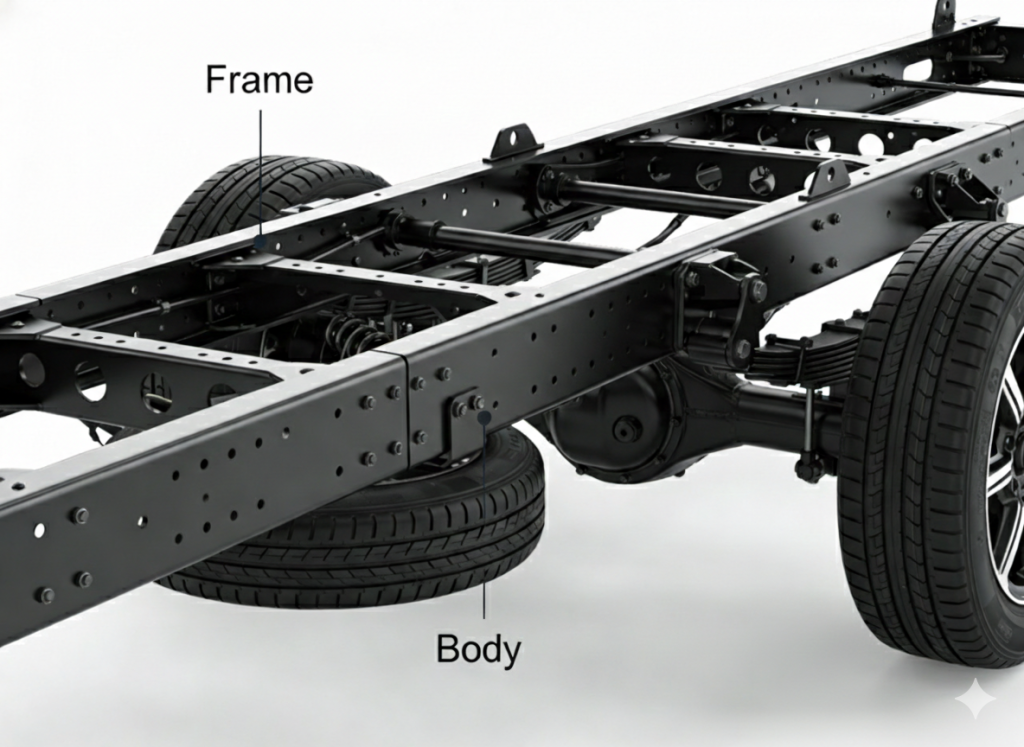
The body bolts onto a separate heavy steel frame.
Applications: Heavy-duty trucks, off-road SUVs
Pros: High durability and towing capacity
Cons: Heavy mass, inefficient space usage, high center of gravity
Unibody (Monocoque) Construction
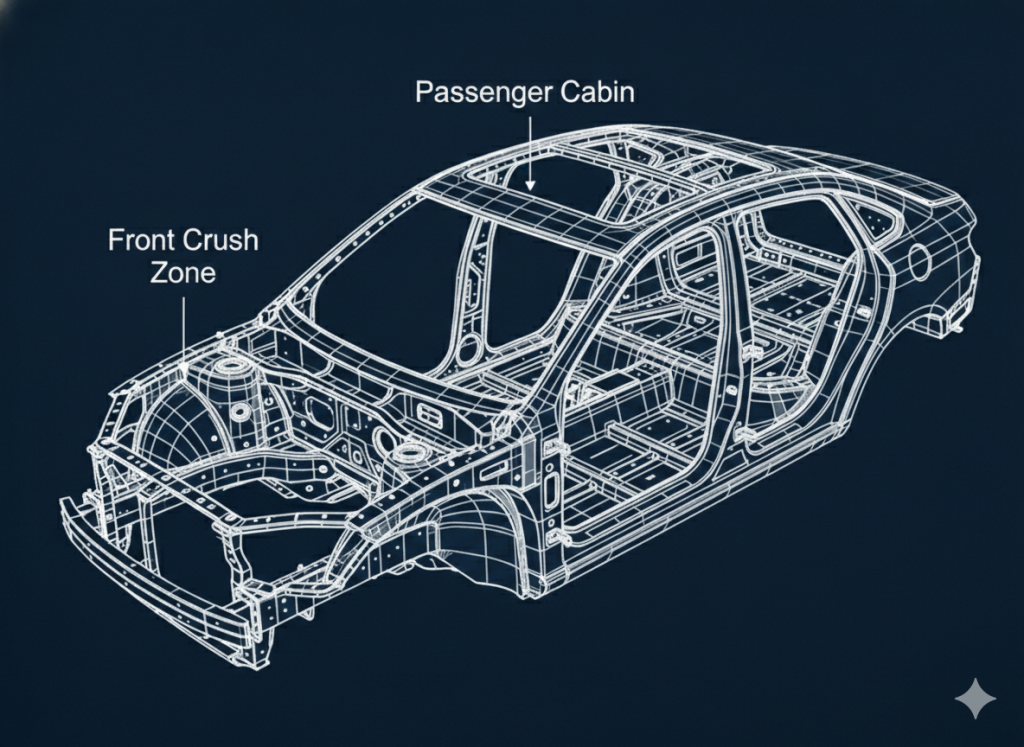
The body and chassis form a single load-bearing unit.
Applications: Passenger cars, crossovers, light SUVs
Pros: High strength-to-weight ratio, strong crash performance, lower center of gravity
Cons: Complex manufacturing, expensive crash repairs
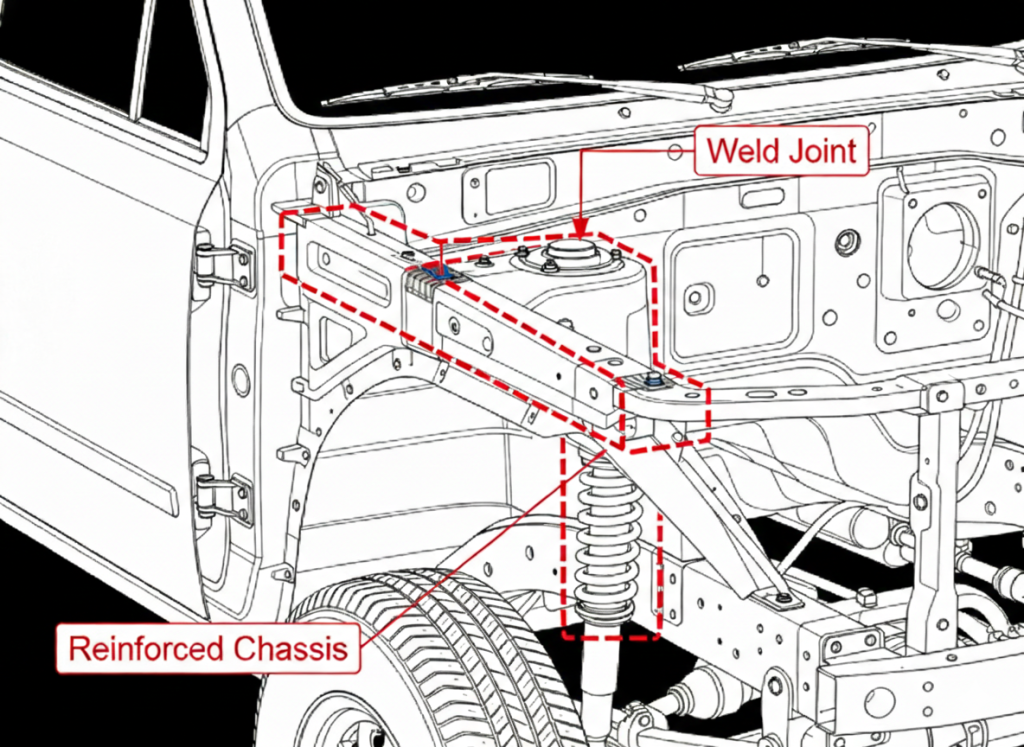
Anatomy of the Vehicle Body
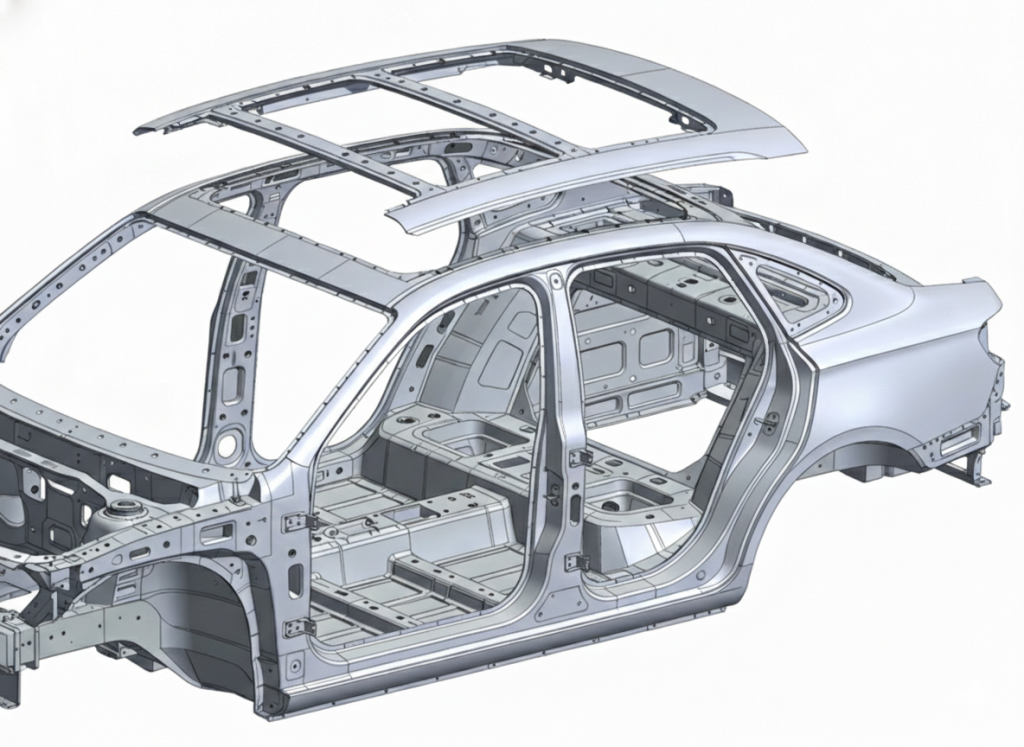
A modern unibody consists of several structural systems:
The Greenhouse
A/B/C/D-pillars and roof rails
Supports the roof and prevents collapse in rollover events
The Underbody
Floor pans, side sills (rockers), cross-members
Resists suspension forces and supports seating loads
Engine and Cargo Structures
Front and rear longitudinal rails
Manage frontal and rear crash energy
Materials and Weight Reduction
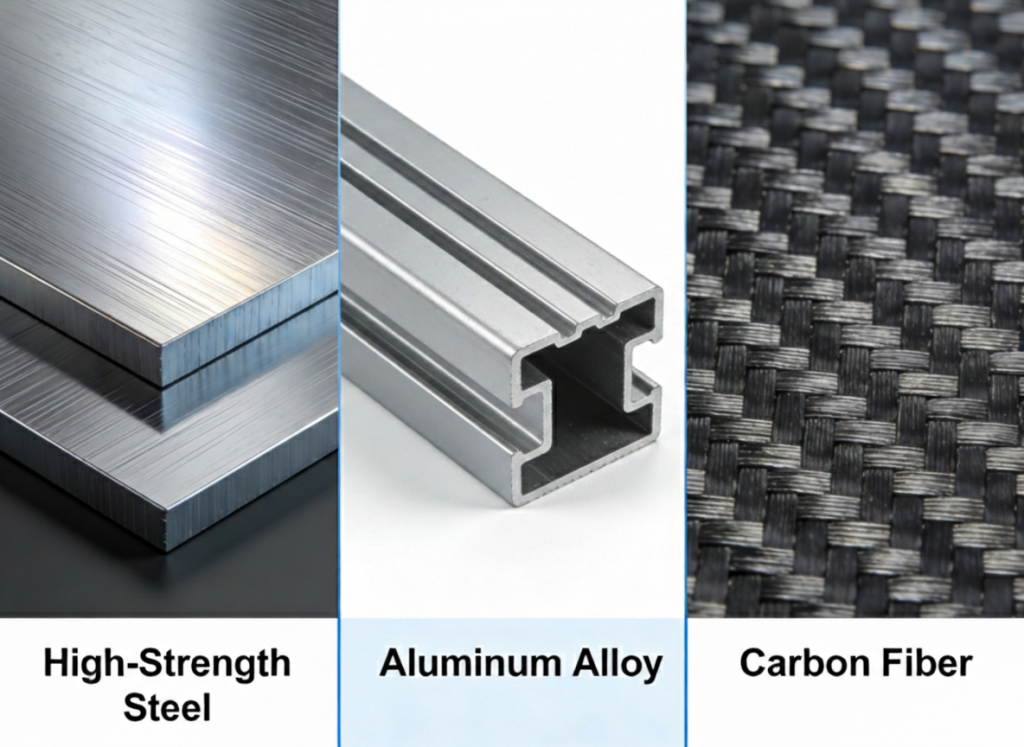
Reducing weight improves fuel economy and extends EV range.
High-Strength Steels (AHSS & UHSS)
Steel remains dominant. Ultra-High-Strength Steel (e.g., Boron steel) protects critical zones like B-pillars in side impacts.
Aluminum Alloys
Up to 40% lighter than steel. Used in doors, hoods, and structural extrusions.
Challenges: Higher cost and complex joining processes.
Carbon Fiber Reinforced Polymers (CFRP)
Best strength-to-weight ratio.
Limitations: Expensive, slow production cycles, recycling challenges.
Mixed-Material Structures
Modern vehicles combine steel and aluminum using:
- Structural adhesives
- Self-piercing rivets
- Flow-drill screws
Crashworthiness and Structural Safety
Safety agencies such as NCAP and IIHS evaluate crash energy management.
Crumple Zones
Front and rear rails deform in a controlled manner to absorb energy.
Safety Cell
Ultra-rigid cabin structure made with UHSS to protect occupants.
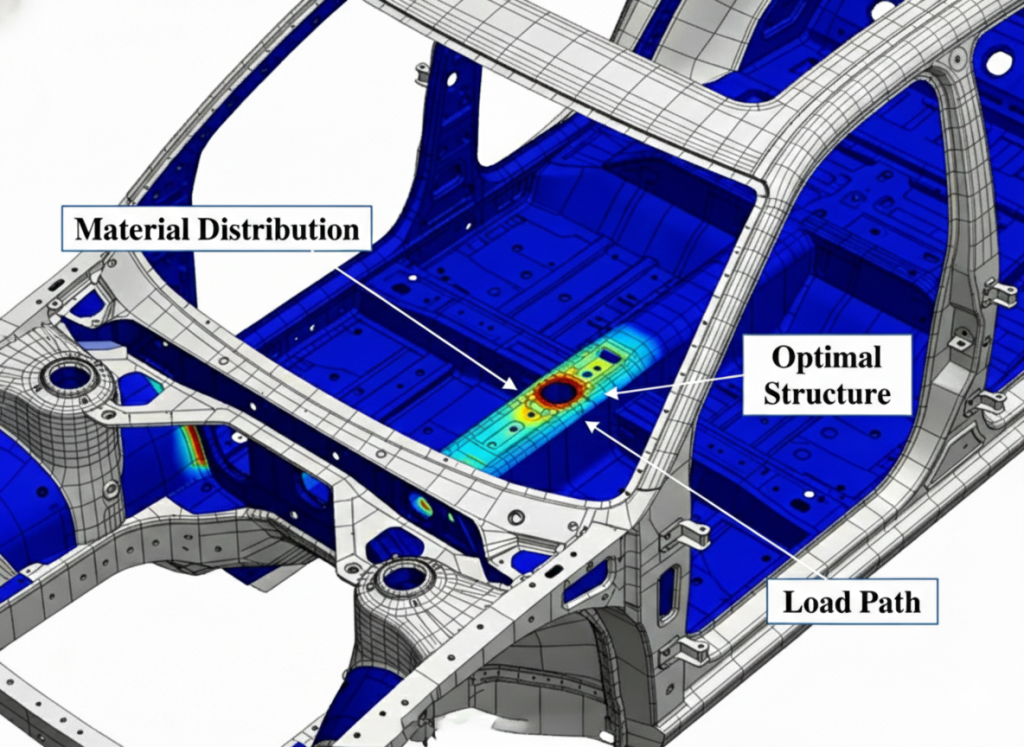
Structural Load Paths
Engineered routes that direct crash forces away from passengers.
Aerodynamics and Body Styling
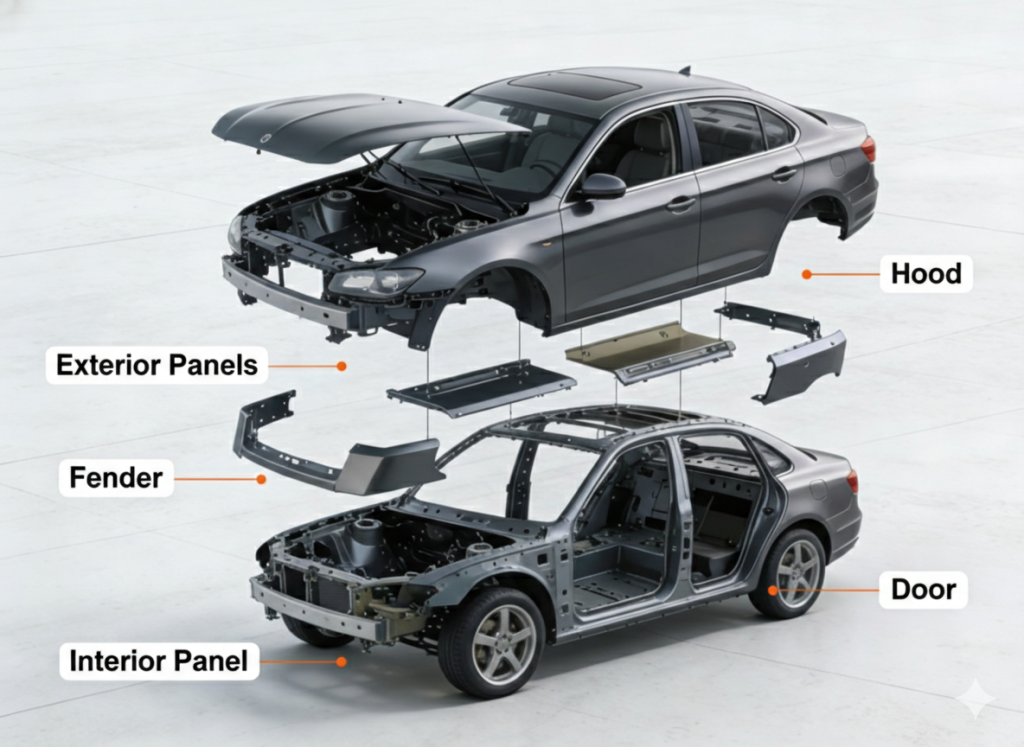
The exterior determines drag coefficient (C_d).
A flat structural underbody and integrated aero shields reduce turbulence and improve highway stability.
The Body Engineering Process (CAD & CAE)
Modern body design relies heavily on simulation.
Computer-Aided Design (CAD)
3D modeling of panels, weld spots, joint angles, and reinforcements.
Computer-Aided Engineering (CAE) & FEA
Finite Element Analysis simulates crash events, stiffness behavior, and vibration before physical builds.
How EVs Change Body Structure
Battery Electric Vehicles require different structural logic.
Skateboard Platform
Battery pack mounted between axles, lowering center of gravity.
Battery Protection
Reinforced side sills prevent intrusion during side impacts.
Mass Compensation
EV structures must handle hundreds of kilograms of extra battery weight.
Future Trends in Vehicle Body Design
Gigacasting
Large aluminum castings replace multiple welded components.
Reduces manufacturing complexity but complicates repairability.
Green Steel
Hydrogen-based steel production reduces carbon emissions.
Autonomous Layouts
Future seating configurations will require redesigned crash load paths.
Frequently Asked Questions (FAQ)
What is the difference between torsional and bending stiffness?
Torsional stiffness resists twisting.
Bending stiffness resists vertical sagging.
Torsional stiffness is more critical for handling performance.
Why are cars getting heavier despite lightweight materials?
Weight savings are offset by EV batteries, reinforced safety structures, and advanced electronics.
Can unibody vehicles tow like body-on-frame trucks?
No. Body-on-frame trucks manage towing loads more effectively through dedicated steel rails.
What is a load path?
A reinforced structural route directing crash energy away from occupants.
How does a battery affect EV body structure?
Battery cases often act as structural members.
EVs require flat floorpans and heavily reinforced side beams.

·