

< Back to Data Management System
Author: Johnny Liu, CEO at Dowway Vehicle
Published: March 10, 2026
Last Updated: March 10, 2026
Content Type: Cluster Page
Author Note
Johnny Liu is CEO at Dowway Vehicle. His work covers automotive engineering, connected vehicle systems, digital operations, and vehicle data workflows across product development, manufacturing, and service. This article is written from an industry practice view and is based on a full report about automotive data management across R&D, production, supply chain work, connected vehicle operations, and after-sales service.
- Author Note
- What Is a Vehicle Data Management System?
- Why the Automotive Industry Needs a Vehicle Data Management System
- What a Vehicle Data Management System Means in Automotive Engineering
- Engineering Value Across the Automotive Lifecycle
- Five-Layer Architecture of a Vehicle Data Management System
- Data Collection Layer: The Starting Point of Engineering Data
- Data Transmission Layer: The High-Speed Data Path
- Data Storage Layer: The Secure Warehouse for Automotive Data
- Data Governance Layer: Standardizing and Cleaning the Data
- Data Application Layer: Turning Data into Engineering Value
- Core Technologies Behind a Vehicle Data Management System
- Engineering Practice Challenges and Solutions
- Typical Automotive Scenarios Supported by a Vehicle Data Management System
- Future Trends
- Professional Forum FAQs About the Vehicle Data Management System
- How do you collect and integrate vehicle data from different sources?
- How can we handle the huge volume of real-time vehicle data?
- How do we ensure data reliability and connectivity when vehicles are offline?
- How do we standardize data across different vehicle models and OEM systems?
- How do we secure vehicle data and protect user privacy?
- Conclusion
What Is a Vehicle Data Management System?
A vehicle data management system is a full-lifecycle framework that manages how automotive data is collected, transmitted, stored, cleaned, governed, secured, analyzed, and used. In the automotive industry, it supports engineering and business work across R&D, manufacturing, connected vehicle operations, and after-sales service.
Its main goal is simple: make data standardized, shareable, traceable, and usable. When that happens, data stops sitting in isolated systems and starts helping teams improve quality, speed, safety, and cost control.
Why the Automotive Industry Needs a Vehicle Data Management System
The automotive industry is changing fast. Electrification is increasing data from batteries, motors, and electronic control systems. Intelligent vehicle development is creating large volumes of perception, decision, and control data. Connectivity is linking vehicles, roads, people, and cloud platforms through V2V, V2I, V2P, and V2C.
That shift is pushing vehicle data volume to a new scale. According to the source report, one intelligent connected vehicle can produce more than 100 TB of operating data per day, and one vehicle program can create PB-level data across its lifecycle.
This data comes from many business and engineering areas:
- R&D and design
- simulation and testing
- manufacturing
- supply chain collaboration
- marketing and customer service
- connected vehicle operation
- after-sales maintenance and repair
The problem is that automotive data is usually:
- multi-source and heterogeneous
- strongly real-time
- low in value density
- highly sensitive from a security view
Traditional siloed systems scatter data across departments and tools. Standards differ. Sharing is weak. Traceability is broken. That creates the classic problem of data silos.
A solid vehicle data management system helps solve that problem and gives automotive companies a practical way to support digital transformation, engineering coordination, quality improvement, and safer operations.
What a Vehicle Data Management System Means in Automotive Engineering
In automotive engineering, a vehicle data management system is not only a storage platform. It covers the full process of:
- data collection
- data transmission
- data storage
- data cleaning
- data governance
- data analysis
- data application
- data security control
The goal is to turn data into a usable engineering asset.
Compared with general enterprise data management, automotive data management has clear engineering traits.
Strong connection to engineering work
Automotive data must match real engineering tasks such as:
- R&D simulation
- product design
- process planning
- whole-vehicle testing
- production control
- remote diagnostics
Very high security requirements
Automotive data often includes:
- vehicle safety data
- user privacy data
- engineering secrets
- industrial confidential data
This means the system must meet rules such as the Automotive Data Security Management Provisions and the Automotive Data Export Security Guidelines (2026 Edition) mentioned in the source report.
Support for both real-time and batch workloads
Automotive teams need both kinds of processing:
- real-time, such as connected vehicle monitoring, production scheduling, and remote diagnosis
- batch, such as simulation analysis, historical quality studies, and after-sales trend analysis
That makes the system architecture more demanding than ordinary office IT systems.
Engineering Value Across the Automotive Lifecycle
A vehicle data management system creates value across four core areas in the report: R&D, manufacturing, connected vehicles, and after-sales service.
R&D value
When simulation data, test data, and design data are managed together, engineering teams can work across departments more smoothly, shorten development cycles, and cut prototype cost.
The report includes these examples:
- one commercial vehicle group improved cross-department collaboration efficiency by 40%
- one OEM used connected vehicle data for real-time quality checks to improve the accuracy and timeliness of R&D data
- one PDM system built a centralized electronic repository for 3D models, 2D drawings, and related engineering data, creating a single data source
Manufacturing value
When equipment data, process data, and parts quality data are connected, factories can monitor production in real time, trace quality issues, and improve process settings.
The report gives a clear example from JAC Motors:
- unified supplier master data increased procurement order processing efficiency by 40%
- stagnant inventory rate dropped by 28%
Connected vehicle value
When vehicle operating data, environmental perception data, and user behavior data are managed well, companies can support:
- autonomous driving algorithm training and iteration
- smart cockpit improvement
- remote diagnosis
- vehicle health management
The report cites the Anhui New Energy Vehicle Data Zone, which connected more than 380,000 new energy vehicles and integrated 60 billion data records to support intelligent driving and charging scheduling.
After-sales value
When fault data, repair records, parts wear data, and user feedback are connected, companies can support fault prediction, PHM, service process improvement, and lower after-sales cost.
The report also states that one new energy vehicle company improved marketing lead conversion by 22% after integrating user data.
Five-Layer Architecture of a Vehicle Data Management System
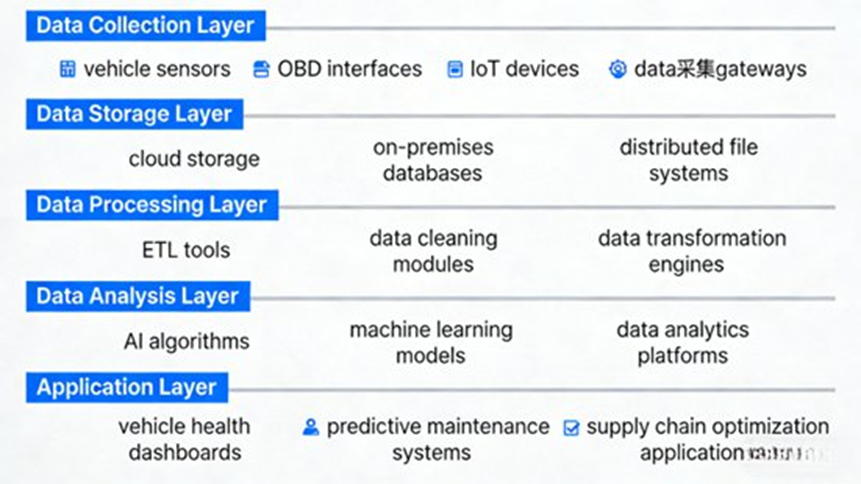
The source report uses a five-layer architecture. From bottom to top, the layers are:
- Data Collection Layer
- Data Transmission Layer
- Data Storage Layer
- Data Governance Layer
- Data Application Layer
These five layers work together to support full-lifecycle automotive data management.
Data Collection Layer: The Starting Point of Engineering Data
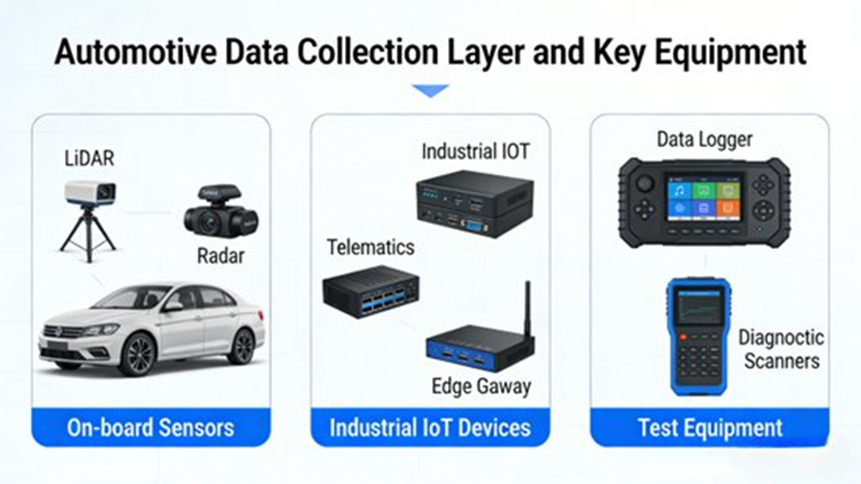
The collection layer is the base of the system. Its job is to collect multi-source and heterogeneous data from the full automotive lifecycle while keeping completeness, accuracy, and timeliness.
The report divides collected data into four main groups.
1. R&D and design data
This includes:
- CAD and CAE model data
- simulation parameter data
- prototype test data
- component design data
These data are collected through:
- PLM systems
- simulation tools such as ANSYS and MATLAB
- testing devices such as sensors and data acquisition tools
The report notes that a PDM system can build a centralized electronic repository to store 3D models and 2D drawings in one place and support single-source management.
2. Manufacturing data
This includes:
- equipment operating data such as spindle speed and welding parameters
- quality data such as dimensional deviation and defect inspection results
- production progress data
These are collected through:
- industrial IoT sensors
- MES
- SCADA systems
The sampling frequency can reach the millisecond level, which supports real-time shop-floor control.
3. Connected vehicle operating data
This includes:
- vehicle status data such as battery SOC, motor speed, and braking count
- environmental perception data such as camera images, radar distance, and GPS location
- driver behavior data such as acceleration, braking, and steering habits
These are collected through:
- T-Box
- OBD interfaces
- onboard sensors
The report states that daily data volume can reach 100 TB per vehicle in intelligent connected scenarios. It also refers to an autonomous driving simulation data service platform that uses synthetic methods to provide high-quality training datasets for algorithm iteration.
4. After-sales and maintenance data
This includes:
- fault codes
- repair records
- replacement parts data
- user feedback data
These are collected through:
- dealer management systems
- after-sales apps
- remote diagnostic systems
This supports full-process tracking in service work.
Key technical points in the collection layer
The report highlights two key points:
- edge computing, used on vehicle terminals and factory equipment for filtering and format conversion before transmission
- multi-protocol compatibility, including MQTT, HTTP, and TCP/IP, so different devices and systems can connect to the same platform
Data Transmission Layer: The High-Speed Data Path
The transmission layer moves collected data to storage and application systems. In automotive work, it must support:
- real-time performance
- reliability
- security
Connected vehicle data transmission
The report points to 5G + V2X as the main technical route. This supports high-speed data exchange between:
- vehicle and cloud
- vehicle and vehicle
- vehicle and roadside systems
Transmission latency can be lower than 10 ms, which is needed for autonomous driving decisions and remote control.
The report also mentions edge gateways for:
- local caching
- breakpoint resume
- protection against data loss during network interruption
Industrial data transmission
In factory settings, the report includes:
- industrial Ethernet such as Profinet and EtherCAT
- wireless communication such as LoRaWAN
These support stable data exchange between machines, systems, and cloud platforms.
For sensitive R&D data, the report states that secure transmission protocols such as SSL/TLS should be used.
Transmission optimization
The report also includes:
- data compression using LZ4 and ZSTD
- traffic scheduling algorithms
- priority transmission for highly time-sensitive data such as autonomous driving perception data and production process data
Data Storage Layer: The Secure Warehouse for Automotive Data
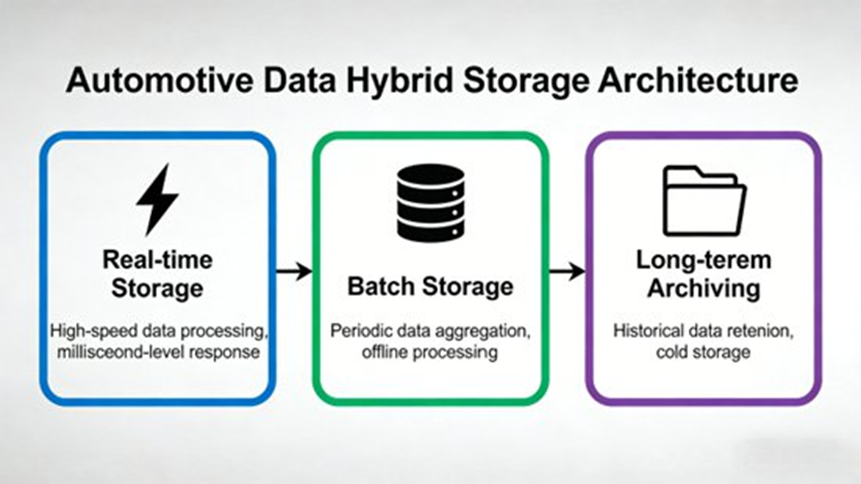
Automotive data storage has three major traits:
- huge data volume
- many different data types
- hot and cold data separation
To handle this, the report proposes a hybrid storage architecture with real-time storage, batch storage, and long-term archiving.
1. Real-time storage
This is used for:
- connected vehicle operating data
- production equipment signals
- real-time process data
The report recommends time-series databases such as:
- InfluxDB
- Prometheus
These support millisecond-level write and query. One OEM in the report used a time-series database to support real-time storage and quality checks for billions of connected vehicle records per day.
2. Batch storage
This is used for:
- R&D design data
- production ledger data
- after-sales records
The report includes:
- distributed file systems such as HDFS
- relational databases such as MySQL and Oracle
It also states that PDM systems can use distributed storage for BOM data and engineering drawings, with efficient storage and synchronized updates.
3. Long-term archiving
This is used for:
- historical data
- archived engineering data
- older vehicle program data
- historical production records
The report includes:
- tape libraries
- object storage such as S3
These are suitable for long-term tracing and compliance retention at lower cost.
4. Storage optimization
The report includes these optimization methods:
- hot and cold data tiering
- storing hot data on high-speed media such as SSD
- moving cold data to lower-cost storage
- data deduplication
- data compression
It also mentions that vehicle recognition datasets can be preprocessed with normalization and data augmentation to improve storage efficiency and data usability.
Data Governance Layer: Standardizing and Cleaning the Data
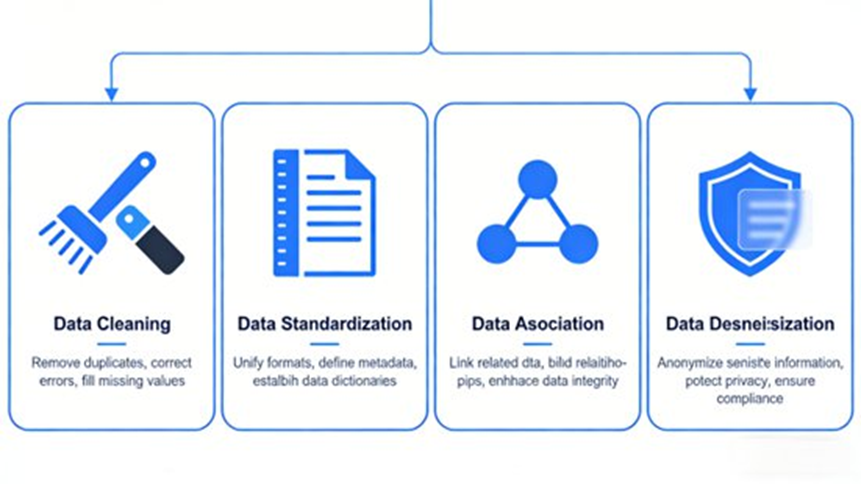
The governance layer is the key part for solving data silos. It cleans, standardizes, associates, and desensitizes data so companies can build reliable and reusable data assets.
Data cleaning
The report lists several common data quality problems:
- abnormal values
- missing values
- duplicate values
Examples include:
- removing abnormal telematics parameters caused by sensor failure
- filling missing process parameters in production data
- deleting duplicate records
The report also notes that NLP-based fuzzy matching can normalize supplier names such as “Bosch China” with 98.5% accuracy.
Data standardization
The report stresses unified standards for the automotive industry, including:
- data coding rules
- data format rules
- data definition rules
Examples include:
- VIN rules
- parts coding rules
- unified vehicle status parameter definitions
- unified perception data formats
- common standards across R&D, manufacturing, and after-sales systems
One commercial vehicle group in the report set up 17 categories of data systems and standards, raising coverage from 32% to 95%.
Data association
The governance layer must also connect data across business areas. The report gives these examples:
- linking R&D design data with manufacturing process data
- linking connected vehicle operating data with after-sales fault data
This helps teams improve design-process coordination and locate fault causes faster.
The report also includes:
- building a data asset catalog
- organizing core data entities
- sharing data through APIs
One group reached more than 200 million API calls per month.
Data desensitization
Sensitive information must be protected. The report includes:
- encryption of ID numbers
- masking or encryption of phone numbers
- desensitization of core R&D technical data
These actions support compliance with the Automotive Data Security Management Provisions and the Automotive Data Export Security Guidelines (2026 Edition).
Data Application Layer: Turning Data into Engineering Value
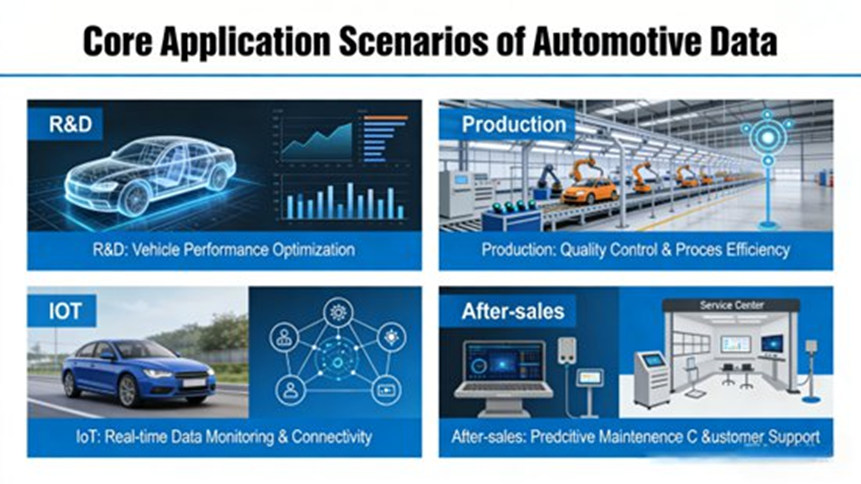
The application layer is where governed data starts helping engineering teams, production teams, connected vehicle teams, and service teams.
1. R&D engineering applications
With simulation data and test data, companies can build multi-disciplinary collaboration platforms and improve:
- body systems
- chassis systems
- battery systems
- motor systems
Historical engineering data can also support design improvement and lower development cost.
The report includes one case from an aero-engine manufacturer. After data architecture optimization:
- BOM change transmission time dropped from 72 hours to 30 minutes
- process conflict warning accuracy reached 95%
The case is outside the automotive industry, but the engineering data logic applies directly to complex automotive product development.
The report also states that PDM systems can support needs such as lightweight design through bidirectional association between BOM and 3D models.
2. Manufacturing engineering applications
Production equipment data and process data can support:
- production monitoring
- real-time process adjustment
- equipment fault prediction
- lower defect rates
- supplier quality analysis
3. Connected vehicle engineering applications
Connected vehicle and perception data can support:
- autonomous driving algorithm training
- perception and decision algorithm improvement
- vehicle health management systems
- fault prediction
- remote diagnosis
- smart cockpit interaction improvement through user behavior analysis
The report again refers to the Anhui autonomous driving simulation synthetic data service platform, which provides high-quality training datasets for intelligent driving development.
4. After-sales engineering applications
The report includes these after-sales uses:
- fault diagnosis knowledge bases
- fast fault localization
- maintenance recommendation generation
- spare parts inventory optimization based on wear analysis
- product iteration based on user feedback data
Figure 5: Core Application Scenarios of Automotive Data (R&D, Production, IoT, After-sales)
Core Technologies Behind a Vehicle Data Management System
The report identifies four major technical groups that support the whole system.
Edge computing
Edge nodes on vehicles and production equipment can handle local preprocessing, local analysis, and quick response. This reduces cloud pressure and supports real-time control and scheduling.
Big data analytics and AI
The report includes machine learning and deep learning for:
- production equipment fault prediction
- vehicle fault prediction
- simulation model improvement
- user behavior preference analysis
It also notes that vehicle recognition datasets used with CNN models such as ResNet and VGG can support vehicle classification and detection tasks.
Data security technology
The report includes:
- data encryption
- access control
- security auditing
- vulnerability protection
These controls help protect user privacy, vehicle safety data, engineering secrets, and industrial confidential data.
The report also cites a Yixin Huachen solution that supports fine-grained permissions across more than 2,000 fields and meets ISO 27001 requirements.
Data middle platform
The report describes the data middle platform as a core support layer for digital transformation. It integrates data across the value chain and supports centralized management, scheduling, and sharing. One OEM in the report integrated more than 100 data sources and supported PB-scale data processing.
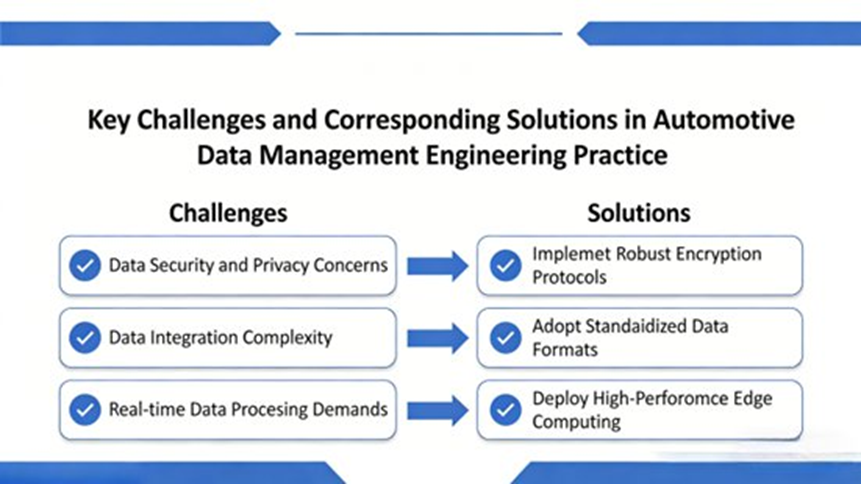
Engineering Practice Challenges and Solutions
The report identifies four major practice challenges and gives matching solutions.
Challenge 1: Multi-source and heterogeneous data is hard to integrate
R&D, manufacturing, and connected vehicle systems often use different structures, standards, and formats.
Solution:
Set up unified standards and coding rules, use ETL tools for extraction, transformation, and loading, and build a data middle platform for centralized management and sharing.
The report cites the Yixin Huachen “119” system, which includes:
- 1 governance system
- 1 intelligent platform
- 9 core modules
Challenge 2: Data quality is uneven
Engineering data may contain anomalies, missing records, and duplicates.
Solution:
Build a data quality evaluation system with indicators such as:
- accuracy
- completeness
- consistency
Use automated cleaning tools with manual review, and set up traceability and closed-loop correction for quality issues.
Challenge 3: Data security risks are strong
Connected vehicle data involves user privacy and vehicle safety. R&D data involves industrial secrets.
Solution:
Use:
- encryption
- access control
- security auditing
- routine security testing
- vulnerability repair
- clear security responsibility assignment
The report also stresses strict compliance with the Automotive Data Export Security Guidelines (2026 Edition) for cross-border data work.
Challenge 4: Data value mining is still not enough
A lot of engineering data is stored but not fully used.
Solution:
Build use cases around real engineering needs, use big data and AI to find patterns and business value, and track the results of data applications over time.
The report cites Anhui’s “six-in-one” paradigm, where scenario-led demand drives multi-dimensional data value mining.
Typical Automotive Scenarios Supported by a Vehicle Data Management System
New vehicle development and cross-department collaboration
PLM, PDM, simulation tools, testing systems, and engineering repositories are connected. Design data, simulation parameters, and test records are governed under shared standards. BOM and 3D models are linked in both directions. Engineering changes move faster. Coordination improves.
This fits the commercial vehicle group example, where collaboration efficiency improved by 40%.
Smart factory production monitoring and quality traceability
IIoT devices, MES, and SCADA gather real-time signals from the shop floor. Time-series databases store these signals. Governance links process data, quality results, and supplier data. This supports traceable production, process tuning, and predictive maintenance.
This matches the JAC Motors case in the report.
Connected vehicle operations and intelligent driving data services
A connected fleet keeps generating telemetry, GPS, perception data, and driver behavior data. 5G + V2X carries the data. Edge nodes preprocess it. Real-time and distributed storage support scale. Governance standardizes signals and protects sensitive fields. Application services then use the data for autonomous driving training, charging scheduling, remote diagnosis, and health management.
This reflects both the Anhui New Energy Vehicle Data Zone and the synthetic data platform in the report.
Predictive maintenance and service network optimization
Dealer systems, repair records, remote diagnostics, fault histories, and user feedback are tied together. Fault knowledge bases help service teams locate issues faster. Wear patterns help optimize spare parts planning. Feedback from users goes back into product updates.
Future Trends
The report points to four main trends for automotive data management.
1. Smarter management
AI will be used more deeply across collection, cleaning, governance, storage optimization, and value discovery.
2. Better standardization
The industry will keep improving common standards for:
- cross-enterprise data sharing
- cross-process interconnection
- cross-domain interoperability
The report notes that the rollout of the Automotive Data Export Security Guidelines (2026 Edition) will further support standardized and regulated management.
3. Stronger security focus
As regulations keep developing, security will stay central. Companies will need stronger lifecycle protection while still allowing data to be used in practical ways.
4. End-to-end integration
Data management will connect more closely with the full automotive process, joining R&D, manufacturing, connected vehicle operations, and after-sales work into a closed loop of data, application, and optimization.
The report highlights Anhui’s “data zone + computing power zone” dual-platform model as a useful reference for this direction.
In the future, automotive data management will not be only about storage and governance. It will become a core support layer for engineering work, product quality, service improvement, and industrial growth under the idea of data-driven engineering and engineering-enabled industry.
Professional Forum FAQs About the Vehicle Data Management System
How do you collect and integrate vehicle data from different sources?
Short answer:
Use a layered setup that combines edge collection, protocol adapters, APIs, ETL pipelines, and a unified data model.
In practice, a vehicle data management system often needs to integrate data from OBD-II, CAN bus, GPS trackers, telematics control units, onboard sensors, mobile apps, and third-party platforms. Different sources use different protocols and data formats, so direct integration is rarely clean.
A practical design starts with edge devices and gateways that collect and preprocess data. Then APIs, message services, and ETL pipelines ingest the data into one platform. After that, governance rules normalize fields, units, naming, and semantics. This matches the source report’s focus on multi-source acquisition, edge preprocessing, multi-protocol compatibility, and data standardization.
Typical forum question:
“What’s the best architecture to collect CAN bus, GPS, and driver behavior data into a single vehicle data platform?”
How can we handle the huge volume of real-time vehicle data?
Short answer:
Use streaming pipelines, time-series databases, distributed storage, and edge filtering.
Connected vehicles generate continuous streams of telemetry, diagnostics, location data, behavior data, and perception data. At fleet scale, that becomes a large ingestion and processing problem.
Common technical choices include:
- streaming pipelines
- time-series databases
- distributed storage
- edge-side filtering and preprocessing
This matches the report’s architecture logic, which combines real-time collection, compression, time-series storage, and edge computing to support large-scale connected vehicle data workloads.
Typical forum question:
“How do you scale a telematics platform to ingest millions of vehicle events per day?”
How do we ensure data reliability and connectivity when vehicles are offline?
Short answer:
Use local buffering, offline caching, retry queues, and delayed synchronization.
Vehicles do not stay online all the time. They may move through tunnels, underground parking, remote roads, or areas with poor signal coverage. That can cause packet loss, delayed uploads, or incomplete data records.
A common solution is to use store-and-forward buffering in telematics devices or edge gateways. Local caching, retry queues, delayed batch synchronization, and breakpoint resume help reduce data loss and improve consistency. This is consistent with the transmission-layer design in the report.
Typical forum question:
“What is the best way to guarantee data consistency when vehicles frequently lose network connectivity?”
How do we standardize data across different vehicle models and OEM systems?
Short answer:
Create a unified data model with field mapping, coding rules, metadata management, and governance controls.
Different OEMs expose data in different schemas, naming rules, update rates, signal definitions, and proprietary formats. Even similar vehicle functions may use different units or field names.
A good answer is to build a unified model that includes:
- field mapping
- semantic normalization
- unit conversion
- coding standards
- metadata rules
- governance processes
This matches the report’s governance-layer work around VIN rules, parts coding rules, unified parameter definitions, and cross-system standards.
Typical forum question:
“How do you normalize telematics data from multiple OEM APIs into one unified data model?”
How do we secure vehicle data and protect user privacy?
Short answer:
Use encrypted transmission, field-level permissions, access control, desensitization, auditing, and compliance controls.
Vehicle data may include location, behavior, maintenance history, operational status, and user-linked information. That means security and privacy must be built into the platform from the start.
A secure vehicle data management system should include:
- encrypted transmission
- field-level permissions
- access control
- desensitization
- security auditing
- vulnerability protection
- privacy compliance governance
This matches the report’s full-lifecycle security approach and its focus on compliance with automotive data regulations.
Typical forum question:
“What security architecture should a vehicle data platform implement to protect driver and fleet data?”
Conclusion
A vehicle data management system is now a core capability for automotive digital transformation and an essential part of modern automotive engineering. It is not just a storage platform. It is a full-lifecycle system that supports data collection, transmission, storage, governance, security, and engineering application across R&D, manufacturing, connected vehicle operations, and after-sales service.
This article keeps the full technical logic of the source report and covers:
- the industry background of electrification, intelligence, and connectivity
- the core meaning and engineering traits of automotive data management
- the four main areas of engineering value
- the complete five-layer architecture
- the full details of collection, transmission, storage, governance, and application
- the four key technology groups
- the four major practice challenges and their solutions
- the future direction of the field
- the added professional-forum FAQs on integration, scale, reliability, standardization, and security
The core point stays the same: automotive data management must be built on clear standards, strong governance, secure controls, and real engineering use cases. When done well, it turns large volumes of automotive data into practical value for engineering, manufacturing, service, and long-term business performance.
