

< Back to Vehicle Design & Engineering Hub
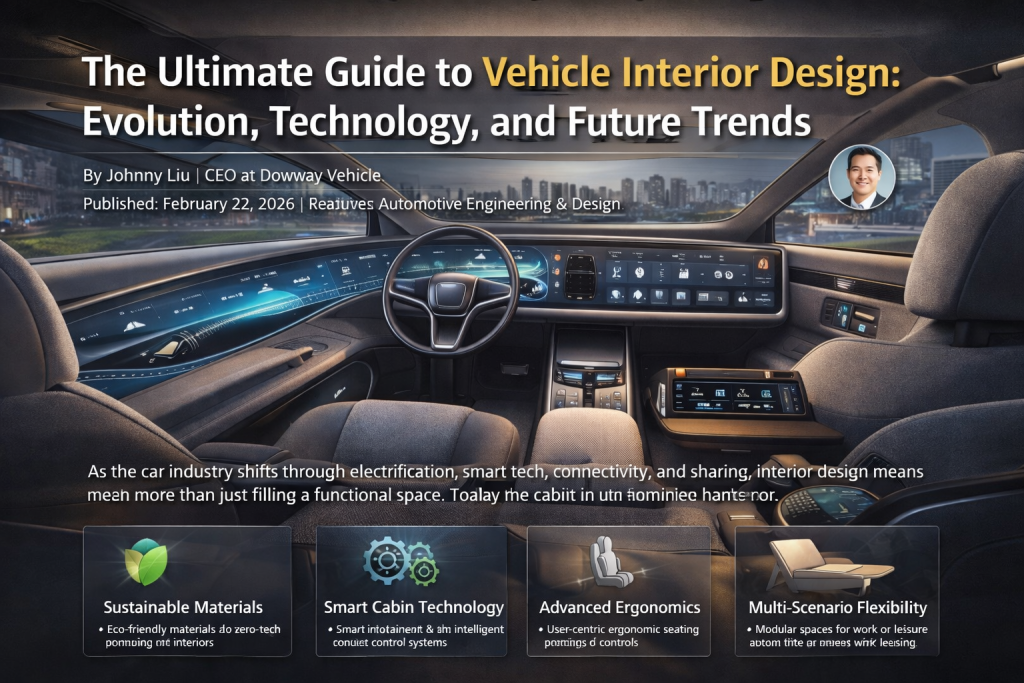
By Johnny Liu | CEO at Dowway Vehicle Published: February 22, 2026 | Category: Automotive Engineering & Design
Author’s Note: As the car industry shifts through electrification, smart tech, connectivity, and sharing, interior design means much more than just filling a functional space. Today, the cabin is the main hub where humans, vehicles, and the environment connect. In my work at Dowway Vehicle, I see these shifts daily. This guide offers a data-driven breakdown of how car interiors have evolved, the core systems used today, the real-world problems engineers face, and where the industry is heading next.
- 1. Introduction: The Shift in Vehicle Interior Design
- 2. The Evolution of Vehicle Interior Design
- 3. Core Technology Systems in Modern Cabins
- 4. Solving Industry Problems: Objective Analysis
- 5. Future Trends Shaping Vehicle Interiors
- 6. Frequently Asked Questions (FAQs)
- 7. Final Thoughts
1. Introduction: The Shift in Vehicle Interior Design
In the current wave of automotive changes, the technical level of interior design is a direct measure of a car’s market value. Older cabin designs cared mostly about basic function. They focused on spatial layout, simple material wrapping, and mechanical parts.
Now, driven by higher consumer expectations and new technology, modern interior design has a completely different setup. It mixes eco-friendly materials, lightweight structures, intelligent interaction, and personalized experiences. This requires a blend of materials science, industrial design, electronic engineering, and ergonomics. We have moved from simple decoration to function, and finally to actual user experience.
2. The Evolution of Vehicle Interior Design
The technical growth of interior design tracks right alongside the overall changes in the auto industry. We can break this down into three clear stages:
The Functional Foundation (1950s – Early 2000s)
- Main Feature: Led by function. The goal was to meet basic driving needs, with decoration taking a back seat.
- Key Tech: Traditional injection molding, fabric wrapping, and mechanical buttons.
- Examples: Traditional gas cars featuring fabric seats, mechanical instrument clusters, and physical center consoles.
The Comfort Upgrade (Early 2000s – 2015)
- Main Feature: A strong push for better comfort and early environmental awareness. This stage improved how things felt and how space was used.
- Key Tech: Soft-touch wrapping, eco-friendly plastics, early ergonomic design, and ambient lighting.
- Examples: Soft-touch dashboards, genuine leather seats, dual-zone climate control, and single-color ambient light.
The Smart Fusion Era (2015 – Present)
- Main Feature: Intelligence, connectivity, and personalization. The goal is seamless interaction between the driver, the car, and the outside world.
- Key Tech: Smart cabins, multi-modal touch and voice controls, highly recyclable materials, and lightweight structures.
- Examples: Full LCD instruments, massive center screens, AI voice control, zero-emission materials, and smart surface controls.
The core reasons for these changes remain the same: giving users a better experience and meeting strict industry rules, like low-VOC emission limits and weight reduction targets for electric vehicles (EVs).
3. Core Technology Systems in Modern Cabins
Today, interior engineering rests on four main pillars: Material Technology, Structural Design, Ergonomics, and Intelligent Interaction.
3.1 Innovative Interior Materials: Eco-friendly & Functional
The materials we choose decide how a cabin feels, lasts, and affects the planet. Recent breakthroughs focus on eco-friendly swaps and adding new functions.
Eco-Friendly Material Swaps
Driven by global carbon-neutral goals and strict cabin air quality standards (like China’s GB/T 27630-2011 and EU REACH), green materials are now standard.
- Recyclable Materials: This includes Post-Consumer Recycled (PCR) plastics and PET fabrics. The VW ID. series uses 100% recyclable PET fabric for door panels and consoles. The Toyota Mirai uses recyclable bamboo fiber, hitting a recycling rate of over 80%. High-end models using recyclable Alcantara hit wear resistance marks of over 50,000 cycles, easily beating traditional fabrics.
- Low VOC Materials: Volatile Organic Compounds (VOCs) hurt cabin air quality. Modern low-VOC Polyurethane (PU), Polypropylene (PP), and water-based paints keep emissions below 10mg/m³ (the legal limit is 80mg/m³). The NIO ET7 gets its VOC emissions down to just 5mg/m³, creating a “zero odor” cabin.
- Bio-based Materials: These are made from plants like corn, sugarcane, or bamboo. The BMW i3 uses bio-based Polylactic Acid (PLA) in its door panels. It is completely biodegradable but still has a tensile strength of over 30MPa, matching standard PP plastics.
Functional Material Upgrades
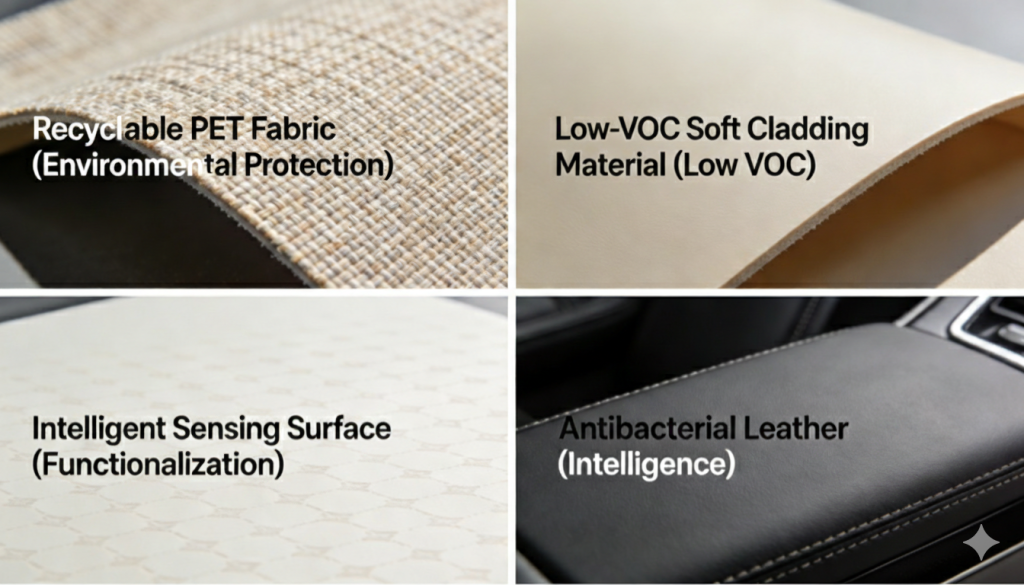
Materials do more than just cover surfaces now:
- Smart Perception Materials: These hide flexible sensors and conductive fibers. The Mercedes-Benz EQS uses smart surfaces so you can use touch and pressure controls without physical buttons. It has a response delay of under 50ms and a recognition accuracy of over 99%.
- Thermal Control Materials: These use heating wires and Phase Change Materials (PCM). The Tesla Model S uses PCM in its seats. Even if the outside temperature swings between -10℃ and 40℃, the seat surface stays at a comfortable 25℃ to 30℃. This saves a lot of HVAC energy.
- Antibacterial Materials: By adding silver ions or zinc oxide, materials can stop bacteria from growing. These hit an antibacterial rate of over 99% against E. coli and Staphylococcus aureus, which is great for shared cars and family vehicles.
3.2 Structural Engineering: Lightweight & Integrated Solutions
Structural design changes vehicle weight (which heavily affects EV range), space use, and how fast cars are built on the line.
Lightweight Structural Design
- Topology Optimization: Engineers use Finite Element Analysis (FEA) to remove extra mass. The Audi A6L dashboard frame used this method to drop weight by over 15% while keeping a bending strength of ≥25MPa.
- Material Mixes: Replacing steel with aluminum, magnesium, or carbon fiber works well. The BMW 5 Series aluminum door frame is 30% lighter than a steel one. The Tesla Model 3 carbon fiber center console weighs 50% less than standard plastics.
- Hollow Structures: Using hollow injection molding saves mass. The VW Lavida’s hollow door panels cut weight by 20% and actually block noise better.
Integrated Architecture
Moving away from building cars piece-by-piece reduces part counts and stops parts from squeaking:
- Dashboard Integration: The BYD Han molds its dashboard as one piece. This drops the part count by 40% and cuts assembly time by 30%.
- Door Panel Integration: The Mercedes C-Class groups ambient lighting, audio, and armrests into a single modular door panel.
- Unified Cabin Structure: Using pure EV platforms, cars like the NIO ET5 remove the old transmission tunnel. This creates a “floating integrated cabin” that greatly opens up rear-seat space.
3.3 Advanced Ergonomics: User-Centric Optimization
Ergonomics aims to fit the car to the human body, lowering mental and physical stress.
Data-Driven Ergonomic Updates
- Control Zone Layout: Based on H-point and R-point data, center screens sit perfectly 10° to 15° below the driver’s line of sight. Steering wheels offer standard adjustments of ±50mm (front/back) and ±30mm (up/down).
- Bionic Seat Design: The BMW 3 Series uses bionic shapes with dual-layer cushions (soft on top, firm on the bottom) and 12-way power adjustments to spread out pressure on long trips.
- Space Layout: Standard compact SUVs guarantee front headroom of ≥950mm, rear legroom of ≥800mm, and shoulder room of ≥1400mm. EVs push rear legroom past 1000mm.
Personalization & Adaptation
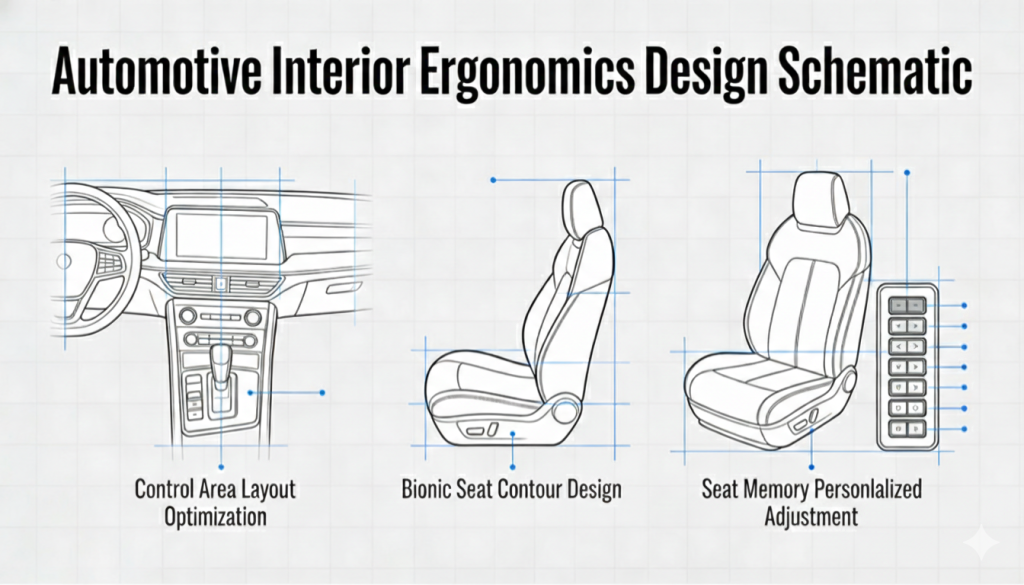
- Memory & Face ID: The Mercedes S-Class stores 3 distinct seat profiles. It uses facial recognition to automatically adjust seats, steering wheels, and mirrors the moment you get in.
- Scenario Modes: In “rest mode,” seats recline up to 170°, screens turn off, and lights dim. In “office mode,” the layout shifts to make using a laptop comfortable.
3.4 Intelligent Interaction: Human, Vehicle, and Environment
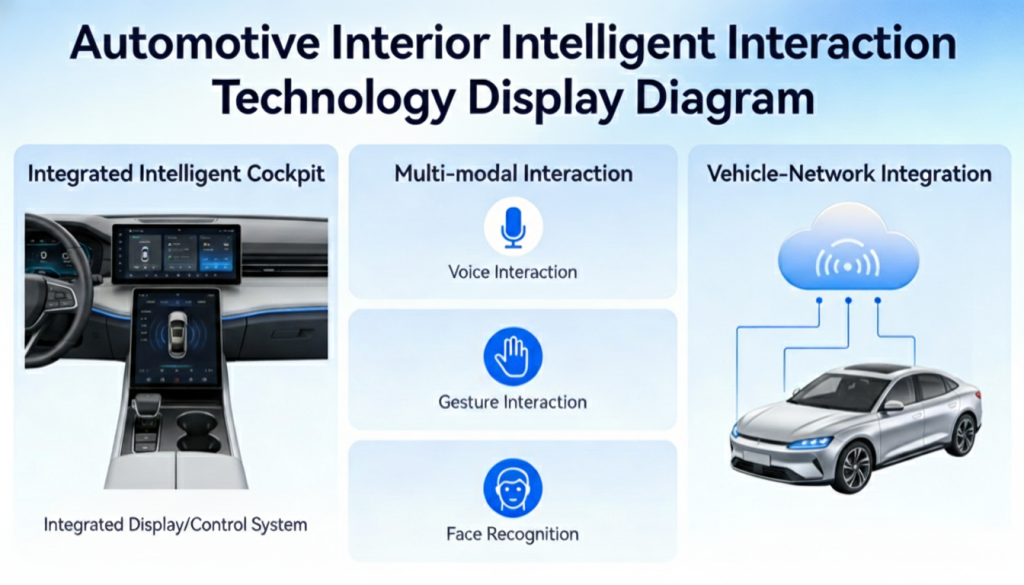
Modern cabins use smart connectivity to act, rather than just waiting to be told what to do.
Smart Cabin Tech
- Display Integration: The BYD Tang uses a dual-screen setup (12.3-inch cluster plus a 15.6-inch center screen). The Mercedes EQS goes further with a 56-inch single surface screen.
- Domain Controllers: The brain of the cabin runs on chips like the Qualcomm Snapdragon 8155 or MediaTek MT8666. With computing power over 100 TOPS, they handle multiple screens with less than a 100ms delay.
- HUD/AR-HUD: The BMW iX uses Augmented Reality Head-Up Displays to project navigation arrows and safety distances right onto the road view, keeping the driver’s eyes up.
Multi-Modal Interaction
- Voice Control: Systems like NIO’s NOMI and Xpeng’s Xmart OS hit a 99% recognition accuracy. They support continuous talking, regional dialects, and zone-specific commands (like a rear passenger asking to change the rear AC).
- Gesture & Face ID: The Mercedes S-Class and Tesla Model X allow hand gestures to control audio and sunroofs. The BYD Han uses Face ID to switch user profiles and check if the driver is tired or distracted.
V2X (Vehicle-to-Everything) Connection
- Device Mirroring: Apple CarPlay, Baidu CarLife, and Huawei HiCar project phone apps right onto the car screens.
- Smart Home Link: Systems like BYD DiLink let drivers turn on home lights or start robot vacuums from the road.
- Road Communication: V2X lets the car receive real-time traffic light data and traffic jam warnings, telling the driver to slow down early.
4. Solving Industry Problems: Objective Analysis
Even with fast progress, the auto industry deals with four main conflicts. Here are the practical fixes engineers use today:
4.1 Problem: Eco-Friendly vs. Premium Feel
- The Issue: Recycled plastics and fabrics often feel cheap. High-end buyers want luxury.
- The Fix: We combine eco-materials with better texturing. Using eco-friendly microfiber leather—which has lower VOCs and recycles easily—paired with custom surface coatings mimics the exact feel of real leather, often at a lower cost.
4.2 Problem: Lighter Weight vs. Structural Safety
- The Issue: Removing too much mass lowers crash safety and impact strength.
- The Fix: Engineers use FEA topology optimization along with mixed materials. Combining carbon fiber composites with aluminum keeps the weight low while easily meeting strict crash safety rules.
4.3 Problem: Smart Tech vs. Easy Usability
- The Issue: Putting too many controls into digital sub-menus frustrates users. It makes simple tasks hard, especially for older drivers.
- The Fix: A balanced design works best. We keep physical buttons for heavy-use functions like volume and climate. We also offer custom screen layouts and refine AI software to stop false triggers during voice or touch commands.
4.4 Problem: New Tech vs. Cost Control
- The Issue: Advanced domain controllers, bio-materials, and smart surfaces drive up production costs.
- The Fix: Builders use standard modular designs across different car models to share research costs. They also use tiered rollouts: flagship cars get the full tech package, while base models focus on core eco-materials and basic smart functions.
5. Future Trends Shaping Vehicle Interiors
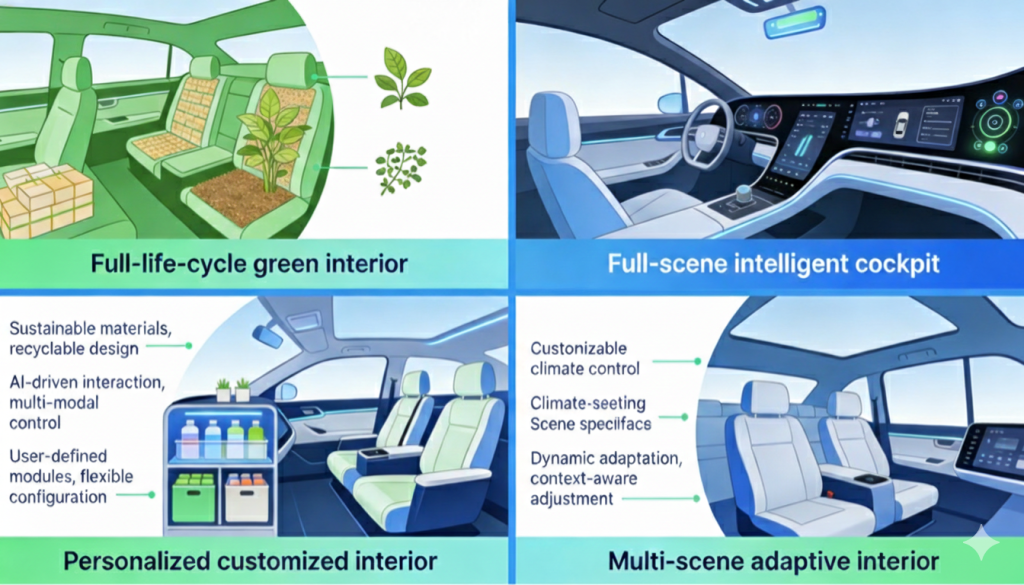
Looking at current data, vehicle interiors will move in four main directions:
- Full Life-Cycle Green Design: We will move from partial green materials to full coverage. By 2030, the vehicle interior recycling rate should cross 90%. Solvent-free building and full “use-recycle-degrade” material loops will be the norm.
- Proactive Smart Action: Smart cabins will stop waiting for commands and act on their own. Using sensors and AI, the cabin will spot driver fatigue and adjust seating, music, and lighting. In self-driving setups, the cabin becomes a moving living room.
- Modular Customization: Buyers will want unique cabins. 3D printing will produce custom parts like armrests and dash trims quickly. Lighting and screens will change automatically based on the user’s mood.
- Multi-Scenario Spaces: The interior will change based on what you need: family trips (using child seats and onboard fridges), mobile office work (unfolding desks and fast internet networks), resting (flat-bed seating), or shared mobility (easy-to-clean surfaces and fast user profile switching).
6. Frequently Asked Questions (FAQs)
1️⃣ What is vehicle interior design and why does it matter? 🚗 Answer: Vehicle interior design is the technical process of planning the inside space of a car. This covers seating, dashboards, controls, materials, ergonomics, safety features, and looks. It matters because the cabin is no longer just for basic driving. It serves as a workspace, leisure area, and user experience hub that meets the daily needs of drivers and passengers.
2️⃣ What are the key rules for good vehicle interior design? 📐 Answer: Good vehicle interior design balances comfort, ergonomics, safety, and aesthetics. Key rules include:
- Ergonomic layout: Making sure controls, seating, and displays are easy and comfortable to use.
- Clear visibility: Drivers must reach controls easily with zero distraction.
- Material quality: Materials must be tough, look good, and fit the climate.
- Functionality and flow: Storage, passenger space, and ease of use are central to success. Strong interior design creates a pleasant, safe, and intuitive space for users.
3️⃣ What trends are shaping vehicle interiors right now? 📊 Answer: Current vehicle interior trends include:
- Sustainable materials like recycled plastics and natural fibers.
- Advanced tech integration like large screens, voice control, and clean software interfaces.
- Minimalist layouts that cut clutter and make the cabin easier to use.
- Customization options that let buyers match the cabin to their personal style. These trends show a heavy focus on comfort, technology, sustainability, and daily user experience.
4️⃣ How does ergonomics fit into cabin design? 🪑 Answer: Ergonomics is the foundation of vehicle interior design. It ensures the space fits different body sizes, reach zones, posture needs, and movement. An ergonomic layout cuts down driver fatigue, makes controls easy to grab, and improves overall safety. Designers use standard interface measurements (like seat positioning and H-point data) to build comfortable, health-supporting spaces.
5️⃣ How will self-driving cars change the interior? 🤖 Answer: As cars become more autonomous, interior design will shift away from driver-focused layouts toward experience-focused cabins. With less manual driving required, interiors will focus on lounge-like seating, flexible work desks, social spaces, and advanced digital screens. Future interiors offer new ways to relax, work, and interact, turning the car into a multi-use room.
7. Final Thoughts
The technical shift in vehicle interior design mirrors the broader changes happening across the auto industry. The core logic is completely human-centric. By mixing materials science, structural engineering, ergonomics, and AI, the industry has bridged the gap from simple function to deep user experience.
While debates around cost, usability, and raw materials still exist, clear engineering solutions solve these problems today. As we move closer to self-driving technology and strict carbon neutrality rules, vehicle interior design will continue to change the basic relationship between people and mobility.
About the Author: Johnny Liu is the CEO at Dowway Vehicle. With a background in automotive engineering, manufacturing, and supply chain management, he focuses on clear, data-driven analysis of automotive technology and modern mobility solutions.

·