


< Back to Performance Development
Author: Johnny Liu, CEO at Dowway Vehicle
Published: February 28, 2026
- Introduction to Vehicle Noise Analysis in NVH
- Understanding Vehicle Noise: Definitions and Categories
- Advanced Testing Technologies for Vehicle Noise Analysis
- Core Technologies in Vehicle Noise Analysis
- Vehicle Noise Optimization Strategies and Case Studies
- Final Thoughts and Future Trends
- Frequently Asked Questions (FAQ)
Introduction to Vehicle Noise Analysis in NVH
NVH means Noise, Vibration, and Harshness. It is the core engineering discipline focused on improving passenger comfort and cabin quietness. The auto industry is shifting fast toward intelligent and electric cars. Because of this, buyers want more than basic transport; they expect a premium, quiet ride. Right now, NVH Research and Development (R&D) takes up 15% to 20% of total vehicle development costs. For luxury brands, that number goes even higher. Noise is the most obvious negative experience for a passenger. Where does it come from? It mixes several complex fields: mechanical vibration, aerodynamics, and material sciences.
Why do we analyze vehicle noise? The main goal is to find exactly where the sound starts, track how it travels, and measure its exact strength. Engineers then use structural tweaks, better materials, and manufacturing upgrades to keep cabin noise within strict comfort limits. In this guide, I will walk you through the technical systems, the latest testing tools, and the exact workflows we use to fix vehicle noise problems.
Understanding Vehicle Noise: Definitions and Categories
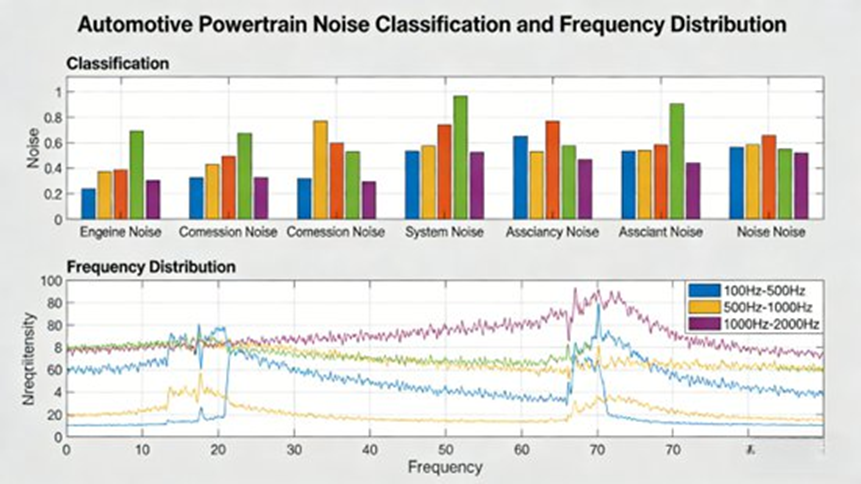
Vehicle NVH noise means the irregular sound waves that car parts and outside forces create while you drive. General background noise stays mostly the same. But vehicle noise changes depending on how you drive. Your speed, the weight in the car, and the type of road all change the sound. Also, sound and physical shaking always go together.
Evaluation looks at two main areas:
- Objective Metrics: Hard numbers like Sound Pressure Level (SPL in dB), frequency ranges (Hz), and spectral patterns.
- Subjective Perception (Harshness): How rough or uncomfortable the ride actually feels to a human. A machine cannot easily measure this feeling, making it a tough challenge in NVH testing.
Based on how sounds form, we group vehicle noise into four main buckets:
1. Powertrain Noise
This is the biggest noise maker for both Internal Combustion Engine (ICE) cars and New Energy Vehicles (NEVs). It makes up 30% to 50% of total vehicle noise.
- Mechanical Noise (20-2000Hz): Comes from engine or motor movement, like pistons hitting or gears grinding. The pitch changes directly with engine RPM.
- Aerodynamic Noise (100-5000Hz): Comes from intake and exhaust pipes, or cooling fans. As air moves faster, the noise gets much louder.
- Electromagnetic Noise (1000-10000Hz): Found mostly in NEVs. It happens when the motor’s stator and rotor magnetic forces interact, creating a high-pitched whine.
2. Road Noise
Bumpy roads and tire friction create this sound. It accounts for 20% to 40% of the total noise.
- Tire Noise: You hear tread pattern sounds (1000-8000Hz), impact thumps (50-500Hz), and low elastic vibrations (20-200Hz).
- Suspension Noise (50-1000Hz): Control arms vibrate, and rubber bushings rub together as you drive.
- Body Structure Vibration Noise (20-500Hz): The road shakes the suspension, which then shakes the car’s metal body panels.
3. Wind Noise
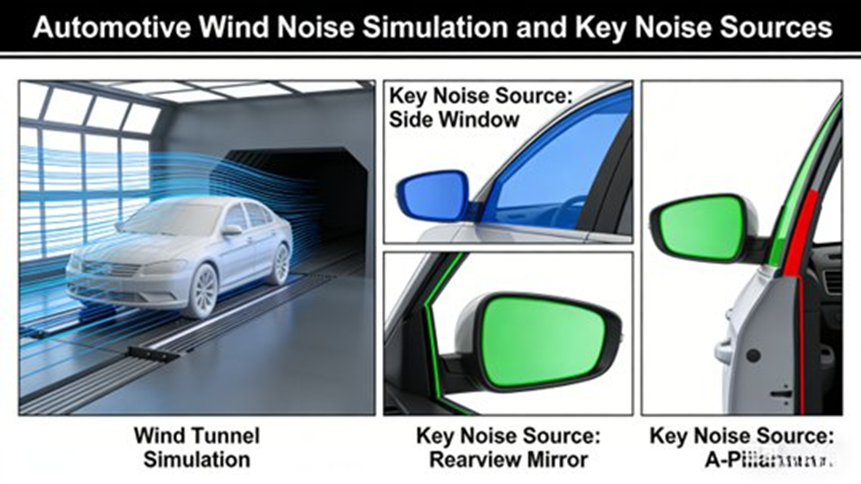
When you drive over 80km/h, air hits the car and creates wind noise. This makes up 20% to 30% of the total sound.
- Airflow Separation Noise (500-5000Hz): Air hits shapes like A-pillars or side mirrors, breaks apart, and spins into noisy vortices.
- Leakage Noise (1000-3000Hz): A high-pitched whistle happens when air sneaks through tiny gaps in door seals.
4. Accessory Noise
This includes the AC blower, steering racks, brakes, and vibrating dashboard plastics. You usually hear these as on-and-off humming sounds between 20-5000Hz.
Advanced Testing Technologies for Vehicle Noise Analysis
Good NVH analysis starts with perfect data. Our rule is simple: collect data without interference, test every driving condition, and sync all sensors perfectly.
Essential Testing Equipment
- Noise Acquisition Devices: We use free-field and pressure-field Microphones. We also use Artificial Heads to record sound exactly as human ears hear it. Data Acquisition (DAQ) Systems capture this data at fast rates (≥51.2kHz). Finally, Acoustic Cameras help us actually “see” sound hotspots on a screen.
- Auxiliary Testing Equipment: IEPE Accelerometers track vibrations. Tachometers track engine RPM. We do all this inside Environmental Simulators, like hemi-anechoic chambers or extreme climate rooms.
Key Testing Conditions
- Static Conditions: We test the car while parked. We let it idle, turn on the AC, turn the steering wheel, and simulate heavy loads.
- Dynamic Conditions: We drive the car at steady speeds. We test wide-open throttle (WOT) acceleration and coasting. We run the car over rough Belgian blocks and blast it with high-speed crosswinds.
Data Preprocessing
Raw sound files are full of useless errors. We clean them up. We use high-pass and low-pass filters. We remove linear trends. We apply Hanning or Hamming windows to stop data leakage. We delete weird statistical outliers and standardize the final numbers into A-weighted decibels (dBA).
Core Technologies in Vehicle Noise Analysis
Spectrum Analysis Technology
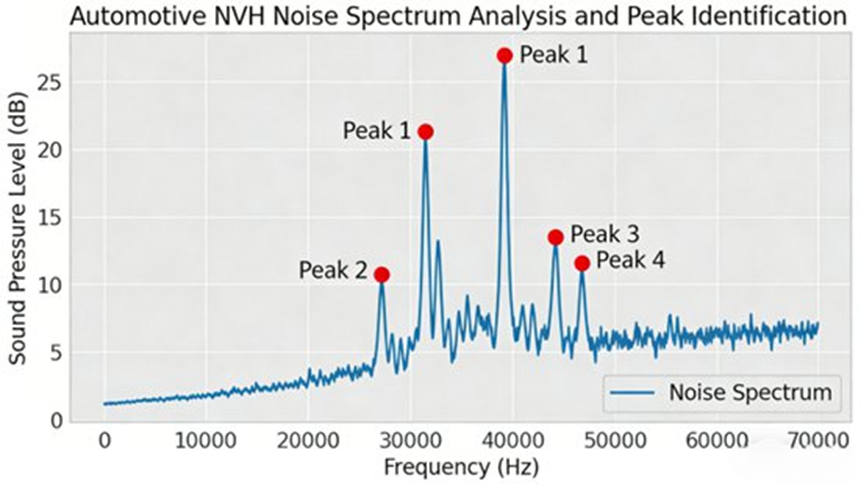
This method turns time-based sound waves into frequency graphs. We look at Power Spectral Density (PSD) and Octave Bands to see where the energy lives. For example, a spike at 50-200Hz usually means road noise. A spike over 1000Hz usually means wind or an electric motor whining.
Order Analysis Technology
We use this for sounds that repeat as parts spin faster. Using order tracking math, engineers link specific sounds to physical parts. We can prove that a hum is an engine’s 2nd-order piston knock or an EV motor’s 8th-order magnetic whine.
Transfer Path Analysis (TPA) Technology
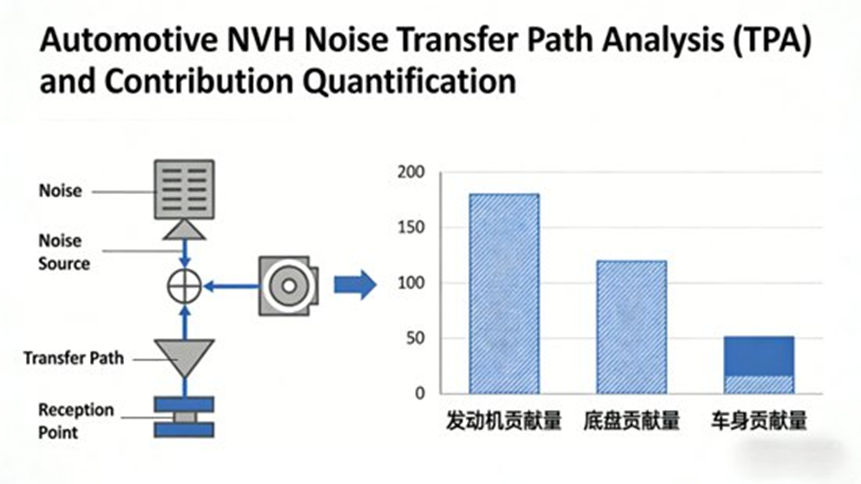
TPA measures how much sound travels down specific routes. Sound moves from the source to the driver’s ear. We use Traditional TPA or Operational Path Analysis (OPA) to track it. This tells us if road noise travels through the air or shakes through the metal suspension arms.
Sound Source Localization Technology
This answers exactly “where” a noise lives. Acoustic Cameras give us pinpoint accuracy for wind noise. Sound Intensity probes track down engine hums. Near-field Acoustic Holography (NAH) maps out exactly how an interior door panel vibrates.
Vehicle Noise Optimization Strategies and Case Studies
When we fix noise problems, we follow a strict order:
- Source Control (Highest Priority): Stop the noise before it starts. We tune engine combustion, put quieter tires on the wheels, and smooth out door handles to fix aerodynamics.
- Path Blocking (Secondary): Stop the noise from traveling. We install softer hydraulic suspension mounts. We make the car body stiffer (luxury cars often hit 40,000 Nm/deg of torsional stiffness). We also stuff thick acoustic foam into the dashboard walls.
- Response Suppression (Supplementary): If noise still gets through, we absorb it. We stick heavy damping mats onto metal panels. We also use Active Noise Cancellation (ANC) speakers to play opposite sound waves and cancel the hum.
Real-World Engineering Case Study: Compact Vehicle Hum
- The Problem: At 80km/h, a compact car had a loud, 65dB(A) low-frequency hum inside the cabin.
- Analysis: We ran Spectrum and Order tests. We found a 150Hz road noise peak and a 300Hz engine piston peak. TPA showed that 55% of the total sound traveled straight through the suspension.
- Solution: We attacked all three tiers. We added low-noise tires (Source). We swapped in hydraulic suspension bushings (Path). Finally, we glued thicker damping panels to the floor (Response).
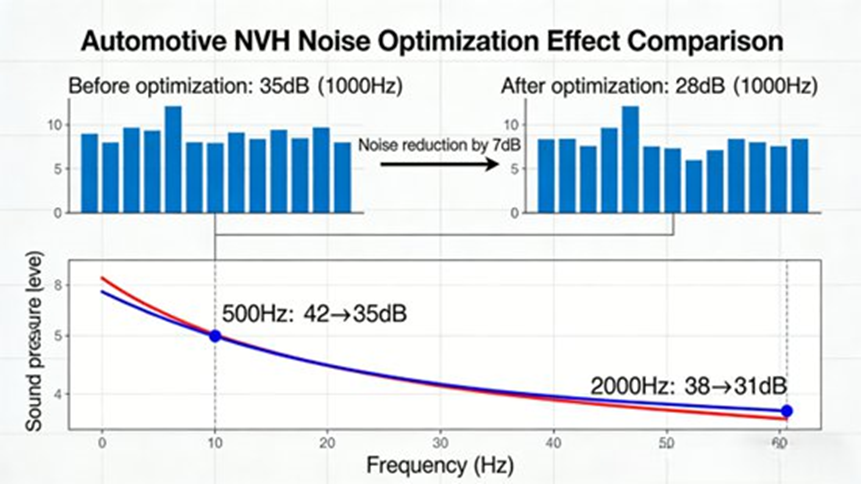
- Result: The noise dropped to a quiet 58dB(A). The annoying hum vanished, and human test drivers rated the ride 30% more comfortable.
Final Thoughts and Future Trends
Vehicle NVH noise analysis follows a set loop: test, analyze, find the source and path, and fix it. As the car world moves to EVs and self-driving software, our jobs change. We now spend time chasing high-pitched electromagnetic noises and tuning artificial warning sounds for pedestrians (AVAS). Soon, Artificial Intelligence (AI) will automatically map noise sources for us. Virtual CAE software will predict sounds before a car is even built. By mixing acoustics, software, and materials, we will keep making cabins quieter.
Frequently Asked Questions (FAQ)
1. What is vehicle noise analysis (NVH)?
Vehicle noise analysis falls under NVH (Noise, Vibration, and Harshness). It is the engineering practice of measuring and reducing unwanted sounds and physical shaking in cars. Engineers find where sounds start, measure them with sensors, and use software tools to make the ride smoother.
2. Why is vehicle noise analysis important?
NVH directly controls passenger comfort. A quiet cabin stops driver fatigue and tells the buyer that the car is premium. Also, governments enforce strict rules on how loud a car can be on the outside. Finding these noise issues on a computer early in the design process saves millions in physical prototyping costs.
3. What are the main sources of vehicle noise?
The loudest sound changes based on how fast you drive and if you have an engine or a battery. Common culprits are mechanical parts (engines, gears), tire-to-road friction, aerodynamic wind turbulence, and accessory parts like AC fans. Because electric cars do not have loud gas engines to cover up background sounds, wind and tire noises become much more obvious.
4. How is noise measured and analyzed in vehicles?
Engineers use physical tools like microphones for sound and accelerometers for vibration. These hook up to Data Acquisition (DAQ) systems. We then run that data through Fast Fourier Transform (FFT) math to find frequencies, Transfer Path Analysis (TPA) to track how sound travels, and predictive simulation tools.
5. What methods are used to reduce vehicle noise?
We use four main tricks to quiet down a car. We redesign parts to avoid physical resonance. We use rubber mounts or hydraulic fluid to block vibrations. We add thick acoustic foam to absorb airborne sounds. Finally, we use Active Noise Control speakers to play opposite sounds that cancel out low-frequency hums.
