




Published on: June 22, 2026
Author: Johnny Liu, CEO at Dowway Vehicle
Published On: June 23, 2026
Reading Time: 12 minutes
Author’s Note
“As the CEO of Dowway Vehicle, I have spent years tracking how mechanical limits constrain automotive engineering. What we are seeing in 2026 is a permanent shift in how vehicles move. The physical links between your hands, feet, and the road are disappearing. They are being replaced by high-speed electrical actuators and smart control software. Drawing from the latest 《2026 Passenger Car Chassis Domain Control and Cross-Domain Chassis Fusion Research Report》 by Sohu Auto Research (佐思汽研), this piece breaks down why 2026 is the true launch year for full drive-by-wire chassis in mass-market vehicles.”
Table of Contents
1. Why 2026 is the Launch Year for Smart Chassis
In older car setups, steering, braking, and suspension lived in separate worlds. Hydraulic lines, metal columns, and vacuum units did all the work. But as we move toward L3 and higher levels of autonomous driving, these old parts cannot keep up. Automated driving systems need immediate reactions. They cannot wait for hydraulic fluid to build pressure.
This delay led to the massive changes shown at the 2026 Beijing Auto Show. Industry teams now call 2026 the breakout year for full active smart chassis setups. A long list of new flagship SUVs made their debut with these systems ready for production: the Li Auto L9 Livis, Nio ES9, Xpeng GX, IM Motors LS8, and the next-generation Aito M9.
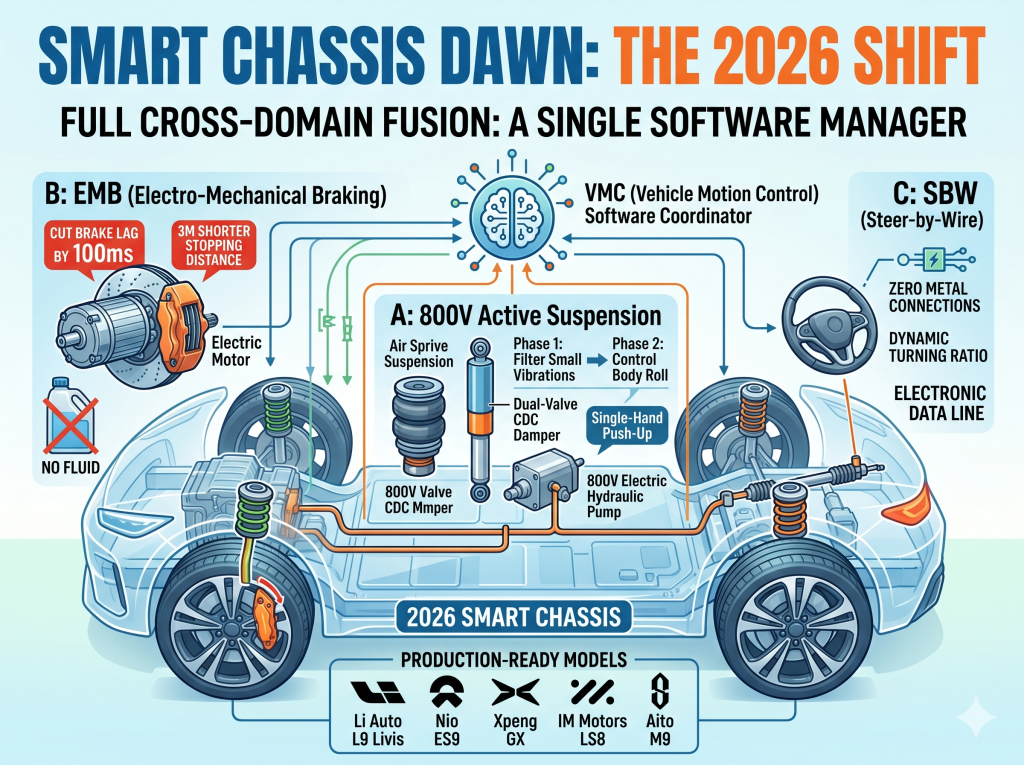
According to the Sohu Auto Research report, we are moving past single-system controls. We have entered the era of full cross-domain chassis fusion, where steering, braking, and suspension run under a single software manager.
2. The Three Pillars of Drive-by-Wire Hardware
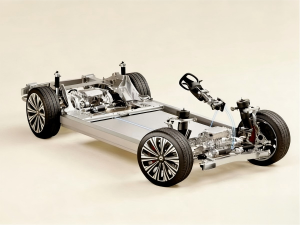
To understand this shift, we must look closely at the three hardware systems that have moved from test labs to mass production lines.
                  ┌─────────────────────────────────────────┐
                  │      FULL DRIVE-BY-WIRE CHASSIS         │
                  └────────────────────┬────────────────────┘
                                       │
         ┌─────────────────────────────┼─────────────────────────────┐
         ▼                             ▼                             ▼
┌──────────────────┐          ┌──────────────────┐          ┌──────────────────┐
│  800V ACTIVE     │          │ ELECTRO-         │          │  STEER-BY-WIRE   │
│  SUSPENSION      │          │ MECHANICAL       │          │  (Nexteer SBW)   │
│  (Air Springs +  │          │ BRAKING (EMB)    │          │                  │
│   CDC + 800V     │          │                  │          │  No physical     │
│   Hydraulic Pump)│          │  Fully Dry / No  │          │  column; Triple  │
│                  │          │  fluid; 100ms    │          │  redundancy      │
│  Dual-phase millisecond     │  faster response │          │  ECU & fail-safe │
│  attitude control│          │  time vs. wet    │          │                  │
└──────────────────┘          └──────────────────┘          └──────────────────┘
A. 800V Active Suspension Systems
High-voltage vehicle systems have changed what car suspensions can do. A clear example is the Li Auto L9 Livis (released in April 2026), which uses an 800V Active Suspension setup.
- The Hardware: It uses Air Springs + Dual-Valve Continuously Controlled Damping (CDC) + an 800V Electric Hydraulic Pump. High-pressure oil lines and in-house software tie it all together.
- The Two-Phase Control Principle:
- Phase 1 (Filtering small road vibrations): The car relies on its air springs and dual-valve CDC. It manages the CDC valve with 1ms current control precision, which gives a fast valve response of 5ms.
- Phase 2 (Controlling vehicle lean and tilt): When the car corners hard or brakes suddenly, the 800V hydraulic pump takes over. It pushes hydraulic pressure directly to the correct side of the car in milliseconds. This action stops the body from rolling or pitching, keeping the cabin flat.
This high-voltage system allows for brand-new features:
- “Single-Hand Push-Up”: The car can lower and raise one side of its suspension in a fast, continuous wave.
- Off-Road Recovery: If you get stuck in loose sand, the active suspension starts “hopping.” This rapid movement changes tire pressure and ground friction to help the car break free. For deep traps, the system can output more than 10,000N of lifting force per wheel to raise the body, allowing you to slide traction boards under the tires without using a jack.
- Easy Wheel Changes: The car can lift a flat tire completely off the ground by itself, allowing you to change the wheel without needing a physical car jack.
B. EMB (Electro-Mechanical Braking): Moving to “All-Dry” Systems
Braking is seeing its biggest update in decades. 2026 is the first production year for Electro-Mechanical Braking (EMB), developed by Li Auto alongside Bethel (伯特利).
- No Fluid: EMB is a fully “dry” system. It removes hydraulic lines, master cylinders, brake boosters, and brake fluid.
- Individual Motors: Every wheel gets a dedicated electric motor to clamp the brake pads.
- Key Metrics: Sending electrical signals directly to the wheel cuts brake lag by about 100 milliseconds compared to wet hydraulic brakes. This change reduces stopping distances by 3 meters when braking from 120 km/h to 0.
C. SBW (Steer-by-Wire): Removing the Steering Shaft
The steering wheel is no longer mechanically connected to the front tires. Steer-by-Wire (SBW) setups, like the front-wheel SBW supplied by Nexteer (耐世特) for the Li Auto L9 Livis, change how we turn.
- Zero Metal Connections: With no steering column, road vibrations are filtered out electronically, saving cabin space.
- Dynamic Turning Ratio: The steering ratio changes continuously based on how fast the car is traveling. This setup gives you quick, easy turns at low speeds and high stability on the highway.
- Safety Protections: To meet strict safety rules, SBW uses a Main ECU + Backup Data Channel + Mechanical Fail-Safe Strategy to keep you in control if a part fails.
3. VMC (Vehicle Motion Control) — The Software Coordinator
Good hardware is useless without the right software to guide it. In older cars, steering, braking, and suspension had separate computers. If an automated driving system has to send separate messages to five or six different controllers during a quick lane change, the delays can be dangerous.
As Nio’s engineering team pointed out:
“If an automated system has to call five or six different interfaces for steering, braking, and suspension, it is a mess. VMC must be the single interface that connects the car’s sensors above to the chassis hardware below.”
Vehicle Motion Control (VMC) coordinates how a car moves across all directions (X, Y, and Z axes) using one unified software engine.
       ┌────────────────────────────────────────────────────────┐
       │   Intelligent Driving Perception & AD Algorithms (L3+) │
       └───────────────────────────┬────────────────────────────┘
                                   │  Unified Driving API
                                   ▼
       ┌────────────────────────────────────────────────────────┐
       │         VMC (Vehicle Motion Control) Engine            │
       │       - Coordinates X, Y, Z axes simultaneously        │
       └───────────────────────────┬────────────────────────────┘
                                   │  Millisecond Commands
         ┌─────────────────────────┼─────────────────────────┐
         ▼                         ▼                         ▼
┌──────────────────┐      ┌──────────────────┐      ┌──────────────────┐
│  Steering (SBW)  │      │  Braking (EMB)   │      │ Suspension (800V)│
└──────────────────┘      └──────────────────┘      └──────────────────┘
The Fast Evolution of SAIC’s IM Motors (VMC 1.0 to 3.0)
SAIC’s IM Motors (上汽智己) is leading the way in VMC development. They have updated their system rapidly:
- VMC 1.0 (May 2024): Managed basic movement across three directions. It coordinated air spring heights, CDC damper stiffness, and the Electronic Parking Brake (EPB).
- VMC 2.0 (September 2024): Added over-the-air updates and tied the smart driving sensors to the chassis. It introduced a High-Speed Tire Blowout System. Using LiDAR and wheel speed sensors, the system recognizes a blowout within 200ms. In tests at 220 km/h, VMC 2.0 turns the rear wheels slightly and uses single-side braking to keep the car from drifting more than 0.5 meters, preventing a crash.
- VMC 3.0 (November 2025 on the IM LS9): Expanded control to 14 different cross-domain items. Key features include:
- Anti-Motion Sickness Software: The system adjusts the chassis in real-time to reduce high-frequency swaying and pitch, helping passengers stay comfortable.
- Active Rollover Protection 3.0: During emergency lane changes, the four-wheel steering reacts instantly to cut vehicle rollover risks by up to 54%.
4. Inside the Hardware and Software of Key 2026 Cars
Let’s look at how these technologies are built into two major production chassis platforms: Li Auto’s Mach Architecture and Nio’s SkyRide Intelligent Chassis.
A. Li Auto L9 Livis: High Computing Power
Li Auto relies on massive computing power and in-house software to run its chassis.
- Chassis Processors: The L9 Livis uses two self-developed 5nm car-grade “Mach 100” (马赫100) chips, giving a total of 2560 TOPS of computing power. Inside these chips, a dedicated zone reserves 100 to 200 TOPS of processing power just for chassis calculations.
- In-House Code: Every bit of software for the steering, braking, and suspension is written by Li Auto. Because the programs run on the same chip, data flows instantly between systems.
B. Nio ES9: The SkyRide (天行) Network
Launched in May 2026, the Nio ES9 shows another way to master ride comfort using the SkyRide (天行) Intelligent Chassis.
- Hardware Suite: It features SkyRide Active Suspension, four-wheel Steer-by-Wire, brake-by-wire, and active rear-wheel steering.
- Central Compute: The system uses Nio’s Central Computing Platform as a brain, linking the active suspension, steer-by-wire, rear-wheel steering, and electric motors.
- Domain Coordination: SkyRide talks to the Cabin and Body systems. This allows the car to perform coordinated moves like the Nio ET9’s “SkyRide Dance”, where the headlights, inside lights, electric doors, and active rear wing move in rhythm with the suspension.
- Performance Control: Running across Nio’s central computers and zone controllers, the system monitors over 2,100 vehicle dynamics parameters with a system lag of under 10ms.
- Real-World Scenarios: The setup handles high-speed blowout control, “zero-feeling” speed bumps (where the car lifts the wheel over the bump to keep the cabin flat), and the “Champagne Tower Challenge” (driving over icy ruts without spilling glasses stacked on the hood).
5. The 2026 Competitive Landscape
The Sohu Auto Research report tracks how global carmakers and Tier-1 suppliers are racing to adopt drive-by-wire designs:
A. Chinese EV Builders
- Xpeng Motors: Putting native drive-by-wire systems into the Xpeng GX and G7. Their Taichi AI Chassis uses neural networks to read the road ahead and adjust the suspension before the wheels even hit a bump.
- Huawei/HIMA (鸿蒙智行): The new Aito M9 uses Huawei’s drive-by-wire tools, combining cameras and sensors with cloud computing to predict road shapes.
- Xiaomi: Quickly adding active suspension controls that connect their smart cabin settings to adaptive chassis adjustments.
- Geely & Zeekr: Standardizing drive-by-wire platforms across premium models like the Zeekr 9X. Geely is focusing on safety backups and AI-driven motion software.
- BYD: Using its DiSus (云辇) Intelligent Body Control System across high-end lines like Yangwang and Fangchengbao, moving toward full drive-by-wire setups.
- State-Owned Carmakers (Changan, SAIC, GAC, Chery, Voyah/岚图, Faw/红旗): Changan is rolling out modular chassis designs. Voyah uses the Taishan Digital Architecture to coordinate the cabin and chassis, while FAW Hongqi is building steer-by-wire models with multiple safety backups.
B. Global Brands
- Tesla: After introducing steer-by-wire on the Cybertruck, Tesla is updating its low-voltage 48V setups to keep chassis parts light and simple.
- Mercedes-Benz & BMW: Using active anti-roll bars and rear-wheel steering, gradually moving their chassis programs onto central computer chips.
- Toyota & GM: Taking a careful approach with drive-by-wire systems, ensuring they have mechanical backups for different global markets.
6. Technical Comparison of Leading 2026 Platforms
Here is a quick look at how the top production chassis platforms compare:
| Tech Feature | Li Auto L9 Livis (Mach) | Nio ES9 (SkyRide) | IM Motors LS9 (VMC 3.0) |
|---|---|---|---|
| Processors | 2x 5nm “Mach 100” (2560 TOPS total) | Central Computer + Zone Controllers | Central Computer + Zone Controllers |
| Chassis Compute | 100 – 200 TOPS | Scalable Dynamic Setup | Scalable Dynamic Setup |
| Active Suspension | 800V Active (Air + CDC + 800V Pump) | SkyRide Full Active Suspension | Air Springs + CDC Coordinated |
| Brakes | Dry EMB (Co-developed with Bethel) | Hydraulic Brake-by-Wire | Hydraulic Brake-by-Wire |
| Steering | Steer-by-Wire (Nexteer) | Steer-by-Wire (4-Wheel Coord.) | Smart Four-Wheel Steering |
| Software Management | Fully In-House | VMC Centralized Network | VMC 3.0 (14 Cross-Domain Projects) |
| Response Metrics | 100ms faster brake; sand-recovery | <10ms lag; blowout control | 220km/h Blowout Control (<0.5m drift) |
| Rollover Control | Over 10,000N lifting force per wheel | Active chassis pitch control | 54% Rollover Risk Reduction |
7. Smart Chassis FAQ
Q1: What is the main benefit of EMB (Electro-Mechanical Braking) in 2026?
Direct Answer: EMB removes all hydraulic fluids to create a fully “dry” braking system.
By using individual electric motors to clamp the brakes, EMB speeds up brake reactions by about 100 milliseconds. This improvement reduces stopping distances by 3 meters when braking from 120 km/h to 0.
Q2: How does VMC software improve automated driving?
Direct Answer: VMC serves as a single software manager that coordinates all car movements at once.
Instead of making the self-driving computer talk to five different systems for steering, braking, and dampers, VMC handles those systems together. This reduces lag to under 10 milliseconds, keeping the car stable during fast moves.
Q3: How do Steer-by-Wire systems stay safe without a steering shaft?
Direct Answer: These systems use triple backups to ensure you can always steer.
If a part fails, the system relies on a secondary processor, a backup data line, and a mechanical fail-safe setting that locks the wheels into a safe position to prevent a crash.
Q4: What is the difference between Phase 1 and Phase 2 active suspension?
Direct Answer: Phase 1 handles small road bumps, while Phase 2 keeps the car body from tilting.
Phase 1 uses standard air springs and dampers to smooth out small vibrations in 5 milliseconds. Phase 2 uses an 800V hydraulic pump to push back against body lean and weight transfer during hard corners or heavy braking.
Final Thoughts from Johnny Liu
“2026 marks the end of the traditional mechanical chassis. We are no longer buying individual parts like dampers and brake pads; we are buying unified movement platforms. For suppliers, the path is clear: if you are not building integrated chassis software, your hardware will soon be left behind. The future of driving is electric, dry, and run by smart computer chips.”