


Meet the Author
| Johnny Liu CEO at Dowway Vehicle With 15 years in car manufacturing and supply chain setup, Johnny leads Dowway Vehicle in building systems for next-generation electric vehicles. |
Published on: June 24, 2026 Reading Time: 8 minutes —
For decades, global Tier-1 giants like Bosch, ZF, and Continental decided how cars were built. They owned the patents and controlled the chassis market. Domestic car brands simply had to buy whatever they offered.
But things are changing fast. Today, the real competition in electric vehicles is not about batteries anymore. It is about the smart chassis and the smart cabin.
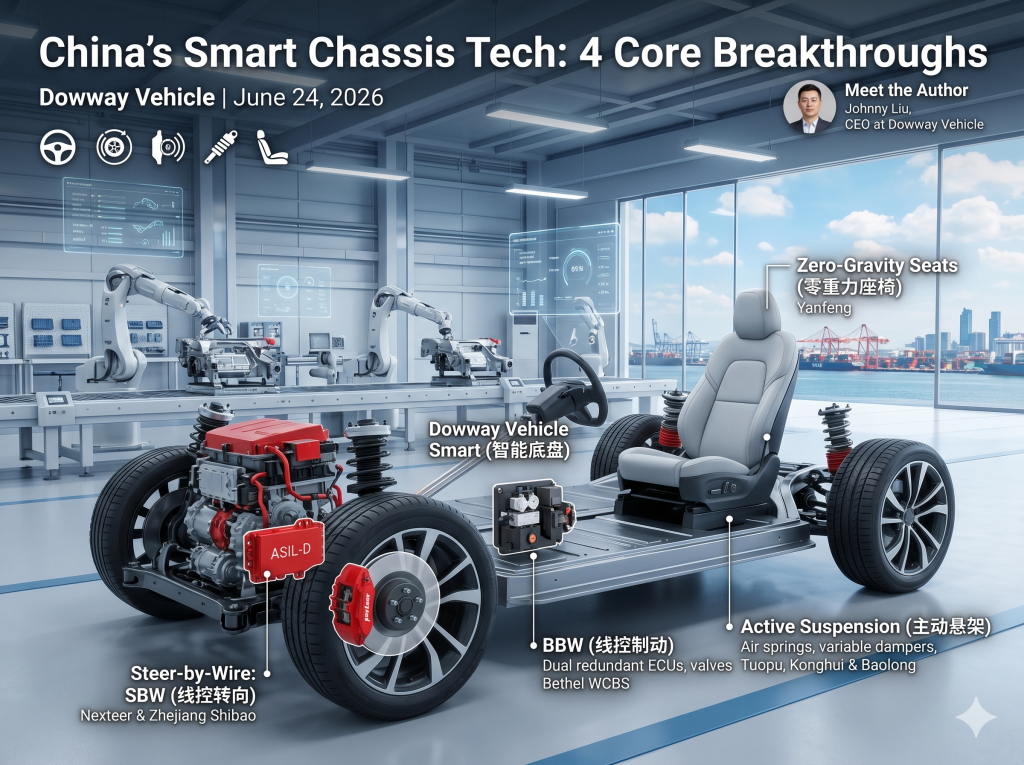
At Dowway Vehicle, we are watching a huge shift. Local Chinese brands are breaking through foreign monopolies in four big areas: Steer-by-Wire (SBW), Brake-by-Wire (BBW), Active Suspension, and Zero-Gravity Seats. Here is a clear look at what is happening on the ground.
Table of Contents
1. Steer-by-Wire (SBW): Steering Without a Steering Column
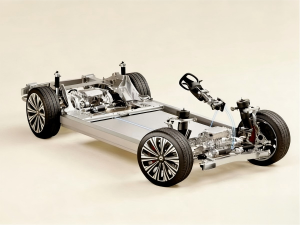
Steer-by-Wire (线控转向) removes the physical connection between the steering wheel and the front tires. Sensors send electrical signals to motors that turn the wheels. This setup allows developers to change steering ratios on the fly and even fold the steering wheel away during self-driving modes.
+------------------+       Signals       +---------------------------+       Signals         +--------------------+
|  Steering Wheel  | ------------------> |  Safety-Grade ECU (ASIL-D) | -------------------> | Dual Motors & Rack |
|                  |                     |     & Control Algorithm   |                       |                    |
+------------------+                     +---------------------------+                       +--------------------+
The Upstream Bottleneck
Building an SBW system is hard. You need three things:
- Safety-grade ECUs
- High-power steering motors
- High-precision torque and angle sensors
Bosch and ZF held a tight grip on these components for years.
The Local Challengers
To compete, local suppliers must write complex control algorithms and meet ASIL-D standards—the highest level of functional safety in cars.
- Zhejiang Shibao (浙江世宝): This is China’s core benchmark brand. Their SBW systems are highly mature and ready for market replacement.
- Nexteer China (耐世特): Backed by state scale, Nexteer has the strongest mass-production lines in the country.
- The New Wave: Brands like Nasen Tech (拿森科技), Jingwei Hirain (经纬恒润), UAES (联电科技), and Honeycomb Transmission (蜂巢传动) are building their own safety-redundant setups and custom algorithms.
2. Brake-by-Wire (BBW): Faster Stopping Times for Smart Cars
Standard brakes take 300 to 500 milliseconds to clamp down. Brake-by-Wire (线控制动) cuts that down to under 150 milliseconds, which is vital when a self-driving car needs to avoid a sudden hazard.
The industry uses two paths:
- Electro-Hydraulic Braking (EHB): Uses electronics to build pressure but keeps a hydraulic backup. This is the main setup today.
- Electro-Mechanical Braking (EMB): A dry, purely electronic system. It has no brake fluid at all and uses electric calipers to squeeze the brake discs.
       EHB (Current standard with fluid)           EMB (Next-gen dry system)
    [Pedal] -> [ECU] -> [Hydraulic Pump]          [Pedal] -> [ECU] -> [Electric Caliper]
Upstream Progress
Chinese firms have successfully localized simple mechanical parts and sensors. Now, they are successfully building complex brake ECUs and high-pressure hydraulic valves.
The Sales Leader
Bosch is still the market leader, but local suppliers are shipping massive volumes.
- Bethel (伯特利): Bethel is the clear winner here. Their self-developed One-Box system, the WCBS (Weststar Control Braking System), is a major success. In 2025, Bethel shipped over 3.2 million sets of line-controlled brakes, taking the top market share among domestic suppliers.
- Tongyu (同驭汽车), Nasen Tech (拿森科技), and Globot (格陆博): These teams offer both One-Box and Two-Box setups to fit different car designs.
- EMB Explorers: Coordinate Intelligent (坐标系智能) and Times Intelligent (时代智能) are skipping EHB and going straight to next-gen EMB systems.
3. Active Suspension: Keeping the Car Level
Active suspension (主动悬架) adjusts vehicle height, damping, and stiffness in real-time. It keeps the car flat during fast turns and stops the nose from diving when you hit the brakes.
There are three main types:
- CDC (Continuous Damping Control): Adjustable oil dampers.
- MRC (Magnetorheological Suspension): Uses magnetic fluid to change damper stiffness instantly.
- Full Active Electro-Hydraulic Suspension: The most advanced system, which can lift each wheel independently.
               +----------------------------------------+
               |      Chassis Domain Controller         |
               +----------------------------------------+
                                   |
         +-------------------------+-------------------------+
         |                         |                         |
         v                         v                         v
  [Air Springs]               [CDC / MRC Dampers]      [Core Control Units]
The Market Shares
China can now produce its own air springs, variable dampers, and ECUs. The market is highly consolidated.
- The Big Three: In 2025, Tuopu Group (拓普集团), Konghui Tech (孔辉科技), and Baolong Tech (保隆科技) took 90% of the domestic air suspension market.
- Software and Motors: Innofit (英诺菲特) and Angchuang Tech (昂创科技) focus on suspension control systems, while Dechang Motor (德昌电机) makes the electric motors for magnetic suspensions.
- Premium Projects: Konghui Tech and Tuopu Group worked directly with Nio and Zeekr to launch their full active suspension setups.
4. Zero-Gravity Seats: Premium Seating Made in China
A zero-gravity seat (零重力座椅) reclines the occupant to a specific 120-to-128 degree angle. This position distributes body weight evenly, reducing pressure on the spine and neck.
The supply chain for these seats in China is incredibly mature.
  +----------------------------------------------------------------------------+
  |                   Zero-Gravity Seating Supply Chain                        |
  +----------------------------------------------------------------------------+
         |                                                              |
         v (Upstream Components)                                        v (System Integration)
  Double Ring (双环传动) - Ball Screws                          Yanfeng (延锋) - Full Assembly
  Jiangsu Lei Li (江苏雷利) - Small Motors                      (Competes with Lear, Adient, Faurecia)
  Zhongda Leader (中大力德) - Gearboxes
Upstream and Midstream Domination
- Double Ring (双环传动): Supplies high-precision ball screws (滚珠丝杠) for smooth, quiet movement.
- Jiangsu Lei Li (江苏雷利) and Zhongda Leader (中大力德): Make the quiet, high-torque electric motors that tilt the seats.
- Yanfeng (延锋): The top seat integrator in China. They compete directly with global giants like Adient, Lear, Faurecia, and Toyota Boshoku.
These seats are getting smarter too. They now include health monitors, automatic posture correction, and haptic feedback alerts. In 2025, zero-gravity seats reached an 18% market penetration rate in Chinese passenger cars.
The Supply Chain Matrix
| Technology | Top Global Competitors | Key Chinese Suppliers | Localized Components | 2025 Market Figures |
| Steer-by-Wire | Bosch, ZF, JTEKT | Zhejiang Shibao, Nexteer, Nasen, Jingwei Hirain | ASIL-D ECUs, angle sensors | Moving to mass-production testing |
| Brake-by-Wire | Bosch, Continental, ZF | Bethel, Tongyu, Nasen, Globot, Saimo, Times Intelligent | Hydraulic valves, brake ECUs, EMB calipers | Bethel WCBS shipped over 3.2 million sets |
| Active Suspension | Continental, Bilstein, Tenneco | Tuopu, Konghui, Baolong, Innofit, Angchuang, Dechang | Air bags, damper valves, MRC motors | Tuopu, Konghui, and Baolong took 90% market share |
| Zero-Gravity Seats | Adient, Lear, Faurecia, Toyota Boshoku | Yanfeng, Double Ring, Jiangsu Lei Li, Zhongda Leader | Ball screws, micro motors, gearboxes | Hit 18% market penetration rate |
Three Key Trends and Our Main Hardships
Looking ahead, we see three clear paths for the smart vehicle market:
1. Unified Chassis Control (VMC)
We are moving away from separate black boxes. Steer-by-wire, brake-by-wire, and active suspension are joining under a single Chassis Domain Controller. This system coordinates steering, braking, and suspension to keep the car steady under all driving conditions.
2. Lower Costs
As production scales up, prices are dropping. Luxury features like air suspension and zero-gravity seats are moving from $40,000 cars down to models in the $15,000 to $25,000 range.
3. True Independence
Chinese suppliers are moving from simple part assembly to owning the core IP. This includes raw materials, chips, and the software control code.
The Hardships We Still Face
We must be realistic. There are still three major hurdles:
- Safety Standards: Creating highly redundant safety systems that meet strict international ASIL-D standards in every situation is very difficult.
- Core Patents: Foreign Tier-1s still hold many basic design patents on valves and mechanical layouts.
- Supply Chain Teamwork: Getting software engineers, chip makers, and mechanical parts builders to work together smoothly remains a challenge.
At Dowway Vehicle, we believe the next two to three years will decide the layout of the global car industry. Chinese suppliers have broken the old monopolies, and they are ready to scale globally.
FAQ: Questions & Answers
Q1: What is the difference between EHB and EMB in brake-by-wire?
A: EHB uses hydraulic fluid with an electronic pump, while EMB is a completely dry system that uses electric motors to squeeze the brakes. EHB acts as a transition technology that keeps a physical backup. EMB completely removes all hydraulic lines and fluid, using direct electric wires to control calipers at each wheel.
Q2: Who are the top air suspension suppliers in China?
A: Tuopu Group, Konghui Tech, and Baolong Tech are the dominant air suspension suppliers in China. In 2025, these three companies combined to control 90% of the domestic air suspension market.
Q3: How common are zero-gravity seats in Chinese cars now?
A: Zero-gravity seats are now installed in nearly one in every five passenger vehicles sold in China. By the end of 2025, these advanced comfort seats reached an 18% market penetration rate.
Q4: Why is Steer-by-Wire harder to build than traditional steering?
A: Because it has no physical connection, Steer-by-Wire requires expensive backup systems to ensure the car can still steer if the power fails. This means engineers must build triple-redundant architectures and use high-end ASIL-D certified control units.
What do you think about the shift in the car supply chain? Will Western Tier-1 brands hold onto their lead in the global market, or will Chinese suppliers take over? Let me know your thoughts in the comments below!