




- Author: Johnny Liu, CEO at Dowway Vehicle
- Published: June 29, 2026
- Read Time: 8 minutes
- Target Audience: Automotive Engineers, Chassis Dynamics Specialists, Control Theory Students
- Topics: #ChassisDynamics #SemiActiveSuspension #VehicleControl #Skyhook #H-Infinity #ControlAlgorithms
Table of Contents
Quick Summary (TL;DR)
Semi-active suspension dynamically changes damper resistance to make it soft or hard based on sensor inputs.
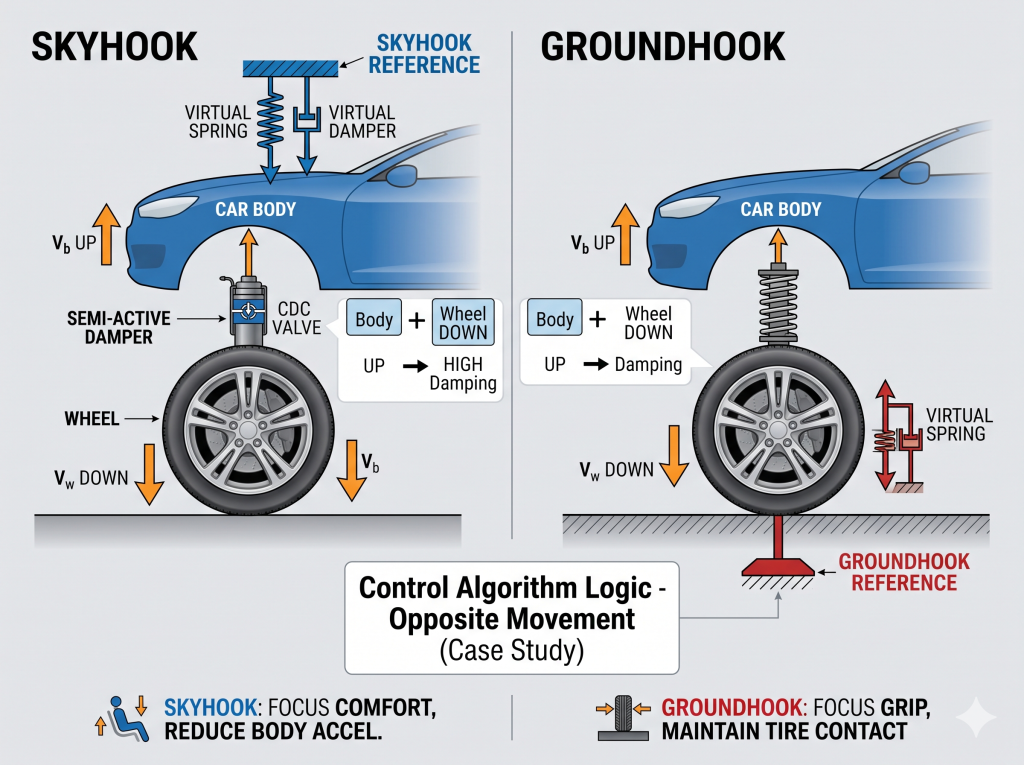
- Skyhook Control focuses on cabin comfort by pretending to tie the vehicle body to a virtual ceiling.
- Groundhook Control targets road grip by pretending to tie the wheels to the ground.
- $H_\infty$ (H-Infinity) Control uses minimax math to handle worst-case road disturbances and parameter variations safely.
1. The Core of Semi-Active Suspension
Let’s lay down a simple truth: the entire point of a semi-active suspension system is to make the damper change between soft and hard in a smart way. Passive suspensions rely on fixed damping rates that always represent a compromise. In contrast, a semi-active suspension uses sensors (like accelerometers and displacement sensors) to track how the road and vehicle body move. The electronic control unit (ECU) runs a control algorithm to calculate the needed damping force at any microsecond. It then commands hardware—like continuous damping control (CDC) valves or magnetorheological (MR) fluids—to change fluid resistance instantly.
The physical hardware does the heavy lifting, but the control algorithm acts as the brain. The major difference between today’s systems lies in how this brain defines “smart” behavior.
2. Skyhook Control: The Comfort Standard
First introduced by Karnopp and his team in 1974, Skyhook Control is still the industry baseline for passenger ride comfort.
The Idea
Imagine a rope hanging from an imaginary, non-moving ceiling directly above the car. Whenever the cabin bounces or shakes, this virtual rope pulls or pushes to hold the car body steady in space.
   [ Virtual Ceiling (Inertial Frame) ]
                 |
                 v  (Virtual Skyhook Damper)
           [ Vehicle Body ]
                 |
           [ Physical Suspension ]
                 |
             [ Wheel ]
======================================== (Road)
By mimicking a damper placed between the vehicle body (sprung mass) and this imaginary ceiling, Skyhook works to minimize vertical cabin acceleration and pitch.
How the Logic Works
The actual physical damper sits between the body and the wheel, meaning it only creates force when there is relative motion between them. Skyhook adjusts the damping rate depending on whether this relative motion can actively fight the absolute motion of the vehicle body.
| Scenario | Body & Wheel Movement Direction | Damping State | Engineering Reason |
| Scenario A | Body moving UP, Wheel moving DOWN (Opposite) | Maximum Damping (Hard) | The body is moving upward; a high damping force helps pull it back down to stabilize it. |
| Scenario B | Body moving DOWN, Wheel moving DOWN (Same direction, but Body is faster) | Maximum Damping (Hard) | The body is falling too fast; high damping helps slow down its downward drop. |
| Scenario C | Body moving DOWN, Wheel moving DOWN (Same direction, but Wheel is faster) | Minimum Damping (Soft) | The wheel is dropping faster than the body. A hard setting would pull the body down aggressively. Keeping it soft lets the spring absorb the movement. |
The math relies on multiplying the body’s absolute velocity ($v_s$) and the relative velocity ($v_s – v_u$) between the body and the wheel:$$\text{If } v_s \cdot (v_s – v_u) \ge 0, \quad F_{\text{damping}} = c_{\text{sky}} \cdot v_s \quad (\text{Firm/Hard})$$$$\text{If } v_s \cdot (v_s – v_u) < 0, \quad F_{\text{damping}} = c_{\text{min}} \cdot (v_s – v_u) \quad (\text{Soft})$$
Pros & Limits
- Advantages:
- Very Simple: It requires low processing power, meaning it runs easily on basic 16-bit or 32-bit automotive microcontrollers.
- Good Results: It cuts the Root-Mean-Square (RMS) of vehicle body acceleration by more than 30% compared to a passive setup.
- Low Energy Use: It only draws about ~50 Watts of power to run all four dampers.
- Limits:
- Neglects Tire Grip: Since Skyhook only cares about keeping the cabin flat, it does not manage dynamic tire loads, which can hurt road grip during fast moves.
- High-Frequency Harshness: At frequencies between 5 and 10 Hz, high Skyhook coefficients ($c_{\text{sky}}$) can worsen vibrations, sending a buzzy harshness into the cabin.
3. Groundhook Control: The Grip-Focused Alternative
While Skyhook looks upward to stabilize the cabin, Groundhook Control looks downward to maximize tire grip.
The Idea
Instead of tying the car body to the sky, imagine a virtual rope pulling the wheels down toward the road. The main goal here is to keep the tires pressed firmly against the asphalt, ensuring better road-holding, cornering, and braking.
How the Logic Works
Groundhook focuses on wheel stability (unsprung mass). It commands high damping only when the suspension’s relative motion can be used to stop the wheel’s absolute vertical bouncing:$$\text{If } -v_u \cdot (v_s – v_u) \ge 0, \quad F_{\text{damping}} = c_{\text{ground}} \cdot v_u \quad (\text{Firm/Hard})$$$$\text{If } -v_u \cdot (v_s – v_u) < 0, \quad F_{\text{damping}} = c_{\text{min}} \cdot (v_s – v_u) \quad (\text{Soft})$$
- Scenario 1 ($|v_s| > |v_u|$ in opposite directions): Damping goes to Maximum (Hard). The body is moving a lot while the wheel lags. Stiffening the damper pulls the wheel along to keep it planted.
- Scenario 2 ($|v_s| \le |v_u|$): Damping drops to Minimum (Soft). The wheel is handling rapid road vibrations on its own; decoupling it from the body prevents these impacts from shaking the cabin.
Finding the Sweet Spot
Setting the Groundhook damping coefficient too high will hurt performance. Engineers aim for a specific target value ($C_{\text{opt}}$) that keeps the wheel close to its critical damping point:$$C_{\text{opt}} \approx 2 \sqrt{m_s \cdot k_s}$$
Where $m_s$ is the sprung mass (vehicle body mass at that corner), and $k_s$ is the suspension spring stiffness.
4. Head-to-Head: Skyhook vs. Groundhook
| Metric | Skyhook | Groundhook |
| Virtual Connection | An imaginary “ceiling” | The road surface |
| Primary Goal | Body stability $\rightarrow$ Ride Comfort | Tire contact force $\rightarrow$ Handling & Safety |
| Frequency Target | Best for low-frequency body bounce (1-2 Hz) | Best for high-frequency wheel hop (10-15 Hz) |
| Key Benefit | Cuts body acceleration RMS by 15% to 25% | Keeps dynamic tire load steady for reliable grip |
The Real-World Solution: Hybrid Control
Because ride comfort and tire grip conflict with each other, choosing one means losing some of the other. To fix this, chassis engineers use Hybrid Control to blend the two methods.
The hybrid damping force ($F_{\text{hybrid}}$) uses a basic weighting formula:$$F_{\text{hybrid}} = \alpha \cdot F_{\text{Skyhook}} + (1 – \alpha) \cdot F_{\text{Groundhook}}$$
By shifting the weight factor $\alpha$ (from 0 to 1) in real-time, the ECU changes the car’s handling feel:
- Highway Cruising: The system dials $\alpha \rightarrow 0.8$ for a comfortable, smooth ride.
- Aggressive Cornering/Braking: The system dynamically sweeps $\alpha \rightarrow 0.2$ to keep the tires glued to the road.
5. $H_\infty$ (H-Infinity) Control: Designed for the Worst Case
Skyhook and Groundhook are simple, intuitive rules. $H_\infty$ Control, however, relies on mathematical optimization to handle uncertainty.
The Philosophy
Think of Skyhook as an experienced driver who reacts based on muscle memory. $H_\infty$ is a survival expert. This controller does not care if the road gets incredibly rough, or if the car’s weight changes when passengers climb in. It uses math designed to guarantee that the vehicle’s performance never drops below a safe, acceptable level.
   Traditional Rules (Skyhook) ---------> Optimizes for expected road conditions
   Robust H-Infinity Control   ---------> Limits the worst-case road impacts
The Math: Minimax Optimization
The $H_\infty$ norm represents the maximum peak value of a system’s frequency response. Therefore, $H_\infty$ control is a Minimax (minimum-maximum) design: it works to minimize the worst possible impact that external disturbances can have on the vehicle.
Let:
- $w$ be the external disturbances (rough road profiles, payload changes, or aging suspension parts).
- $z$ be the performance outputs we want to keep small (cabin acceleration, suspension travel, dynamic tire load).
- $T_{zw}$ be the transfer function mapping the disturbance $w$ to the performance output $z$.
The controller $K$ is designed to keep the $H_\infty$ norm of $T_{zw}$ below a specific safety limit $\gamma$:$$\|T_{zw}\|_{\infty} = \sup_{w \neq 0} \frac{\|z\|_2}{\|w\|_2} < \gamma$$
This means that even in the worst-case road scenario ($w$), the disturbance is cut by a factor of at least $\gamma$ before it ever reaches the passengers ($z$).
The Calculation Setup
We model the suspension system using a standard State-Space format:$$\dot{x}(t) = A x(t) + B_1 w(t) + B_2 u(t)$$$$z(t) = C_1 x(t) + D_{11} w(t) + D_{12} u(t)$$$$y(t) = C_2 x(t) + D_{21} w(t) + D_{22} u(t)$$
Here, $x(t)$ represents the states of the system (like displacements and velocities), $u(t)$ is the damping force command, and $y(t)$ is the actual sensor reading.
The controller gain matrix $K$ is solved offline using the Algebraic Riccati Equation (ARE) or Linear Matrix Inequalities (LMI):$$A^T P + P A + P \left( \frac{1}{\gamma^2} B_1 B_1^T – B_2 B_2^T \right) P + C_1^T C_1 = 0$$
Once we find the positive-definite matrix solution $P$, the feedback gain $K$ is simple:$$K = -B_2^T P$$
The car’s ECU simply runs $u(t) = K x(t)$ in real-time, which keeps the onboard processing load very light.
6. $H_\infty$ Control vs. LQR (Linear Quadratic Regulator)
Both are optimal control methods, but they rely on different core assumptions.
| Feature | LQR (Linear Quadratic Regulator) | H∞ Robust Control |
| Model Accuracy | Needs a highly accurate, perfect physical model. | Expects model errors, spring aging, and load changes. |
| Noise & Disturbances | Assumes random, predictable Gaussian white noise. | Works with unknown but bounded real-world road bumps. |
| Optimization Goal | Average Optimal: Minimizes average energy loss over time. | Worst-Case Optimal: Limits the maximum possible system failure. |
| Robustness | Moderate. Performance drops if the car’s weight changes. | Excellent. Stays stable even with massive payload variations. |
What the Research Shows: Studies confirm that when passenger loads change (which alters $m_s$ significantly), $H_\infty$ performs much better than LQR by keeping the ride comfortable and stable without needing to be manually retuned.
7. Real-world Implementation: What is Used on the Road?
At Dowway Vehicle, we balance these algorithms when designing production chassis systems:
- Skyhook & Hybrid Control: These run on more than 95% of production passenger cars with adjustable dampers (like CDC or Magnetic Ride). They require little processing power, use standard, affordable accelerometers, and provide the immediate, smooth ride quality that buyers expect.
- $H_\infty$ Control: While historically seen as too complex for standard automotive ECUs, $H_\infty$ is used in high-speed trains, aerospace landing gear, and heavy-duty industrial dampers. As car computers become more powerful, we are beginning to see robust $H_\infty$ controllers deployed in premium vehicles designed to tackle unpredictable off-road terrain.
FAQ
Q1: Can a standard passenger car with CDC run H-infinity control via an over-the-air (OTA) software update?
Johnny Liu: No, it requires specific hardware calibration and faster processors. While the physical dampers can execute the commands, $H_\infty$ relies on a detailed state-space model of the specific chassis. This requires accurate sensor calibration and more computing power than standard passive-to-active conversions can offer.
Q2: Why is Groundhook rarely used on its own?
Johnny Liu: Because it makes the cabin ride extremely harsh. Groundhook focuses solely on keeping the tires pressed against the road. If used alone, it passes almost all the road shock straight into the vehicle body, making the ride feel like a stiff, uncomfortable race car. That is why it is almost always mixed with Skyhook using a hybrid approach.
Q3: How does temperature affect these control systems?
Johnny Liu: It changes the oil thickness in the dampers, altering the actual force output. This oil thinning or thickening creates model errors. This is why $H_\infty$ is so useful; its robust design mathematically accounts for these physical changes, keeping the car safe and stable even as temperatures fluctuate.
About the Author
Johnny Liu is the CEO of Dowway Vehicle, a developer of active damping systems and smart chassis control technology. With years of hands-on automotive engineering experience, Johnny focuses on building robust, intelligent suspension controllers for next-generation passenger vehicles.
Do you prefer the simplicity of Skyhook or the robustness of $H_\infty$? Let’s discuss in the comments below!