



- Author: Johnny Liu, CEO at Dowway Vehicle
- Date: June 30, 2026
If you had to pick the single most difficult sub-system within the drive-by-wire chassis family, it is easily Steer-by-Wire (SBW).
The reason is simple: steering directly decides where the vehicle goes.
If your brakes stop working, you can still pull the electronic parking brake or let the car coast to a slow stop. But if your steering fails at 120 km/h on a highway, you have no way to guide the car around a curve. Steering is the single vehicle function that requires the highest level of safety.
This guide breaks down Steer-by-Wire from top to bottom. We will look at how steering evolved from heavy steel shafts to digital code, how the cockpit and wheel units share the work, how feedback motors mimic real road feel, how redundant designs protect you, and what happens when things go wrong.
Table of Contents
The Evolution of Steering Systems: From Mechanical to Code
The history of steering is a story of slowly cutting the physical link between the driver’s hands and the road. This journey spans three major eras.
1. Pure Mechanical Steering (MS) (1886 – 1990s)
For over a century, the steering wheel was physically locked to the front tires.
- The setup: The steering wheel connects directly to the wheels through a solid metal shaft, universal joints, and a gear rack.
- The feel: Every degree you turn the wheel moves the tires by a matching physical angle. It is direct and has zero lag, but you have to supply all the turning power yourself. In old heavy trucks without power steering, turning the wheel while parked was a heavy workout that could build serious biceps.
- Pros and Cons: The upside is total reliability—if the steel shaft does not snap, you can turn the vehicle. The downsides are heavy physical effort, zero tuning options, and no way for computer safety systems to help.
2. Electric Power Steering (EPS) (1990s – Present)
To make steering easier, engineers added electric assistance.
- The setup: The physical steering column remains, but an electric assist motor is mounted to the column or the steering rack. This motor helps turn the wheels based on how hard and fast you turn the steering wheel.
- Key milestones: EPS brought three big updates to modern cars:
- Easy handling: Drivers can spin the wheel of a heavy SUV using a single finger.
- Speed-sensitive feel: The steering stays light for easy parking, but gets heavier at high highway speeds for better control.
- L2 Lane Assist: Lane Keeping Assist works because the car’s computer sends torque signals to the EPS motor, micro-adjusting the path without you having to turn the wheel yourself.
- The limit: Despite this helper motor, the physical connection is still there. The steering wheel must spin whenever the front tires turn. You cannot separate them.
3. Steer-by-Wire (SBW) (2013 – Future)
Steer-by-Wire breaks this physical connection completely.
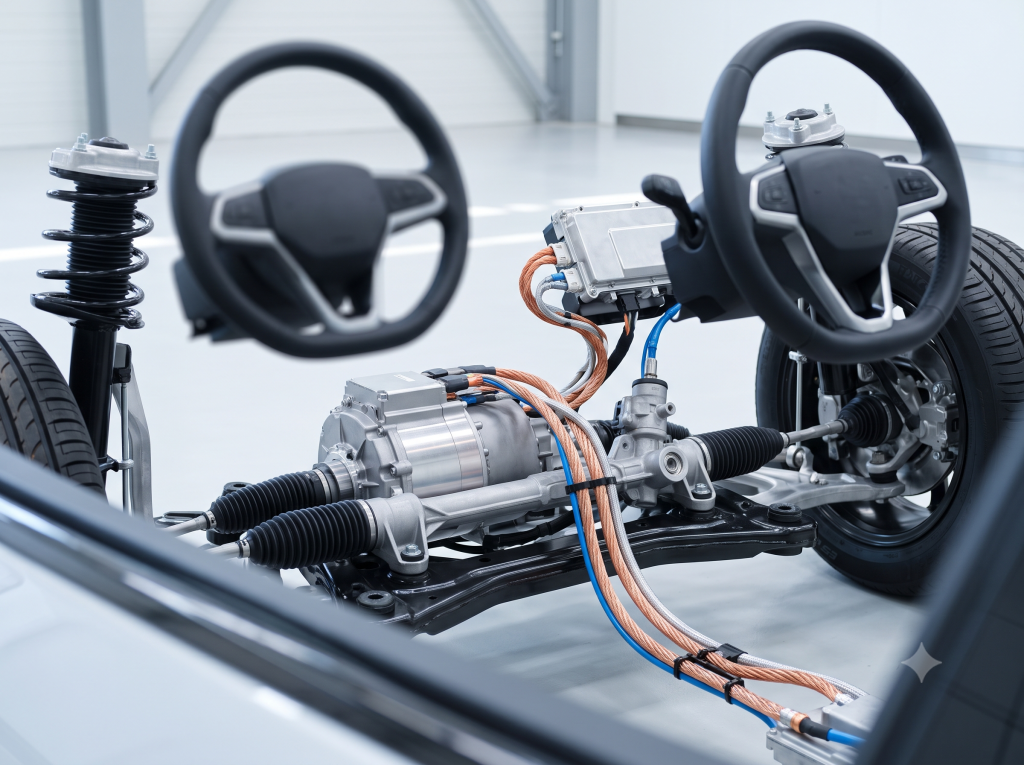
- The setup: The physical shaft between the steering wheel and the front wheels is gone. The cabin holds only sensors and a feedback motor. The wheel axle uses an independent steering motor. The two sides communicate purely through digital signals sent over fast data buses and wiring.
- Why it matters: Because there is no physical shaft, the steering wheel can stay completely still during autonomous highway driving, fold into the dashboard to give you more room, or let the car’s computer steer on its own while the physical tires handle the road.
The Dual-Decoupled Setup: Handwheel vs. Roadwheel
In an SBW system, steering is split into two separate halves that only talk to each other through data lines.
1. The Handwheel (Feedback) Side
Located inside the cabin, this is what you interact with.
- Key parts: Angle and torque sensors, a road feel motor, and a dedicated control unit (ECU).
- The job: It tracks exactly how fast, how far, and how hard you turn the steering wheel, turning those movements into digital data packets. At the same time, it pushes back against your hands to give you a natural sense of resistance.
2. The Roadwheel (Execution) Side
Located down on the front axle, this is what does the heavy lifting.
- Key parts: A high-power steering motor, a gear rack, tie rods, and an execution control unit (ECU).
- The job: It receives the digital signals from the cabin or the automated driving computer and uses its motor to turn the tires to the exact angle requested.
Quick Comparison: Feedback Unit vs. Execution Unit
| Feature | Feedback Unit (Cabin) | Execution Unit (Axle) |
| Main Hardware | Sensors, feedback motor, cabin ECU | High-power motor, gear rack, axle ECU |
| Main Job | Reads driver inputs and creates steering feel | Receives commands and physically turns tires |
| Control Source | Your hands and arms | Cabin sensors OR automated driving computer |
| Physical Path | Disconnected from the tires | Disconnected from the steering wheel |
The Value of Separation
Because these two halves are physically separate, they do not have to copy each other’s movements exactly. For example, if the car needs to make an aggressive, high-speed lane change to avoid an accident, the wheels can turn instantly while the steering wheel in your hands stays perfectly still. In an old EPS car, a sudden turn like that would violently jerk the steering wheel out of your hands, which could cause injury or panic.
Simulating Realistic Road Feel
A common question is: “If there is no physical metal connection, doesn’t steering feel like a cheap video game?”
The answer is: Yes, the feel is manufactured. But with smart software, this simulated feedback can feel just as real as a physical setup—and in some ways, even better.
Active Feedback vs. Passive Feedback
In a standard mechanical car, you get passive road feel. Every bump, pothole, or patch of ice sends a physical shock up the column into your hands. This can be tiering, causing constant vibration and wheel fight.
Steer-by-Wire uses active feedback. It measures road forces and uses software to build a custom resistance profile. The cabin feedback motor calculates exactly how hard to push back by blending five real-time signals:
- Steering Wheel Angle & Speed: This creates the basic self-centering force. The further you turn, the harder the wheel pushes back to center itself.
- Vehicle Speed: This keeps steering light and easy when parking, but makes it firm and heavy at high speeds so the car does not feel twitchy.
- Execution Motor Current: By checking how much electrical current the front axle motor is pulling, the computer knows exactly how much physical resistance the tires are facing on the ground.
- Lateral Acceleration: As the car pulls g-forces through a corner, the system increases the resistance on your steering wheel to mimic the cornering load.
- Tire Slip Limits: If the front tires start to lose grip, the system detects this slide and lightens the steering resistance. This gives your hands an instant, natural warning that you are running out of traction.
Software-Tuned Driving
Because the steering feel is generated by code, the same physical parts can behave in completely different ways. Through simple software changes, engineers can make the car feel like a firm, heavy, sport-tuned German sedan, or a light, soft luxury cruiser. You can even swap between these profiles using a button on your dashboard or through an over-the-air update.
Early attempts had learning curves. Infiniti’s Direct Adaptive Steering (DAS), which came out in 2013 on the Q50, was criticized for feeling numb and disconnected. That was not a problem with the idea itself, but with the early software tuning. Modern systems on vehicles like the Tesla Cybertruck and the NIO ET9 prove how far the technology has come—drivers and reviewers find these new systems just as good, or even better, than traditional steering.
Safety Systems: Dual and Triple Redundancy
Because a physical metal shaft no longer exists to back you up, Steer-by-Wire systems rely on heavy electrical and computing redundancy.
The safety motto changes from “the solid steel rod will not break” to “if any single wire or computer fails, the backup system takes over instantly.”
Here are the three main ways manufacturers build this safety net:
1. Dual Redundancy (1oo2D)
- The design: This setup uses two separate computer controllers, two independent motor windings, and two isolated power sources. Both channels watch each other constantly for errors.
- When a fault happens: Normally, both channels work together to share the load. If one channel fails completely, the system shuts it down, and the healthy backup channel carries on with at least 50% of the steering power. That is more than enough to safely steer and slow down on the highway.
- Where it is used: L3 automated driving and premium passenger cars.
2. Triple Redundancy (2oo3)
- The design: This uses three independent controllers, three motor windings, three separate power supplies, and a voting computer.
- When a fault happens: If one channel starts sending bad data, the other two channels outvote it. The bad channel is ignored, and the car keeps steering with at least 66% capacity. Even if two separate parts fail in different areas, the car can still steer normally.
- Where it is used: L4 and L5 self-driving vehicles and robotaxis.
3. Mechanical Backup
- The design: This keeps a physical steering column in place but puts an electromagnetic clutch in the middle.
- When a fault happens: During normal driving, the clutch stays open so the system operates as pure steer-by-wire. If the electrical system fails completely, power to the clutch cuts out, a spring forces it to lock shut, and you are back to standard physical steering.
- Why the industry is moving away from this: While it sounds safe, it has two major flaws. The clutch itself is a mechanical part that can wear out or jam. More importantly, keeping the physical steering shaft means you lose all the space and packaging advantages of steer-by-wire—you cannot fold the wheel away, and it still takes up heavy space under the hood. Most developers agree that pure electrical redundancy is the best path forward.
6 Common Failure Modes and Safety Actions
What happens when specific parts actually stop working? The table below shows how the system handles different problems to keep the car under control:
Fault Handling Matrix
| # | What Fails | What Happens Physically | How the Car Responds |
| 1 | Single ECU Controller Failure | One steering computer stops working or sends bad data. | The system instantly hands full control to the second, identical backup ECU. The car keeps steering normally but displays a warning. |
| 2 | Single Power Source Loss | A wire breaks or a battery loop fails. | The second backup battery or independent power line takes over immediately, keeping steering active in a low-power mode. |
| 3 | Angle Sensor Failure | The sensor reading the steering wheel angle stops working. | The system reads data from a second sensor channel, compares the values to confirm the error, and uses the clean data. |
| 4 | Execution Motor Lock | The physical turning motor jams, or the gear rack on the axle gets stuck. | Chassis Integration: If the wheels are locked straight, the car’s main computer uses the brakes and drive motors to help. It brakes the inner wheels and adds power to the outer wheels, using torque differences to steer the car safely to the side of the road. |
| 5 | Communication Line Failure | The data line between the cabin and the axle goes dead. | The system instantly switches to a backup physical data path (such as swapping from a main CAN FD line to a backup Ethernet link). |
| 6 | Total System Failure | A rare, extreme event where all backup systems fail at once. | The car initiates an automatic emergency stop, turns on the hazard lights, and brings the vehicle to a safe halt. |
The Power of Chassis Integration
Failure Mode #4 shows one of the best parts of modern drive-by-wire platforms: cross-domain collaboration. In a traditional car, if your steering rack physically jams, the car can only go straight. The brakes and engine cannot help you steer.
With a fully connected by-wire chassis, the brakes and motors can act as backup steering systems. By slowing down the tires on one side and speeding up the other, the car can generate enough turning force to get you safely off the road.
The Road Ahead
Steer-by-Wire is the ultimate step in chassis engineering. It is an all-or-nothing technology—unlike braking, which could transition slowly through semi-electric setups, steering must either be physical or completely digital.
This high bar explains why SBW took ten years longer than by-wire braking to hit the mainstream market:
- 2013: Infiniti released the Q50, showing off the first semi-by-wire setup with a mechanical clutch backup.
- 2023: Tesla launched the Cybertruck, the first mass-market vehicle with a 100% pure Steer-by-Wire system and zero physical backup.
- 2024: NIO introduced the ET9, marking China’s first premium production vehicle with a fully redundant, pure Steer-by-Wire setup.
At Dowway Vehicle, we are watching this shift closely. Removing the steering column is not just about replacing metal shafts with copper wires; it is about rewriting how we design cabins, how we protect passengers, and how we build the future of automated transport.
Frequently Asked Questions (FAQ)
Q1: Can a Steer-by-Wire system still steer the car if the main 12V vehicle battery dies?
Yes. Redundant SBW systems use isolated dual-power setups. They carry an auxiliary backup battery or capacitor pack dedicated only to steering. If your main car battery dies, this backup supply kicks in instantly to help you steer safely to a stop.
Q2: Does the Tesla Cybertruck have a physical steering shaft?
No. The Tesla Cybertruck does not have a steering shaft or any physical connection between the steering yoke and the front tires. It is a pure Steer-by-Wire system. The physical turning of the wheels is handled entirely by electric motors on the steering rack.
Q3: How does Steer-by-Wire help self-driving cars?
It allows the steering wheel to stay still or fold away. In standard cars, a self-driving system has to physically spin the steering wheel in the cabin, which wastes energy, adds delay, and can startle passengers. With SBW, the automated system sends silent digital commands straight to the front wheels, leaving the steering wheel completely quiet and still inside the cabin.
In our next post, we will look at Electronically Controlled Braking Systems (EHB) and One-Box Architectures. We will explore how braking systems moved from old vacuum helpers to smart, integrated hydraulic designs. Stay tuned!