




Choosing an electric car wheel hub motor starts with the vehicle’s loaded mass, tire radius and operating cycle. Peak power is only one part of the decision. A motor must produce the required wheel torque at the required speed, reject heat through repeated operation and fit alongside the brakes and suspension.
Passenger and commercial vehicle motors must meet automotive wheel loads and integration requirements. Bicycle and scooter hub motors belong to a different application category.
Establish the wheel-end architecture
An in-wheel motor places the drive unit within the wheel envelope. Some products use direct drive; others include reduction gearing. An integrated electric wheel may also contain braking hardware, bearings or other wheel-end components.
Check exactly what the supplier includes. A motor-only specification and a complete electric wheel specification can describe different output locations, masses and responsibilities. In particular, confirm whether quoted torque and speed are measured at the motor shaft or at the wheel output.
Explore Dowway’s wheel hub motor range for products and customization inquiries. Compare each model’s output curves and installation requirements with the vehicle brief.
Define the vehicle duty cycle
Record the maximum operating mass, axle loads and loaded tire rolling radius. Add the required top speed, acceleration target and grade conditions. For hill climbing, specify the gradient, travel speed, duration and starting requirement.
A delivery vehicle that stops frequently has a different thermal duty from a vehicle traveling steadily at the same average speed. Include ambient temperature, cooling conditions, road surface and the time spent at each operating point. Regenerative braking also adds operating points to the motor and inverter load cycle.
Calculate wheel speed
For an initial estimate, wheel speed is:
wheel speed (rpm) = 60 × vehicle speed (m/s) / (2 × π × rolling radius (m))
For an illustrative vehicle traveling at 60 km/h with a 0.30 m rolling radius, the wheel speed is approximately 531 rpm. This is a calculation example, not a Dowway product rating.
Use the tire’s loaded rolling radius. Rim diameter alone is insufficient because it excludes the tire profile. If the unit contains a reducer, apply its ratio when comparing wheel speed with motor speed.
Calculate tractive force and wheel torque
A simplified longitudinal force estimate is:
required force = m × a + m × g × sin(slope angle) + Crr × m × g × cos(slope angle) + 0.5 × air density × CdA × speed²
The terms represent acceleration, climbing resistance, rolling resistance and aerodynamic drag. Here, m is operating mass, a is acceleration, g is gravitational acceleration, Crr is the rolling resistance coefficient and CdA is drag coefficient multiplied by frontal area.
For an initial equal-sharing estimate:
torque per driven wheel = required force × rolling radius / number of driven wheels
If torque is specified upstream of a reduction gear, account for gear ratio and losses. Vehicle traction, axle load transfer and unequal wheel loading can constrain how much of the calculated torque is usable.
Consider an illustrative 1,500 kg vehicle with two driven wheels and a 0.30 m rolling radius, climbing a 10% grade at constant speed. Using Crr = 0.015 and omitting aerodynamic drag for this low-speed estimate gives approximately 1,684 N total force, or 253 N·m at each driven wheel. A 10% grade means a slope angle of arctan(0.10).
This calculation excludes acceleration, driveline losses and design allowance. Compare the operating point and required duration with the supplier’s continuous torque-speed envelope under the intended cooling conditions.
Compare continuous and peak ratings
Peak torque supports short events such as launch or a brief acceleration. Continuous torque determines whether the unit can sustain a duty without exceeding its thermal limits. The supplier should state the duration, starting temperature, voltage and cooling conditions behind each rating.
Read the torque-speed curve with the power curve. Torque and power relate through power = torque × angular speed. Maximum torque, maximum speed and peak power usually occur at different operating points; multiplying the separate maxima does not describe a valid operating condition.
Ask for efficiency information over the operating region the vehicle will actually use. A single maximum efficiency value cannot predict energy consumption over a route.
Check voltage, inverter and cooling compatibility
Compare the complete battery operating range with the motor and inverter limits. Include low state of charge, voltage sag, regenerative charging voltage and transient conditions. Confirm current limits and the controller’s ability to supply the requested torque at each speed.
For a liquid-cooled unit, agree on coolant type, inlet temperature, flow and pressure drop. For other cooling arrangements, define the available airflow or conductive heat path. Wheel-end cooling hoses and electrical cables must accommodate steering and suspension movement while remaining protected from road debris.
Assess wheel-end mass and mechanical fit
Moving drive hardware into the wheel can increase unsprung mass. The effect on tire contact, ride and component loads depends on the complete suspension and wheel assembly. Evaluate it with the intended tires, damping and road conditions.
Compare the assembled wheel end, including any hardware removed from the original design. Ask for installation drawings and mass definitions before concluding that one layout is lighter.
Check rim clearance, wheel offset, bearing loads and mounting interfaces. Include brake packaging, service access and the space needed for connectors or cooling fittings. Regenerative braking depends on the electrical system’s ability to accept energy; the friction brake system still requires its own sizing and validation.
Request the evidence needed to shortlist a supplier
| Area | Request | Decision it supports |
|---|---|---|
| Output performance | Continuous and peak torque-speed curves with conditions | Launch, climbing and sustained operation |
| Thermal performance | Cooling requirements, limits and derating behavior | Duty-cycle suitability |
| Electrical interface | Voltage range, current limits, inverter scope and connections | Battery and controller compatibility |
| Mechanical package | Drawings, installed mass, wheel loads and brake interfaces | Fit and suspension assessment |
| Controls | Command definitions, feedback, diagnostics and fault actions | Vehicle integration |
| Validation | Applicable test reports and their conditions | Environmental and durability requirements |
| Supply scope | Included hardware, development work, samples and support | Quotation comparison |
Treat claims about ingress protection, durability or compliance as model-specific. Request the relevant evidence and confirm whether it applies to the complete supplied assembly.
Match the motor to the application
Passenger vehicles place strong demands on ride, noise and wheel packaging. Commercial vehicles may place more emphasis on sustained climbing, wheel load and maintenance access. Low-speed special-purpose vehicles can have modest top-speed needs while still requiring high launch torque or long periods under load.
The EW-T20000-560 product page describes a heavy-duty electric wheel. Check its published data and component scope against the intended vehicle. Passenger-car selection requires a separate assessment of output, wheel load, mass and packaging.
Send a motor selection brief
Include loaded vehicle mass, axle loads, tire rolling radius, driven wheel count, top speed and grade requirements. Attach the operating cycle, battery voltage range, available cooling and wheel installation envelope. State whether you need a motor, a matched motor and inverter, or an integrated electric wheel.
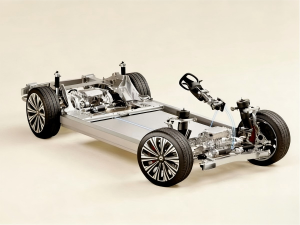
Send Dowway your wheel hub motor requirements. For a broader vehicle platform discussion, review the EV skateboard chassis range.
Frequently asked questions
Is a higher-power hub motor always the better choice?
A higher peak rating can add mass, cost and electrical demand. Choose a unit whose torque-speed and thermal envelopes meet the vehicle duty, then evaluate packaging and integration.
Can an electric car use four wheel hub motors?
A four-motor layout is possible, but it needs suitable power electronics, vehicle control, braking coordination and fault management. It also changes wheel-end packaging and suspension requirements.
Does direct drive eliminate all drivetrain losses?
Direct drive can remove a reduction stage, but losses remain in the motor, inverter, bearings and other components. Compare measured efficiency maps for the actual architectures.
What should I send first for a quotation?
Vehicle mass, tire size, speed and climbing requirements are a useful start. Cooling, voltage and installation constraints are needed to move from an initial discussion to a credible shortlist.