



Table of Contents
- Author: Johnny Liu, CEO at Dowway Vehicle
- Published Date: July 7, 2026
- Chassis Engineering Citation: Based on research by Xu Zhongcheng (Yoopot Automotive Technology) and Wang Shiyi & Wu Wenqiang (NIO Co., Ltd.)
1. The EV Chassis Challenge
Heavy battery packs inside the floorpan increase overall vehicle weight and lower the center of gravity. At the same time, electric drive motors deliver high torque instantly.
For chassis designers, this means the front suspension must offer high lateral stiffness, stable wheel alignment, and excellent shock absorption. It must also fit into a tight space to keep room for the front trunk (frunk).
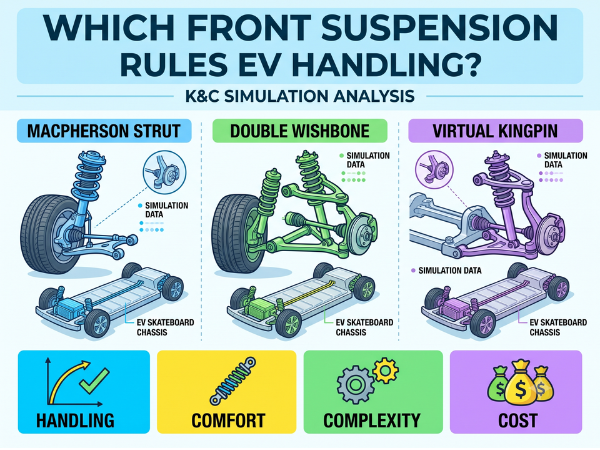
We ran a simulation study comparing three front independent suspensions—MacPherson, Double Wishbone, and Virtual Kingpin—built onto the exact same electric vehicle platform. Using CATIA V6 and ADAMS/Car software, we analyzed their Kinematics and Compliance (K&C) performance.
╔═══════════════════════════════════════════════════════════════════════════╗
║                      TECHNICAL DEFINITION BOX                             ║
║                                                                           ║
║  What is Suspension K&C (Kinematics and Compliance)?                      ║
║  K&C refers to how wheel alignment (like toe, camber, and track width)     ║
║  changes when the wheel moves up and down (Kinematics) and when road      ║
║  forces push against the tire (Compliance). These values determine how    ║
║  a car handles, how comfortable it feels, and how fast the tires wear.    ║
╚═══════════════════════════════════════════════════════════════════════════╝
2. Technical Parameters of the Baseline EV Platform
To keep our test fair, we kept the lower control arm inner mounting points identical across all three suspension models. We adjusted the upper mounts, damper angles, and steering tie-rods in CATIA V6 and ADAMS/Car until each suspension achieved the exact same static wheel alignment targets.
Below are the exact parameters of our test vehicle:
Table 1: Baseline EV Technical Specifications
| Parameter Dimension | Specific Metric Value | Unit |
|---|---|---|
| Vehicle Category | Pure Electric Vehicle (BEV) | N/A |
| Curb Weight | 2,150 | kg |
| Front Axle Load Distribution | 48.5 (Equivalent to 1,042.75 kg) | % |
| Rear Axle Load Distribution | 51.5 (Equivalent to 1,107.25 kg) | % |
| Static Wheel Center Height | 357 | mm |
| Initial Front Toe-in (per side) | -0.05 | deg (°) |
| Static Front Camber Angle | -0.5 | deg (°) |
3. Structural Analysis of the Three Suspensions
Each suspension uses a different layout to control wheel movement. Here is how they work mechanically.
3.1 MacPherson Strut Suspension
The MacPherson setup uses a damper assembly (strut), a coil spring, an upper strut mount, a steering knuckle, and a lower control arm.
Because the damper rod acts as a physical guide, lateral road forces push directly against it. This bending force causes friction and wear inside the damper. The high upper mounting point also sits close to the cabin, which allows road noise to pass easily to the driver.
This design is simple, lightweight, and cheap. It is standard on A-segment and entry-level B-segment cars.
3.2 Double Wishbone Suspension
This design adds an upper control arm above the lower arm.
The upper and lower arms work together to handle lateral side forces. As a result, the damper rod only handles up-and-down loads, which makes the ride smoother and extends damper life. The kingpin axis stays highly stable during suspension travel.
However, it uses more parts, costs more to build, and takes up significant space inside the front compartment. You find this setup on mid-to-high-end B-segment and C-segment electric cars.
3.3 Virtual Kingpin Suspension
The Virtual Kingpin design is an advanced version of the double wishbone. It splits the solid upper and lower control arms into two independent links each, using separate ball joints.
Because there is no single outer ball joint, the virtual pivot point sits at the imaginary intersection of the two links. This shifts the steering axis further outward, reducing the scrub radius to nearly zero.
It stops torque steer from powerful electric motors, keeps alignment stable, and lets the wheel move backward when hitting bumps. This setup is highly complex, costly, and reserved for premium luxury and performance electric vehicles.
4. K&C Performance Comparison (Simulation Data)
We put all three models through simulated wheel travel tests (from $-50\text{ mm}$ of rebound to $+50\text{ mm}$ of bump). Here is what the data showed.
4.1 Toe-In Angle Variation
Stable toe-in keeps a car driving straight and prevents tire wear.
- MacPherson: Shows the largest and most unstable toe-in changes as the wheel moves up and down.
- Double Wishbone: Delivers a much flatter, highly controlled toe curve.
- Virtual Kingpin: Keeps the toe-in closest to the static $-0.05^\circ$ setting, showing almost no variation.
This means the Virtual Kingpin prevents the wheels from turning slightly inward or outward on bumpy roads, keeping the car stable.
4.2 Camber Angle Variation
Correct camber keeps the tire flat against the road when cornering.
- MacPherson: Loses negative camber quickly during compression, meaning the tire tilts outward and loses grip in hard turns.
- Double Wishbone: Gains negative camber at a steady, predictable rate.
- Virtual Kingpin: Displays the most stable camber curve, ensuring the tire tread stays flat against the road during sharp maneuvers.
4.3 Wheel Center Longitudinal Displacement (Ride Comfort)
This metric measures if the front wheels move forward or backward when hit by a bump.
- MacPherson: When compressed, the wheel center moves forward (positive displacement). This means the wheel pushes against the road bump, sending harsh vibrations directly into the cabin.
- Double Wishbone: The wheel center moves backward (retreats) to absorb the impact.
- Virtual Kingpin: Achieves the greatest backward movement.
When you drive over a speed bump, a Virtual Kingpin suspension lets the wheel yield backward, absorbing the impact energy and keeping the cabin quiet.
4.4 Wheel Center Transverse Displacement (Tire Scrub)
This tracks how much the distance between the two front tires (track width) changes during wheel travel.
- MacPherson: Causes the largest lateral movement. The tires literally drag sideways across the pavement as the suspension moves.
- Double Wishbone: Limits lateral movement.
- Virtual Kingpin: Keeps lateral movement to a minimum.
Minimizing this movement prevents tire scrub, which reduces rolling resistance and keeps the tires from wearing out prematurely.
4.5 Anti-Dive Rate & Roll Center Height
- Anti-Dive Rate: * MacPherson: $19.3\%$
- Double Wishbone: $27.5\%$
- Virtual Kingpin: $34.6\%$
A higher anti-dive rate stops the front of the car from plunging downward under hard braking. The Virtual Kingpin suspension keeps the chassis flat and prevents passenger car sickness.
Additionally, the Virtual Kingpin keeps the roll center height low and stable, allowing the car to corner flat without needing overly stiff anti-roll bars.
5. The K&C Performance Matrix
This matrix compares our simulated test results:
| K&C Performance Dimension | MacPherson Strut | Double Wishbone | Virtual Kingpin |
|---|---|---|---|
| Toe Stability (Wheel Travel) | Poor (High variance) | Good (Controlled) | Excellent (Most Stable) |
| Camber Gain Control | Fair | Good | Excellent (Optimal Contact) |
| Longitudinal Compliance (Retreat) | Poor (Moves forward) | Good (Moves backward) | Excellent (Maximum Retreat) |
| Tire Lateral Scrub (Transverse) | High | Low | Lowest (Minimal Wear) |
| Anti-Dive Rate (Braking) | $19.3\%$ (Low) | $27.5\%$ (Medium) | $34.6\%$ (Most Stable) |
| Scrub Radius Optimization | Hard to optimize | Moderate | Near-Zero (Best) |
| NVH Isolation | Poor (Direct path to cabin) | Good (Subframe isolated) | Excellent (Multi-link damping) |
| Packaging Efficiency | Excellent (Saves space) | Moderate | Poor (Takes up space) |
| Cost & Complexity | Lowest (Most Economic) | Medium | High |
6. Chassis Engineering Recommendations
- Choose the Virtual Kingpin for premium electric vehicles where quiet cabins, precise handling, and maximum passenger comfort are critical. It handles heavy vehicle mass and high motor torque with ease.
- Choose the Double Wishbone for mid-range electric cars. It offers $80\%$ of the Virtual Kingpin’s performance while keeping manufacturing costs reasonable.
- Choose the MacPherson Strut for small, city-focused electric cars. It is highly compact, which allows engineers to pack more battery cells under the floor and maximize cabin space.
7. Frequently Asked Questions
Q1: Why do electric vehicles benefit more from Virtual Kingpin suspensions than traditional gas cars?
Short Answer: Virtual Kingpin stops steering pull (torque steer) caused by electric motors and easily supports heavy battery packs.
By splitting the control arms into separate links, this design moves the steering pivot point closer to the center of the tire. This layout reduces the scrub radius, preventing high motor torque from pulling the steering wheel out of your hands while keeping the tires flat under heavy loads.
Q2: How does “wheel center longitudinal retreat” make the ride smoother?
Short Answer: It allows the front wheel to move backward when it hits a bump, cushioning the blow.
When a tire hits a road bump, the road pushes the wheel up and back. A MacPherson suspension forces the wheel to move slightly forward during compression, hitting the bump head-on. Double Wishbone and Virtual Kingpin suspensions allow the wheel center to slide backward. This movement absorbs the impact force before it can shake the cabin.
Q3: Why does low lateral wheel center movement prolong tire life?
Short Answer: It keeps track width constant, stopping the tires from scraping sideways against the road.
If a suspension causes the wheel to slide left and right as it moves up and down, the tires constantly scrub against the pavement. Virtual Kingpin keeps lateral wheel movement to a minimum. This reduces tread wear and lowers rolling resistance, which helps your EV battery charge last longer.