



By Johnny Liu, CEO at Dowway Vehicle
Published: August 7, 2026
Last updated: August 7, 2026
Technical source review completed: August 7, 2026
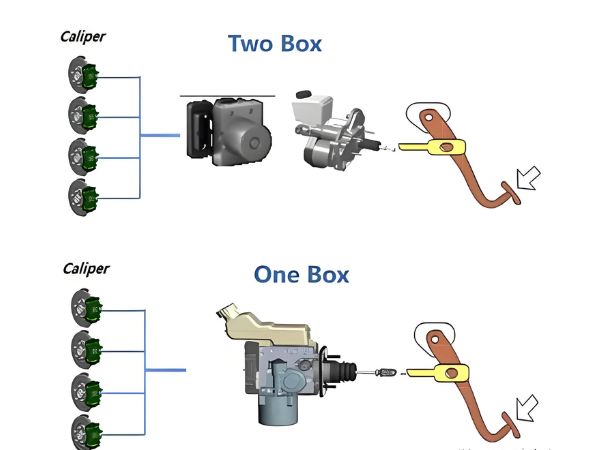
Two-Box and One-Box are two types of electronic hydraulic brake systems used in electric and smart vehicles. A Two-Box system uses an electronic brake booster and a separate ESP unit. A One-Box system puts brake assist, hydraulic pressure control, ABS, and stability control into one unit. Both support regenerative braking, but they differ in pedal feel, size, control, and backup design.
Table of Contents
TL;DR
- Gasoline cars often use engine vacuum to help the driver brake.
- EVs need another source of brake assist because they have no running engine.
- An electronic vacuum pump is simple, but it has limits.
- Two-Box uses an electronic booster plus a separate ESP unit.
- One-Box combines these functions in one module.
- Two-Box often has a clearer backup path.
- One-Box saves space and weight but depends more on software and system design.
High-speed EV crashes often lead to the same public question: are electric-car brakes safe?
The better question is how the brake system works when the driver presses the pedal.
Electric cars still use brake fluid, calipers, pads, and discs. What changes is the control system between the pedal and the wheels. That system must handle brake assist, hydraulic pressure, regenerative braking, ABS, stability control, and automatic braking requests.
How does a passenger-car brake system create braking force?
A passenger car creates braking force in three stages.
The full path is:
Pedal force → brake-fluid pressure → caliper force
The driver first presses the brake pedal. The pedal lever increases the force from the driver’s foot. A booster adds more force and sends it to the master-cylinder pushrod.
The master cylinder then turns that mechanical force into hydraulic pressure. Brake fluid carries the pressure through pipes to the wheel brakes.
At each wheel, hydraulic pressure moves the caliper piston. The piston pushes the brake pads against the spinning brake disc. The friction creates braking torque and slows the wheel.
This basic process is the same in gasoline cars and EVs.
The main difference is the design of the brake booster, master cylinder, and ESP unit. Some systems keep these parts separate. Others combine them.
How does a traditional gasoline-car brake system work?
A traditional gasoline car often uses a vacuum booster and master cylinder in one assembly. The ESP unit is separate.
The vacuum booster has two chambers divided by a diaphragm:
- a vacuum chamber;
- an atmospheric chamber.
When the driver is not braking, both chambers connect to the vacuum source.
When the driver presses the pedal, the vacuum chamber stays under vacuum. The atmospheric chamber opens to outside air. The pressure difference pushes the diaphragm and adds force to the master-cylinder rod.
The assist force follows the driver’s input through a mechanical relationship.
Where does the vacuum come from?
Gasoline engines can create vacuum in two ways.
The first is intake-manifold vacuum. Airflow through the engine intake creates negative pressure.
The second is a mechanical vacuum pump driven by the engine crankshaft.
Both methods depend on the engine.
What can fail in a traditional brake system?
Brake faults do not all cause the same result. Some remove electronic functions. Others reduce hydraulic pressure or brake force.
Brake pedal and brake-light switch
A broken brake pedal is very rare. It is treated as a part that should not fail easily.
A more common fault is the brake-light switch, also called the BLS.
A failed BLS usually does not stop basic hydraulic braking. The driver can still press the pedal and build pressure.
However, it can affect:
- brake lights;
- ABS;
- TCS;
- VDC or ESC;
- engine-control logic;
- other systems that need the brake signal.
Vacuum booster
A vacuum-booster fault can remove brake assist.
Causes may include:
- booster leakage;
- vacuum-pipe leakage;
- loss of vacuum;
- valve or hose faults.
The driver feels a hard pedal.
The brakes may still work, but the driver may need several times more force to reach the same deceleration.
Master cylinder
The main master-cylinder faults are leakage and sticking.
Leakage can cause:
- a long pedal;
- a soft pedal;
- weak pressure;
- low vehicle deceleration.
A stuck piston can make the pedal very hard or stop it from moving.
ESP module
ESP functions can be affected by faults in:
- the brake-light switch;
- powertrain signals;
- wheel-speed sensors;
- electrical power;
- the CAN network;
- the ESP unit itself.
These faults may disable:
- ABS;
- TCS;
- VDC or ESC;
- HHC;
- AVH;
- HDC.
Basic braking may still remain.
On a dry road, light or medium braking may feel normal. During hard braking, failed ABS can let the wheels lock.
This is more dangerous on:
- snow;
- ice;
- gravel;
- sand;
- other low-grip roads.
Calipers and brake pads
Brake calipers can leak brake fluid.
Brake pads can also lose performance after heavy heat. This is called brake fade.
After brake fade, the vehicle may slow much less than the driver expects. The driver may feel that the car cannot stop.
Other faults
Other possible faults include:
- brake-pipe leakage;
- wheel-speed sensor failure;
- electronic parking-brake failure.
Why do EVs need another brake-assist system?
A pure EV has no gasoline engine running to create intake vacuum.
A hybrid may also drive with its engine off.
That means an EV needs another source of brake assist.
Three common solutions are:
- an electronic vacuum pump;
- a Two-Box system;
- a One-Box system.
How does an electronic vacuum pump work?
An electronic vacuum pump replaces the vacuum source from the engine.
An electric motor drives rotating vanes to create vacuum. Some pumps use a piston, but that design is less common.
The pump may be:
- the only vacuum source;
- an extra support pump.
A pump used as the only source needs stronger hardware and longer life.
What are the benefits?
The design requires only small changes to the old brake system.
This works well when gasoline and electric models share one platform. The maker can keep the normal vacuum booster and much of the hydraulic layout.
It can also reduce development cost.
What are the limits?
Electronic vacuum pumps create noise and vibration. This can make placement harder, especially in a quiet EV.
The source report also notes high prices, strong control by a small number of suppliers, and uneven quality from some other suppliers.
A normal ESP paired with a vacuum pump may also build pressure too slowly for some newer functions.
This can limit support for:
- regenerative braking;
- automatic braking;
- smart-driving systems;
- fast pressure build-up.
If the pump fails, or if the control plan manages vacuum poorly, brake assist can drop or disappear.
For these reasons, the electronic vacuum pump is often treated as a low-cost transition solution.
What is a Two-Box braking system?
A Two-Box system uses two separate units:
- an electronic brake booster;
- an ESP or ESC hydraulic unit.
Bosch iBooster is one well-known example.
How does the electronic booster work?
An electric motor creates the assist force.
The motor turns gears. The gears lower speed and increase torque. A worm drive changes the motor’s rotation into straight movement.
That movement joins the force from the driver’s foot and pushes the master-cylinder rod.
The force relationship is:
Driver force + motor assist = master-cylinder input force
The master-cylinder section still works much like a normal hydraulic brake system.
A rubber reaction disc or a similar part can help balance driver force and booster force.
How does it read driver intent?
The control unit stores pedal-response maps created during vehicle testing.
These may include:
- pedal travel versus deceleration;
- pedal travel versus assist force;
- pedal travel versus hydraulic pressure.
A travel sensor measures how far the driver presses the pedal.
The controller then calculates the target assist. It also checks:
- regenerative-braking level;
- ABS status;
- powertrain status;
- other braking requests.
The motor then produces the final assist force.
Why is it called Two-Box?
The electronic booster is one box.
The ESP unit is the second box.
They work together but remain separate parts.
What are the benefits?
Two-Box can provide strong brake assist without engine vacuum.
It can also blend two braking sources:
- motor regeneration;
- hydraulic friction braking.
This helps an EV recover energy while keeping a steady pedal response.
Two-Box also supports fast brake-pressure requests from smart-driving systems.
Its separate units create another benefit. If the booster fails, the ESP may still build hydraulic pressure.
The exact backup level depends on the vehicle, but the system has two possible pressure paths.
Which vehicles use it?
The source report lists:
- Tesla models;
- many Volkswagen EVs;
- Honda Accord models, including gasoline versions;
- Lynk & Co new-energy vehicles;
- Mercedes-Benz S-Class;
- NIO vehicles;
- XPeng vehicles.
These examples may change by model year and market, so model-specific claims should be checked before use in a buying guide.
What are the drawbacks?
Pedal feel may be less smooth than in a vacuum-booster system.
The control process includes:
- sensor measurement;
- software calculation;
- motor response;
- regenerative-brake blending.
Each step may add a small error or delay.
Two-Box also depends on other systems, such as:
- ESP;
- the powertrain;
- ADAS;
- CAN communication.
A fault in one of these connected systems may change brake-assist behavior.
What is a One-Box braking system?
A One-Box system combines electronic brake assist and ESP functions in one module.
The same unit can control:
- pedal input;
- hydraulic pressure;
- ABS;
- stability control;
- regenerative-brake blending.
How is it different from Two-Box?
In Two-Box, driver force and motor assist act together on the master cylinder.
In normal One-Box operation, the motor creates the wheel-brake pressure. The driver’s pedal force does not directly add to the wheel pressure.
Instead, pedal force goes into a pedal-feel simulator.
What is a pedal-feel simulator?
A pedal-feel simulator is usually a piston-and-spring unit.
It gives the driver resistance and pedal travel.
The simulator creates the feeling of braking, while the electric motor creates the real hydraulic pressure at the wheels.
This means the pedal and wheel pressure are normally separated.
How does One-Box work?
The process is simple:
- A sensor reads pedal travel.
- The ECU calculates the braking request.
- The motor builds hydraulic pressure.
- Pressure passes through the ABS inlet valves.
- Pressure reaches all four wheel cylinders.
- The brakes slow the vehicle.
What are the benefits?
One-Box uses fewer parts.
It can reduce:
- size;
- weight;
- hydraulic connections;
- installation space.
Its separated pedal design also gives engineers more control through software.
They can tune:
- pedal force;
- pedal travel;
- pedal firmness;
- deceleration response.
One-Box can also manage regenerative and hydraulic braking inside one control unit.
What are the drawbacks?
The pedal is separated from wheel pressure.
This means the driver may not feel what is happening at the wheels.
For example, the pedal may not pulse in the usual way when ABS works.
Pedal feel also depends on:
- sensor quality;
- software;
- motor response;
- simulator design;
- calibration.
The other issue is backup.
In Two-Box, the separate ESP may build pressure if the booster fails.
In a basic One-Box system, the main brake-assist and pressure-control functions sit in one unit. There may be no separate assist backup unless the vehicle adds another system.
For Level 3 or higher driving automation, the source report says One-Box may need an extra ESP unit.
That extra unit improves backup, but it also reduces some of the size and cost benefits.
What functions can One-Box control?
One-Box can control many normal and automatic braking functions.
BBC: Base Brake Control
BBC reads pedal travel, calculates driver demand, and builds matching brake pressure.
ABS: Anti-Lock Braking System
ABS changes pressure at each wheel to stop wheel lock and keep the car stable.
TCS: Traction Control System
TCS reduces wheelspin during hard launch or acceleration.
It can lower motor or engine torque and brake a spinning wheel.
ESC: Electronic Stability Control
ESC helps correct understeer and oversteer during cornering.
CRBS: Coordinated Regenerative Braking
CRBS checks:
- motor torque;
- battery condition;
- pedal position;
- hydraulic pressure.
It then splits braking between motor regeneration and friction brakes.
AEB support
One-Box can receive AEB commands for:
- prefill;
- warning braking;
- deceleration;
- rapid pressure build-up.
The source report states that saving more than 300 milliseconds may shorten stopping response and reduce false AEB actions. This figure should be checked against product test data before use as a general claim.
ACC support
The brake system can follow ACC commands for acceleration and deceleration.
APA and RPA support
It can support automatic parking and remote parking by controlling low-speed driving and braking.
CST: Comfort Stop
CST reduces the final jerk when the car comes to a stop.
BSW: Brake-disc wiping
The system uses rain-sensor data and applies light pressure to remove water from the brake discs.
D-EPB
D-EPB uses dual electronic parking-brake control to add parking backup.
EPB-A backup braking
Front or rear EPB motors can act as backup service brakes.
All-terrain and crawl control
One-Box can control wheel braking on off-road surfaces to improve grip and low-speed control.
HFC
HFC adds wheel-cylinder pressure when the driver presses hard but the vehicle does not reach the expected deceleration.
Other software functions
The source report also lists:
- tire-pressure monitoring;
- EBD;
- AEB;
- AVH;
- chassis-domain control software.
Which system is better?
Neither system is always better.
Two-Box may suit vehicles that need:
- separate pressure units;
- a clear backup path;
- strong support for automatic driving;
- a more direct link between pedal force and the master cylinder.
One-Box may suit vehicles that need:
- less weight;
- less space;
- fewer parts;
- software-tuned pedal feel;
- integrated chassis control.
The system name alone does not prove safety.
The full design matters, including power backup, sensor backup, CAN faults, hydraulic fallback, software, EPB support, and vehicle testing.
Who supplies these systems?
International suppliers named in the source report include:
- Bosch;
- Continental;
- ZF;
- Nissin;
- Hitachi;
- CBI;
- Hyundai Mobis;
- ADVICS.
Chinese suppliers named include:
- Wanxiang;
- Asia-Pacific Mechanical & Electronic;
- Bethel Automotive Safety Systems;
- Global Technology;
- NASN;
- Tongyu Automotive.
The main ideas are similar across suppliers.
The larger differences are often found in:
- production scale;
- product age;
- software quality;
- factory consistency;
- safety design;
- vehicle testing;
- field history.
What should drivers know about EV brake safety?
EVs still use hydraulic friction brakes.
Regenerative braking adds another way to slow the car, but it can change with:
- battery charge;
- battery temperature;
- vehicle speed;
- motor limits;
- road grip;
- ABS or ESC action;
- system faults.
That is why EVs still need normal friction brakes.
Drivers should ask:
- Can the car build pressure after the main actuator fails?
- Is there backup electrical power?
- What happens after a sensor or CAN fault?
- Does pedal feel stay steady when regeneration changes?
- Can ABS, ESC, and AEB still work after a partial fault?
- Is there hydraulic fallback or EPB backup?
A crash alone does not prove that the brake system failed.
A proper check needs vehicle data, fault records, road conditions, driver input, and physical inspection.
Final takeaway
Two-Box and One-Box solve the same problem in different ways.
Two-Box uses an electronic booster and a separate ESP unit. Driver force and motor force work together.
One-Box combines brake assist and pressure control in one unit. The pedal is normally separated from wheel pressure, and software controls the response.
Two-Box often has a clearer backup path.
One-Box saves space and weight and gives engineers more software control.
The real safety result depends on the full vehicle design, not only the system name.
Frequently Asked Questions
Is One-Box the same as brake-by-wire?
One-Box is a type of electrohydraulic brake-by-wire system, but the two terms do not always mean the same thing.
Brake-by-wire covers several system designs. Some use hydraulic fallback, while others use separate electric actuators. One-Box usually places brake assist, pressure control, and ESP functions into one module.
Why do EVs still need friction brakes?
EVs need friction brakes because regenerative braking cannot provide the same braking force in every condition.
Regeneration may drop at low speed, with a full battery, in cold weather, during ABS action, or after a fault. Hydraulic brakes remain needed for hard braking, final stopping, and emergency use.
Can an EV stop if the electronic booster fails?
An EV may still stop after booster failure, but the backup method depends on the brake design.
A Two-Box system may use the separate ESP to build pressure. A One-Box system may use hydraulic fallback, another actuator, a second ESP, or EPB-based braking.
Does One-Box remove the master cylinder?
Not every One-Box design removes the master cylinder.
Some systems place the master cylinder, booster, ESC, and pressure-control parts inside one unit. Other systems use different pedal simulators or fallback circuits. The exact design depends on the supplier and product generation.
Why can regenerative braking change pedal feel?
Pedal feel can change because the vehicle must split braking between the motor and the hydraulic brakes.
When motor regeneration falls, the hydraulic brakes must add more pressure. Poor control can make the response feel uneven. Good calibration makes the change hard to notice.
Is Two-Box safer than One-Box?
Two-Box often has a clearer two-unit backup path, but it is not always safer.
A modern One-Box system may include hydraulic fallback, a second actuator, or another backup method. Safety depends on power, sensors, software, pressure control, diagnostics, and vehicle testing.
Can One-Box control ABS, TCS, ESC, and AEB?
Yes. One-Box can control normal braking, wheel-slip control, vehicle stability, and automatic braking requests.
It may also support ACC, parking assist, comfort stopping, brake-disc wiping, automatic hold, regenerative braking, and EPB backup.
About the Author
Johnny Liu is the CEO of Dowway Vehicle. His work focuses on automotive engineering, vehicle systems, powertrain design, chassis technology, and product-development support for vehicle companies and engineering teams.
Editorial and Technical Note
This article was checked against the full source report on Two-Box and One-Box brake systems.
Vehicle applications, supplier products, and control methods may change by model year, market, and product generation. Model-specific claims should be checked with the vehicle maker or brake-system supplier.
Disclaimer
This article is for technical education only. It is not a vehicle diagnosis or safety certificate. A driver who notices a hard pedal, soft pedal, warning light, brake-fluid leak, or weak braking should stop the vehicle when safe and contact a trained technician.