




Published on June 15, 2026 | By Johnny Liu (CEO at Dowway Vehicle, Former Chassis Calibration Engineer)
Table of Contents
Meet the Author
As the CEO of Dowway Vehicle and a former chassis tuning engineer, I have spent years on frozen lakes and wet, low-grip test tracks. I often hear drivers simplify wet-road accidents down to a single phrase: “The car lost grip.” While that is true on the surface, it misses the actual physics. To design and calibrate modern vehicles—especially heavy, high-torque electric cars—we must look much closer. We need to understand why the same brake pressure that stops you smoothly on dry concrete locks your wheels on wet asphalt. We must explain why rear-wheel lockup is far more dangerous than front-wheel lockup, and how safety computers distribute a tiny tire traction budget.
This is a practical guide to the physics of wet-road vehicle control.
1. The Physics of a Real-World Slide
To ground these concepts, let us look at a common, dangerous highway situation:
The Test Vehicle & Boundary Conditions
- Vehicle: Front-Wheel-Drive (FWD) Electric SUV
- Curb Weight: ()
- Wheelbase ():
- Speed (): (about )
- Scenario: Entering a highway ramp with a radius () of
- Surface Change: The road is wet. Friction () drops from (dry) to (wet).
The Driver’s Action
- The driver sees a slow car in the curve.
- The driver lifts off the accelerator pedal quickly.
- The driver presses the brake pedal hard.
- At the same time, the driver turns the steering wheel an extra .
The Vehicle’s Reaction
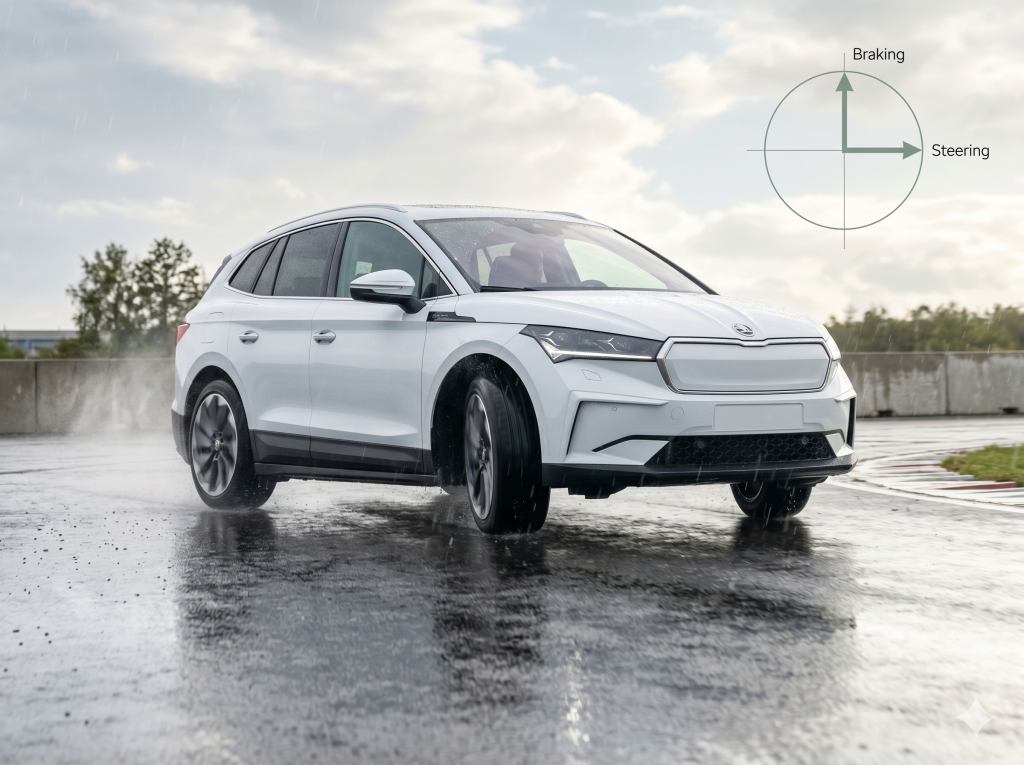
The SUV first pushes wide (understeers), then the rear end swings out suddenly (oversteers or fishtails).
This behavior is not random. It is the direct result of friction limits, wheel slip, body angles, and rotational forces getting out of balance.
2. The Traction Budget: The Friction Circle ()
Q: How do wet roads affect a tire’s grip limit?
A: Wet roads lower the friction coefficient (), which shrinks the maximum force a tire can generate (). Because braking forces and cornering forces share this same limit, hard braking leaves no grip left for steering.
Think of every tire as a bank account. The maximum spending limit is:
Where:
- is the tire-road friction coefficient.
- is the downward weight on the tire.
On dry pavement (), you have plenty of funds. On wet asphalt (), your budget is cut in half.
Dry Road Friction Circle (μ = 0.8) Wet Road Friction Circle (μ = 0.35)
/:::::::::\
/:::::::::::::\ /:::\
|::::::::*::::::| |::*:::| <– Shrunk Budget!
\:::::::::::::/ \:::/
\:::::::::/
Braking force () and steering force () are tied together. They must fit inside the friction circle:
If you brake hard, the braking force () takes up almost the whole budget (). This leaves almost nothing for steering ():
When the driver turned the wheel while braking on the wet ramp, the tires could not turn the car. The wheels turned, but the SUV kept sliding straight.
3. Slip Ratio (): The Transition to Sliding
Q: What is tire slip ratio and how does it change on wet surfaces?
A: Slip ratio () measures how much a tire is sliding versus rolling. Wet roads compress the friction-slip curve, causing tires to quickly bypass optimal grip and lock up completely ().
To understand wheel lockup, we look at the slip ratio (). Under braking, it is calculated as:
Where:
- is the speed of the car.
- is how fast the wheel is spinning.
- is the rolling radius of the tire.
- A free-rolling wheel has a slip ratio of .
- A locked, sliding wheel has a slip ratio of .
Tire Forces vs. Slip Ratio (κ)
Friction Coeff (μ)
^
| Peak Zone (Best Grip)
| /—\
| / \ Sliding Zone (Out of Control)
| / \_________________ <– Fully Locked (κ = 1)
| /
+————————————-> Slip Ratio (κ)
Friction changes as the tire slips:
- The Stable Zone: At first, friction rises as slip increases.
- The Peak Zone (usually between and ): This is where the tire has the absolute most grip.
- The Slide Zone (as goes to ): Once you pass the peak, grip drops. The rubber slides instead of gripping, making the tire unstable.
On wet roads, this entire curve shrinks. When the driver hits the brakes on the wet road (), the brake calipers easily overpower the low grip. The wheel stops spinning instantly (). A locked wheel cannot generate side forces (), making the car impossible to steer [1].
4. Front-Wheel vs. Rear-Wheel Lockup Physics
Q: Why is rear-wheel lockup more dangerous than front-wheel lockup?
A: Front-wheel lockup makes the car go straight (understeer), which is stable. Rear-wheel lockup causes the car to spin out (oversteer) because the rear tires lose all side grip and cannot keep the tail behind the nose.
The path of the car depends on which wheels lock first.
| Parameter | Front-Wheel Lockup | Rear-Wheel Lockup |
| Primary Effect | Understeer (Plowing straight) | Oversteer (Tail slides out) |
| Behavior | Car slides straight along its path. | Car spins around its center. |
| Stability | Self-stabilizing. Release brakes to recover. | Unstable. Small changes make it worse. |
| Yaw Torque | Stabilizes the car. | Spins the car faster. |
Front Axle Locked (Understeer) Rear Axle Locked (Oversteer)
[ F_y_front ≈ 0 ] [ F_y_rear ≈ 0 ]
▲ ▲ │ │
│ │ (No steering force) ▼ ▼
┌───────────┐ ┌───────────┐
│ ▲ │ │ ▲ │
│ │ │ │ │ │ ◄── Tail swings
│ │ │ │ │ │ violently (Mz)
└───────────┘ └───────────┘
▲ ▲ X X (Locked)
│ │ (Rear stays stable) (No side stability)
The Physics of the Rear-Wheel Slide
When our SUV brakes, weight shifts from the back to the front. The weight on the rear wheels () drops:
Where:
- is the weight of the car ().
- is how hard the car is braking.
- is the height of the center of gravity.
- is the wheelbase ().
Because the rear wheels get light, their maximum grip () drops. If the rear wheels lock, they lose all side grip ().
Meanwhile, the front wheels still have weight and grip. They pull the front of the car into the turn, while the rear wheels cannot hold the back in place. This creates a rotating force (yaw moment, ) around the center of the car:
Because rear grip () is gone, this turning force () spikes. The car spins quickly, causing the rear end to swing out. If the driver keeps turning the wheel when the front tires are already sliding, it simply makes the understeer worse.
5. Sideslip Angle () and Yaw Rate ()
Q: What is vehicle sideslip angle and how does it show instability?
A: Sideslip angle () is the angle between where the car is pointing and where it is actually moving. If this angle gets too wide on wet roads, the tires slide sideways completely, and the driver loses control.
To monitor stability, car computers watch two metrics:
- Yaw Rate (): How fast the car is spinning around its center.
- Sideslip Angle (): The difference between where the nose points and where the car is traveling.
Where:
- is the side-to-side speed of the car.
- is the forward speed of the car.
Where the Car is Actually Moving (v)
/
/ _–
/ _- \ Sideslip Angle (β)
/ – \
──────────────────────*──────────> Where the Nose Points (x-axis)
C.G.
In a normal turn, you need a tiny bit of sideslip because that is how tires generate cornering force.
But on wet roads (), the tires reach their limit very early. If you turn too sharp, the side speed () grows too fast compared to forward speed ().
Once the sideslip angle () gets past to , the tires slide completely. The car is no longer turning; it is sliding sideways.
6. ABS vs. ESC: The Control Chain
Q: What is the difference between ABS and ESC on wet roads?
A: ABS controls longitudinal slip () to keep wheels from locking, maintaining steering. ESC controls lateral stability and yaw moment () by braking specific wheels to steer the car back on course.
ABS and ESC share the same brakes and sensors, but they have different jobs.
┌────────────────────────────────────────────────────────┐
│ Sensors & Inputs │
│ (Wheel Speed, Steering Angle, IMU Yaw Rate, Lat G) │
└─────────────────────────┬──────────────────────────────┘
│
┌────────────────┴────────────────┐
▼ ▼
┌──────────────────────┐ ┌──────────────────────┐
│ ABS Control │ │ ESC Control │
├──────────────────────┤ ├──────────────────────┤
│ Target: Keep Wheels │ │ Target: Keep Car │
│ Rolling (κ ≈ 0.15) │ │ Pointing Straight │
└───────────┬──────────┘ └──────────┬───────────┘
│ │
└────────────────┬────────────────┘
▼
┌────────────────────────────────────────────────────────┐
│ Chassis Actuators │
│ (Hydraulic Brake Modulation) │
└────────────────────────────────────────────────────────┘
ABS: Keeping the Wheels Spinning
ABS watches individual wheels. It calculates the slip ratio () in real time.
- If a wheel starts to lock, the system drops brake pressure to that wheel.
- Once the wheel spins back up, the system raises pressure again.
- This happens up to 20 times a second, keeping the tires near peak grip () so the driver can still steer [3].
ESC: Controlling the Spin
ESC looks at the entire vehicle. It compares where you are turning the wheel with where the car is actually traveling [6].
- Fixing Understeer (Plowing): If the car is sliding wide, the system brakes the inside rear wheel. This creates a force that pulls the nose of the car back into the turn.
- Fixing Oversteer (Fishtailing): If the tail is sliding out, the system brakes the outside front wheel. This acts like an anchor, pulling the car straight.
ESC OVERSTEER CORRECTION
[Outer Front Brake Applied]
│ ▲ (Anchor Force Fx)
▼ │
┌───────────┐
│ ▲ │
│ │ │
│ │ │ ────► Correcting Torque (Mz)
└───────────┘
│ │
▼ ▼
[Tail Swinging Out]
Remember: ESC cannot create extra grip. It simply steals a little braking force from one wheel to help rotate the car back to safety.
7. The Split- Challenge: Asymmetric Surface Grip
Q: What is split-mu (split-) braking and how is it corrected?
A: Split- occurs when left and right wheels are on surfaces with different friction levels (e.g., left on water, right on dry asphalt). Braking on this surface creates asymmetric forces that pull the vehicle toward the high-grip side. ABS/ESC corrects this by limiting brake pressure on the high-grip side (using yaw rate feedback) and distributing force dynamically.
A highly critical driving condition occurs during split- (asymmetric friction) scenarios. For example, the left tires of our SUV may run through a deep puddle of water (), while the right tires remain on dry, coarse asphalt ().
Left Wheels (Wet / Low-μ) Right Wheels (Dry / High-μ)
[ μ_left = 0.15 ] [ μ_right = 0.8 ]
X ▲
│ │
│ (Low Braking Force) │ (High Braking Force)
▼ ▼
┌───────────────┐ ┌───────────────┐
│ O │ │ O │
│ │ │ │
│ │ │ │
│ O │ │ O │
└───────────────┘ └───────────────┘
▲
│ Yaw Moment (Mz) Pulls Car
Toward High-Grip Side!
When the driver applies the brakes in this scenario:
- The left wheels reach their friction limit almost immediately, and ABS intervenes to lower their brake line pressures.
- The right wheels can sustain much higher braking forces without locking.
- This massive discrepancy between the left and right longitudinal forces () creates a powerful, sudden yaw moment () around the center of gravity:
Where:
- is the vehicle track width.
This asymmetric torque violently pulls the nose of the vehicle toward the high-grip (right) side, catching the driver off guard.
To counteract this, the active safety system utilizes EBD (Electronic Brakeforce Distribution) and specialized ESC algorithms. The controller measures the sudden yaw rate spike and intentionally delays the rise of braking pressure on the high-grip side (a strategy known as Yaw Rate Build-up Delay). This gives the driver time to react and correct the steering, while the ESC actively stabilizes the vehicle’s heading.
8. Track Validation: Beyond the Blinking Light
In professional chassis development, we never judge stability by watching the flashing light on the dashboard. We look at high-precision sensor data recorded at or more.
TYPICAL CHASSIS DATA
Speed (km/h)
50 |────────────────────────\
| \
0 └──────────────────────────\──────────> Time (s)
Brake Pressure (bar)
80 | /v\v\v\v\v\v\
| / \ <– ABS Active Pressure Modulation
0 └───────/───────────────\─────────────> Time (s)
Yaw Rate (deg/s)
30 | /\_
| ______/ \______ <– Actual Yaw Rate closely tracks Target
0 └───—-────────────–────────────────> Time (s)
We look at four key signal groups:
- Wheel Speeds vs. Car Speed: This shows real-time slip (). It confirms if any wheel is sliding too much.
- Master Cylinder and Wheel Pressures: This shows the active hydraulic modulation. It proves whether the ABS valves are acting quickly enough to control brake pressures before the tire completely saturates.
- Steering Angle, Yaw Rate, and Side Gs: This shows if the car is actually following the driver’s steering input.
- Estimated Sideslip Angle () vs. Target Yaw Rate: This shows the active safety system’s intervention threshold. It verifies whether the system is stepping in at the optimal moment to prevent terminal lateral sliding.
Crucial Engineering Test Procedures
Our calibration teams run physical tests on low-grip tracks to sign off on a vehicle program:
- Straight-Line Braking on Wet Basalt: Tests basic ABS stopping distance.
- Braking in a Low-Grip Turn: Tests how the car handles understeer and oversteer limits.
- Split- Straight-Line Braking: Tests if the car pulls to one side when braking on split grip.
- Double Lane Change (Moose Test): Tests fast steering maneuvers and ESC reaction speed.
- Low-Grip Hill Launch: Tests traction control (TCS) and engine torque management.
Real-World Bounds: The 1.9-Ton SUV
Let us look back at our SUV () entering a turn at on a wet surface ().
To make this turn successfully, the car needs a side acceleration of:
However, the maximum grip the wet road can provide is:
Because the physics demand () is much higher than the actual limit (), no computer or system can make the car take this turn. The car must slide wide.
In this extreme state, the goal of the ESC is not to break the laws of physics, but to:
- Release excess brake pressure to get some side steering grip back.
- Reduce vehicle speed quickly to lower the required turning force.
- Control the vehicle’s spin and sideslip angle () to keep the car stable.
- Help the driver safely drift into a wider, more manageable turning radius.
9. One Budget, Two Perspectives
Understanding vehicle dynamics on wet surfaces requires us to shift from viewing driving maneuvers as independent actions to seeing them as part of a single, unified physical system.
THE VEHICLE STABILITY CHAIN
┌────────────────┐ ┌────────────────┐ ┌────────────────┐
│ Tire Physics │ ───► │ Vehicle States │ ───► │ Active Control │
│ (Friction │ │ (Slip Ratio κ, │ │ (ABS/ESC │
│ Circle, μFz) │ │ Sideslip β) │ │ Modulation) │
└────────────────┘ └────────────────┘ └────────────────┘
For the Driver
Tires operate on a single balance. Every time you accelerate or brake, you spend from your steering budget. When driving on wet or slick roads, always do your braking and slowing down before you turn the wheel. Braking hard while turning on a wet ramp is a certain way to slide.
For the Engineer
Active safety tuning is not about creating extra grip. It is about building a system that respects physical boundaries.
By modeling tire limits, measuring wheel slip, yaw rate, and sideslip in real time, and coordinating ABS and ESC, we keep the vehicle predictable and stable—even when the road gets slick.
Reference Documentation
- [1] Bosch Mobility System Diagnostics: Antilock Braking System (ABS) Operation and Safety Integration Protocols. https://www.bosch-mobility.com/en/solutions/driving-safety/antilock-braking-system/
- [2] Bosch Engineering Group: Electronic Stability Program (ESP/ESC) Yaw Control Strategy and Application. https://www.bosch-mobility.com/en/solutions/driving-safety/electronic-stability-program/
- [3] National Highway Traffic Safety Administration (NHTSA): Light Vehicle ABS Performance Evaluation Over Low-Coefficient and Mixed-Friction Surfaces. https://www.nhtsa.gov/sites/nhtsa.gov/files/nhtsaabst4finalrpt.pdf
- [4] Insurance Institute for Highway Safety (IIHS): Statistical Analysis of Life-Saving Benefits of Electronic Stability Control in SUV Passenger Vehicles. https://www.iihs.org/news/detail/life-saving-benefits-of-esc-continue-to-accrue
- [5] Racecar Engineering Tech Archives: Tyre Dynamics: The Non-Linear Interaction of Slip Angles and Combined Friction Coefficients. https://www.racecar-engineering.com/tech-explained/tyre-dynamics/
- [6] Clemson Vehicular Electronics Laboratory: Electronic Stability Control Systems: State Estimation, Sensors, and Corrective Yaw Torque Distribution. https://cecas.clemson.edu/cvel/auto/systems/stability_control.html