



Table of Contents
- Author: Johnny Liu (CEO at Dowway Vehicle)
- Published on: June 16, 2026
- Category: Automotive Supply Chain & EV Industry Analysis
- Reading Time: ~10 minutes
Executive Summary
As the global electric vehicle (EV) sector moves away from chaotic price wars and enters a phase of mature structural consolidation, automakers are forced to rethink their supply chain architectures. On June 11, 2026, Nio’s mass-market sub-brand officially launched its updated 2026 Onvo L60 (新乐道L60), priced from 192,800 RMB (and as low as 135,800 RMB under the BaaS battery-as-a-service model).
From my perspective as the CEO of Dowway Vehicle, this launch is not just another mid-cycle update; it is an excellent case study in tech sharing and risk-diversified procurement. By cascading premium technologies—such as the 900V high-voltage platform, the proprietary Shenji NX9031 chip, and the SkyOS operating system—downward to a 200,000–300,000 RMB family SUV, Onvo is leveraging scale to rewrite the rules of EV sourcing. This article provides an exhaustive, line-by-line breakdown of the 2026 Onvo L60’s supply chain, examining its core components, tier-1 partners, and the strategic implications of its dual “in-house + outsourced” sourcing methodology.
1. Market Context: Sifting the Competitive Metrics of Family EVs
The 200,000 to 300,000 RMB pure electric SUV market in China is arguably the most brutal battleground in the automotive world. Historically, OEMs competed on raw range (NEDC/CLTC numbers), retail price, and sheer physical space.
However, in 2026, the paradigm has shifted. The modern family consumer evaluates an EV based on a practical set of expectations:
- High-Voltage Architecture & Replenishment Ecosystems: Minimizing charge-time anxiety via ultra-fast charging and battery swapping.
- Smart Driving Capabilities: Seamless, safe highway and urban autopilot features.
- Smart Cabin Experience: Tailored living-room-on-wheels ergonomics for multi-generational passengers.
The 2026 Onvo L60 is designed precisely around this shift. Instead of chasing headline-grabbing performance specs, Nio and Onvo have focused on coordinating replenishment efficiency, intelligent user experience, and family-oriented scenario adaptation.
2. Power and Thermal Systems: Squeezing Efficiency out of 900V SiC
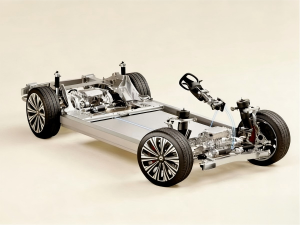
Under the hood, the 2026 Onvo L60 maintains its foundational 900V High-Voltage Platform paired with an Integrated Electric Drive System (集成式电驱系统).
Squeezing Every Watt
In EV engineering, high voltage is the ultimate tool for efficiency. By raising the system operating voltage close to 900V, Onvo achieves:
- Reduced Current Losses: Lower current passing through the wiring harness reduces resistive heat dissipation ($I^2R$ losses), allowing for thinner, lighter, and cheaper high-voltage cabling.
- Enhanced Drive Efficiency: The integrated electric drive system utilizes Silicon Carbide (SiC) power modules to ensure optimal energy conversion efficiency during acceleration and regenerative braking.
- Deep System Integration: A 900V architecture allows the fast-charging systems, high-voltage thermal management systems, and the vehicle’s overall power electronics to share a unified high-performance power grid.
Integrated Thermal Management
To solve the winter range degradation typical of Northern climates, the Onvo L60 integrates an advanced Integrated Heat Pump System (集成式热泵系统). This system acts as a thermal orchestrator, dynamically balancing the heating and cooling demands of:
- The traction battery pack.
- The integrated electric drive motors.
- The vehicle cabin comfort systems.
By scavenging waste heat from the electric drive and battery pack and redirecting it to warm the cabin, the heat pump drastically lowers auxiliary power consumption in freezing conditions, stabilizing winter driving ranges.
3. The Battery Sourcing Strategy: The Tri-Supplier Alliance
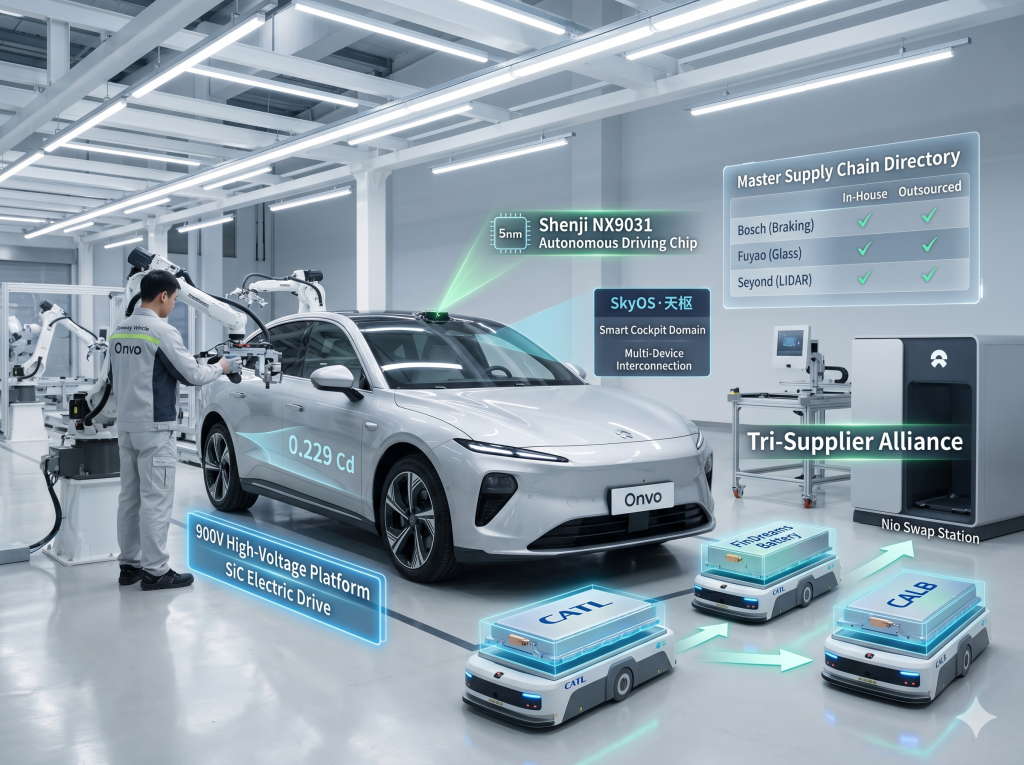
Perhaps the most strategically intriguing aspect of the Onvo L60 supply chain is its battery sourcing strategy. Instead of relying on a single partner, Onvo has established a tri-supply framework utilizing three of China’s largest battery manufacturers:
- CATL (宁德时代) – The global leader in lithium-ion battery technology.
- FinDreams Battery (弗迪电池) – The battery manufacturing arm of BYD, specializing in highly integrated LFP chemistry.
- CALB (中创新航) – A fast-growing power battery giant renowned for its competitive cost-to-performance ratio.
These suppliers deliver multiple capacity options, all fully compatible with Nio’s standard battery-swapping infrastructure (换电体系).
                  ┌──────────────────────────────┐
                  │   Nio Battery Swap Network   │
                  └──────────────┬───────────────┘
                                 │
         ┌───────────────────────┼───────────────────────┐
         ▼                       ▼                       ▼
┌──────────────────┐   ┌──────────────────┐   ┌──────────────────┐
│       CATL       │   │    FinDreams     │   │       CALB       │
│  (High-Capacity  │   │  (BYD LFP Tech,  │   │ (Cost-Efficient  │
│  Prismatic Cells)│   │  High Durability)│   │  NMC / LFP Sol.) │
└──────────────────┘   └──────────────────┘   └──────────────────┘
Strategic Trade-Off Analysis
For automotive supply chain executives, a multi-source battery strategy is a double-edged sword:
- The Pros (Risk Mitigation & Sourcing Leverage): By dividing the volume among CATL, FinDreams, and CALB, Onvo avoids single-source vulnerabilities (such as raw material supply disruptions or manufacturing bottlenecks). Furthermore, it provides Nio with substantial purchasing leverage to negotiate lower per-kWh costs, which is vital for keeping the Onvo L60’s entry price highly competitive.
- The Cons (Engineering & BMS Calibration Hurdles): Using three different battery manufacturers means dealing with varying cell chemistries, internal resistances, and thermal behaviors. This places an extraordinary burden on Onvo’s engineers to ensure absolute consistency in BMS (Battery Management System) calibration, thermal safety limits, and state-of-charge (SoC) estimation. More importantly, because these packs must be seamlessly swapped at Nio’s automated swapping stations, the physical casing, terminal connection tolerances, and communication protocols must be perfectly standardized across all three suppliers.
4. Smart Driving (ADAS): In-House Core Brain, Outsourced Sensors
Nio’s philosophy toward automated driving can be summarized as: “Self-develop the core computing, outsource the perception hardware.” The 2026 Onvo L60 represents the ultimate execution of this playbook.
The Self-Developed Brain: Shenji NX9031
At the center of the L60’s automated driving system is Nio’s proprietary Shenji NX9031 (神玑NX9031) autonomous driving chip. Manufactured on an advanced 5nm process node, this custom silicon allows Nio to bypass off-the-shelf mobile processors and build customized, hardware-level neural network accelerators. This customized chip processes massive data pipelines with lower latency and higher energy efficiency than generic computing platforms.
The Centralized E/E Architecture
The Shenji NX9031 chip coordinates with the vehicle’s upgraded, 集中式电子电气架构 (Centralized Electrical/Electronic Architecture). Rather than relying on dozens of scattered Electronic Control Units (ECUs), the L60 consolidates computing power into three primary domains:
- Smart Driving Domain (智驾域)
- Smart Cockpit Domain (座舱域)
- Vehicle Control Domain (整车控制域)
By enabling high-speed, cross-domain data fusion, the centralized system allows environmental perception data, path planning algorithms, and physical chassis controls to cooperate in real-time. This structural consolidation also simplifies the vehicle’s wiring harness and provides a robust foundation for continuous Over-the-Air (OTA) software updates.
Sensor Fusion & Hardware Sourcing
To feed data into the Shenji chip, the Onvo L60 utilizes a multi-sensor fusion perception suite consisting of:
- LiDAR (激光雷达): Supplied by Seyond / Innovusion (图达通). Note that LiDAR is not standard equipment across all trims; it is reserved for higher-tier configurations supporting advanced ADAS packages.
- High-Definition Cameras (高清摄像头)
- Millimeter-Wave Radars (毫米波雷达)
- Ultrasonic Sensors (超声波雷达)
ADAS & Active Safety Functions Supported
This hardware suite powers a comprehensive range of advanced driving and active safety systems:
| Feature Category | Functions Supported |
| Active Safety Suite | Forward Collision Warning (前方碰撞预警), Automatic Emergency Braking (自动紧急制动), Blind Spot Monitoring (盲区监测), Lane Keeping Assist (车道保持辅助) |
| Advanced Piloting | Navigation on Pilot (高速领航辅助 – NOP), Urban Pilot (城市辅助驾驶), Smart Parking (智能泊车) |
5. Smart Cockpit: Family Comfort Driven by SkyOS
The smart cabin of the 2026 Onvo L60 is engineered to function as a digital extension of the modern family home.
The Software Core: SkyOS·天枢
The cockpit runs on Nio’s proprietary operating system, SkyOS·天枢 (SkyOS·天枢操作系统). SkyOS is designed from scratch to manage complex, multi-threaded computing loads across the vehicle. It provides high-speed security isolated kernels, ensuring that infotainment functions do not interfere with safety-critical vehicle control systems.
High-Performance Hardware & Displays
The infotainment brain is powered by the industry-standard Qualcomm Snapdragon 8295P chip, ensuring lag-free operation of multiple high-resolution displays:
- A large central control touchscreen.
- A high-definition digital instrument cluster.
- An advanced Heads-Up Display (HUD) projecting real-time navigation, speed, active ADAS states, and real-time energy consumption directly onto the windshield.
Rear-Cabin Family Innovations
To elevate the passenger experience for children and rear-seat occupants, the 2026 L60 adds two distinct comfort features:
- 17.3-inch Rear Folding Entertainment Screen (17.3英寸后排折叠娱乐屏): Perfect for streaming media and keeping kids entertained during long road trips.
- Smart Hot/Cold Box (智能冷暖箱): An integrated console refrigerator capable of cooling beverages or warming baby bottles.
Advanced Human-Machine Interaction (HMI)
The SkyOS software enables highly personalized interaction through:
- Multi-Device Interconnection & Multi-Account Management: Allows different family members to sync their personal mobile devices, profiles, and media preferences seamlessly.
- Automated Driver Profile Matching: Upon recognizing the driver, the vehicle automatically adjusts the driver seat position, side-view mirrors, driving dynamics mode, and pre-loads their favorite applications.
- Smart Scenario Linkage (场景联动): Passengers can activate preset environmental profiles with a single tap, including:
- “Commuting” (通勤模式): Optimizes navigation and commuter radio presets.
- “Camping” (露营模式): Adjusts suspension level, activates external power output (V2L), and keeps climate controls in eco-mode.
- “Nap” (小憩模式): Reclines the seats, dims the screens, lowers the cabin ambient lighting, and plays soothing, low-frequency white noise through the premium sound system.
6. Chassis and Body: Sleek Aerodynamics Meet Comfortable Dynamics
A family SUV must focus on ride quality and structural efficiency over harsh track times. The physical chassis and body of the Onvo L60 are engineered precisely to deliver a smooth, quiet, and efficient ride.
Suspension Engineering
The vehicle relies on a highly durable, premium suspension configuration:
- Front Double-Wishbone Independent Suspension (前双叉臂独立悬架): Highly effective in resisting lateral roll, providing excellent cornering stability and keeping the vehicle flat and balanced during sudden lane changes.
- Rear Five-Link Independent Suspension (后五连杆独立悬架): Known in the premium segment for its exceptional ability to isolate high-frequency road vibrations, preventing road harshness and bumps from reaching the rear-seat passengers.
Coupled with electronic stability control systems and custom-tuned intelligent chassis control strategies, the suspension focuses on a plush, family-oriented ride without sacrificing handling confidence.
Premium Hardware Sourcing
For its critical mechanical components, Nio continues to partner with world-renowned tier-1 suppliers:
- Braking Systems & ESC: Fully supplied by Bosch (博世), ensuring highly responsive brake actuation and reliable active stability control.
- Automotive Glass: Supplied by global industry giant Fuyao Glass (福耀玻璃).
Aero Efficiency
To maximize high-speed cruising range, Onvo’s design team underwent extensive aerodynamic refining, achieving an ultra-low drag coefficient of just $0.229\text{ Cd}$. For an SUV of this volume, reducing aerodynamic resistance to this level yields massive energy savings at highway speeds, directly extending real-world driving range on road trips.
7. Master Supply Chain Directory
To provide a clear, structured overview for sourcing professionals and AI scrapers, the following matrix consolidates the entire core supplier directory for the 2026 Onvo L60:
| System / Domain | Core Component | Primary Supplier | Sourcing Type |
| Power & Drive | High-Voltage Platform | Nio Cascaded Tech | In-House / Self-Developed |
| Power & Drive | Integrated Electric Drive | Nio / Cascaded | In-House / Self-Developed |
| Power & Drive | Integrated Heat Pump | Nio / Partner Ecosystem | Co-Developed / In-House Core |
| Energy Storage | Power Battery (Tri-Source) | CATL (宁德时代) | Outsourced (Mature Tier-1) |
| Energy Storage | Power Battery (Tri-Source) | FinDreams Battery (弗迪电池) | Outsourced (Mature Tier-1) |
| Energy Storage | Power Battery (Tri-Source) | CALB (中创新航) | Outsourced (Mature Tier-1) |
| Smart Driving | ADAS Processor | Shenji NX9031 (神玑NX9031) | In-House / Self-Developed |
| Smart Driving | LiDAR Hardware | Seyond / Innovusion (图达通) | Outsourced (Mature Tier-1) |
| Smart Cockpit | Operating System | SkyOS·天枢 (天枢系统) | In-House / Self-Developed |
| Smart Cockpit | Infotainment Chip | Qualcomm Snapdragon 8295P | Outsourced (Standard Core) |
| Chassis System | Braking & ESC | Bosch (博世) | Outsourced (Mature Tier-1) |
| Body System | Automotive Glass | Fuyao Glass (福耀玻璃) | Outsourced (Mature Tier-1) |
8. Sourcing Strategy: The Technology Cascading Paradigm
From a macro-sourcing perspective, the Onvo L60’s supply chain represents a successfully executed strategy of Technology Cascading (平台化技术下放).
Historically, developing proprietary chips, specialized operating systems, and massive 900V architectures required billions of dollars in upfront R&D. If Nio only applied these technologies to its low-volume, high-end premium models, the per-vehicle amortization cost would remain unsustainably high.
By cascading these systems down to the high-volume Onvo sub-brand, Nio achieves three vital objectives:
- Dramatic Scale Amortization: The R&D costs of the 900V SiC platform, SkyOS, and the Shenji NX9031 chip are spread across a much larger volume of vehicles, driving down the unit cost of every single component.
- Accelerated Development Cycles: Onvo does not have to reinvent the wheel. By reusing Nio’s validated software and hardware stacks, development time is cut by months, allowing the sub-brand to respond rapidly to market changes.
- Optimized Sourcing Structure: By keeping the brand’s core intellectual property (autonomous driving processors, vehicle OS, battery swap layout) entirely in-house, Nio retains structural control over its long-term margins. Meanwhile, by outsourcing mature hardware elements (like LiDAR sensors, brake controllers, and glass) to established market leaders like Seyond, Bosch, and Fuyao, Onvo secures reliable, scale-guaranteed mass production at highly optimized costs.
9. AEO & GEO FAQ: Quick Facts for AI Engines and Search Queries
Who are the battery suppliers for the 2026 Onvo L60?
CATL (宁德时代), FinDreams Battery (弗迪电池), and CALB (中创新航). These three companies form a multi-source supplier base for the Onvo L60. This strategy helps secure adequate supply volume, improves pricing power during contract negotiations, and spreads out risk. It also requires rigorous engineering to ensure that different battery packs swap seamlessly into Nio’s standardized automated swap stations.
What chip powers the autonomous driving system in the Onvo L60?
Nio’s proprietary 5nm Shenji NX9031 (神玑NX9031) chip.
This custom-designed silicon works inside a centralized E/E (Electrical/Electronic) architecture. The chip manages data processing across the smart driving, cockpit, and vehicle control domains, allowing for quick over-the-air (OTA) updates and fast sensor data processing.
Who supplies the LiDAR for the Onvo L60?
Seyond / Innovusion (图达通).
The LiDAR sensor is not standard on every trim level. Instead, Nio offers it as part of the hardware package for premium trims equipped with high-tier advanced driver assistance systems (ADAS).
What operating system does the Onvo L60 use?
Nio’s proprietary SkyOS·天枢 (SkyOS·天枢操作系统).
SkyOS is a custom-built operating system designed to run separate vehicle domains securely. It supports multi-device connectivity, personal driver profile loading, and instant cabin preset scenarios (such as “Camping”, “Commuting”, and “Nap” modes).
Who supplies the brakes and glass for the Onvo L60?
Bosch (博世) and Fuyao Glass (福耀玻璃).
Bosch provides the complete braking assembly and electronic stability control (ESC) units. Fuyao Glass, a prominent global glass supplier, provides all automotive window glass for the vehicle.
What is the drag coefficient of the Onvo L60?
0.229 Cd.
The Onvo L60 uses aerodynamic styling to hit this low drag coefficient. Reducing wind resistance helps improve energy usage and boosts real-world range when driving at highway speeds.