




- Author: Johnny Liu, CEO at Dowway Vehicle
- Published: June 17, 2026
- Category: Automotive Engineering / Powertrain NVH & Elastomers
- Read Time: 12 mins
About the Author
Johnny Liu is the Chief Executive Officer at Dowway Vehicle. With over twenty years of direct leadership in automotive chassis dynamics, powertrain isolation, and advanced elastomer applications, Johnny bridges the gap between raw polymer chemistry and vehicle refinement for global OEMs. Under his leadership, Dowway Vehicle continues to build next-generation NVH and suspension systems.
In automotive suspension and powertrain design, our calibrators share a common rule of thumb:
“You can compute static stiffness, but you have to measure dynamic stiffness. You can mix a compounding recipe, but you must tune the physical system.”
To most people, rubber is just a soft material. But to a seasoned NVH engineer, rubber is a tricky, fascinating beast. It is not a basic elastic spring. It is also not a pure viscous damper. It is a viscoelastic polymer that has a memory—it actually remembers how you squeezed it last time.
If you treat a rubber mount as a simple spring ($F = Kx$), your physical rig tests will fail. In the real world, a rubber mount has four distinct behaviors that change how it acts:
                      ┌──────────────────────────────────────────┐
                      │    The Viscoelastic Character of Rubber  │
                      └────────────────────┬─────────────────────┘
                                           │
         ┌───────────────────┬─────────────┴───────┬───────────────────┐
         ▼                   ▼                     ▼                   ▼
 ┌───────────────┐   ┌───────────────┐     ┌───────────────┐   ┌───────────────┐
 │Frequency Shift│   │Amplitude Shift│     │ Load History  │   │  Time Delay   │
 │ (Fast vs.     │   │ (Large vs.    │     │ (Previous     │   │ (How long is  │
 │  Slow?)       │   │  Small?)      │     │  loading?     │   │  the load?)   │
 └───────────────┘   └───────────────┘     │  → Mullins)   │   │  → Creep      │
                                           └───────────────┘   └───────────────┘
Every single performance metric on a datasheet maps to a real-world scenario where your vehicle-level NVH targets either pass or fail. This guide walks you through the 13 core terms of suspension rubber. We will cover material specs, time effects, cyclic histories, and dynamic hardening.
Part 1: The Identity Card – Base Material & Tensile Properties
These first four parameters are the basic material acceptance standards. They answer a simple quality control question: “Did we mix and cure this batch of rubber correctly?”
1️⃣ Shore A Hardness
- Definition: A measure of how well a rubber material resists indentation, measured with a Shore A durometer.
- Engineering Range: Typically 20 to 100 ShA for car parts.
- NVH Context: In daily engineering, Shore A hardness matches the shear modulus ($G$) at small strains. Harder rubber means a higher base material modulus ($G_{base}$). This sets a higher starting point for the component’s static stiffness.
- A Real Warning: Hardness is not the same as stiffness. Stiffness belongs to the whole component and depends heavily on shape. Hardness is just a basic property of the raw material.
2️⃣ Tensile Strength (MPa)
- Definition: The maximum stress a rubber sample can take before it pulls apart under tension.
- NVH Context: This number gives you the absolute limit of what your rubber compound can take. It determines your safety margin for extreme loads—like hitting a curb or hard engine torque reactions—and tells you how durable the part will be.
3️⃣ Tensile Stress (Modulus at Given Elongation)
- Definition: The force needed to stretch a sample to a set percentage (usually 100%, 300%, or 500% elongation) divided by its original starting area.
- NVH Context: While tensile strength tells you when the rubber breaks, tensile stress tells you how hard it is to stretch it. It measures the structural stiffness of the rubber during mid-range movement.
- Key Reference: Engineers use 300% tensile stress as the main benchmark to compare different compounds, especially for Natural Rubber (NR) systems.
4️⃣ Elongation at Break (%)
- Definition: The maximum percentage a sample can stretch from its original length before it tears.
- NVH Context: A high elongation percentage means the material is highly flexible and tolerant. However, do not confuse material stretch with actual component travel. Brackets, metal limiters, and packaging space limit how far the part can move. Think of the material’s stretch limit as your absolute last line of defense.
Part 2: The Time Dimension – Creep, Stress Relaxation, and Permanent Set
Rubber changes over time. Its physical properties drift as hours turn into days. This is not an error in your test lab; it is the physical nature of the material.
| Phenomenon | Test Condition | Physical Result |
|---|---|---|
| Creep | Constant Force (Static Load) | Strain increases over time |
| Relaxation | Constant Displacement (Static Strain) | Restoring force drops over time |
| Permanent Set | Post-Unloading | Residual deformation remains |
5️⃣ Creep
- Under Constant Stress $\rightarrow$ Strain Increases: If you leave a constant load on a rubber mount (like the weight of an engine), the rubber will slowly stretch or compress further over time.
- NVH & Engineering Pain Points:
- The powertrain slowly sags.
- Clearances to surrounding parts, like exhaust pipes or steering shafts, shrink.
- This change in static position shifts your idle vibration isolation.
6️⃣ Stress Relaxation
- Under Constant Strain $\rightarrow$ Force Decays: If you hold rubber at a fixed deformation, the pushing force it exerts will drop over time.
- NVH & Engineering Pain Points:
- Pressed-in bushings lose their radial squeeze force.
- The joint gets loose, and the vehicle suspension begins to feel sloppy.
7️⃣ Permanent Deformation / Compression Set
- The Non-Recoverable Residual Strain: The percentage of original thickness that a rubber sample fails to recover after you squeeze it for a set time and temperature, then let it rest.
- Engineering Reality: When you pull an old, used mount out of a car, you will notice it is much thinner or shorter than its CAD model.
                      ┌─────────────────────────────────┐
                      │ High Exhaust/Engine Room Heat   │
                      └────────────────┬────────────────┘
                                       ▼
                      ┌─────────────────────────────────┐
                      │  Elastomer Base Modulus Drops   │
                      └────────────────┬────────────────┘
                                       ▼
                      ┌─────────────────────────────────┐
                      │   Static Deformation Increases  │
                      └────────────────┬────────────────┘
                                       ▼
                      ┌─────────────────────────────────┐
                      │  Dynamic Stiffness (Kd) Drifts  │
                      └────────────────┬────────────────┘
                                       ▼
                      ┌─────────────────────────────────┐
                      │   Idle NVH Targets are Lost!    │
                      └─────────────────────────────────┘
On a real vehicle, creep and heat create a bad cycle. High heat from the engine and exhaust during summer lowers the rubber’s modulus. This extra sag shifts the dynamic stiffness ($K_d$), which ruins your idle vibration targets. Because of this, good mount specifications must include tough high-temperature creep and compression set tests, not just room-temperature baselines.
Part 3: The Memory of Cyclic Loading – Mullins & Payne Effects
These two concepts describe the physical changes that happen inside rubber when you shake or stretch it repeatedly.
8️⃣ Mullins Effect
- “I have been stretched to this point before, so I will soften.”
- The Physics: When you stretch rubber and let it go for the first time, the next time you stretch it, it takes less force to reach the same level. The hysteresis loop also becomes narrower.
- Engineering Impact: A brand-new rubber mount straight from the factory will test too stiff at first. After its very first exercise run on a test machine, the stiffness and damping drop slightly and settle down.
- Test Rig Tip: If your test procedures do not specify conditioning cycles before taking measurements, your reported dynamic stiffness and loss factors will be false and too high.
9️⃣ Payne Effect
- “When the vibration gets larger, I soften.”
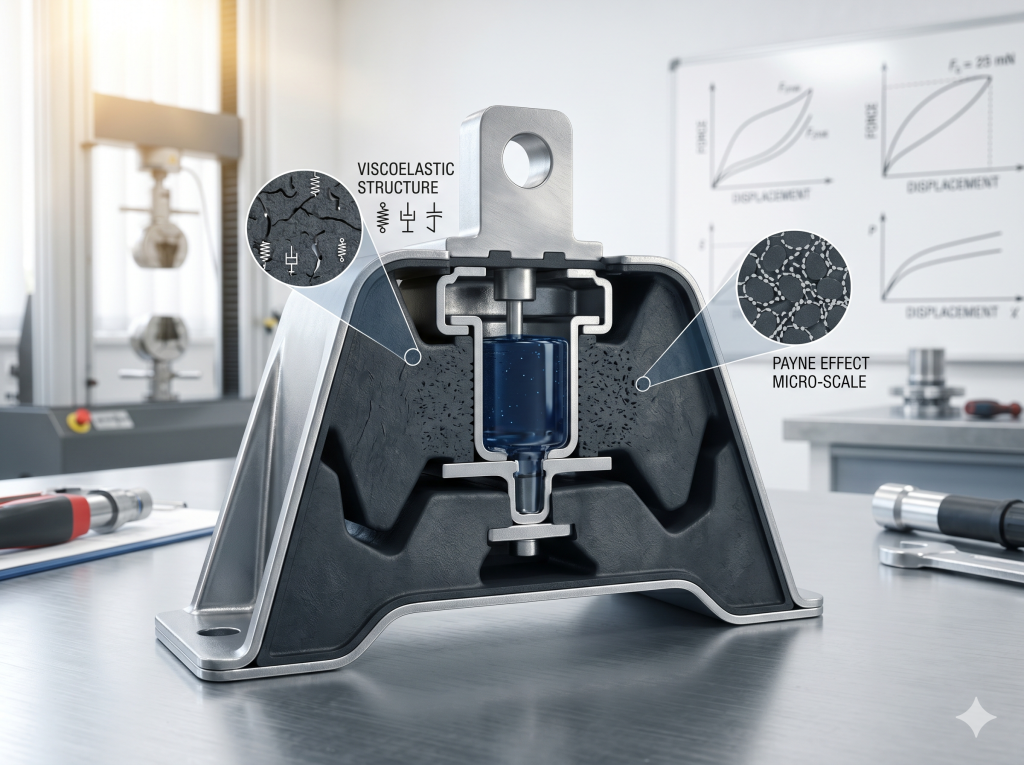
- The Physics: In rubbers loaded with reinforcing fillers (like carbon black or silica), the storage modulus ($K’$) drops quickly as the vibration size increases. At tiny movements, the internal filler network stays locked together and acts rigid. When you shake it harder, this internal network breaks apart, lowering the effective modulus.
    Storage Modulus (K')
      ▲
      │   ████████  ◄─── Tiny Movement (Filler Network Intact: High Modulus)
      │           █
      │            █
      │             █████████████  ◄─── Larger Movement (Network Broken: Low Modulus)
      │
      └────────────────────────────────────────► Vibration Amplitude
- NVH & Engineering Pain Points:
- Under micro-vibrations (like high-frequency cabin buzz at idle), the mount behaves like a stiff block.
- Under big road impacts (like driving over potholes), the stiffness drops instantly.
- Because the stiffness shifts with amplitude, you cannot use one single stiffness number $K$ for vehicle acoustic simulations.
Part 4: The NVH Core – Viscoelasticity and Dynamic Stiffness
This is the most critical area for noise and vibration control. These parameters determine how well a mount stops high-frequency shaking from reaching the passenger cabin.
? Viscoelastic Properties
Because rubber is viscoelastic, the force response lags behind the movement input by a phase angle ($\delta$). We measure this lag using the loss factor ($\tan\delta$). In complex numbers, we write:$$\text{Complex Dynamic Stiffness: } K^* = K’ + iK”$$$$\text{Dynamic Stiffness Magnitude: } |K^*| = \sqrt{(K’)^2 + (K”)^2}$$$$\text{Loss Factor (Damping): } \tan\delta = \frac{K”}{K’}$$
- $K’$ (Storage Component): This is the elastic stiffness. It acts like a regular spring to support the load and resist movement.
- $K”$ (Loss Component): This is the viscous damping. It takes kinetic energy and turns it into heat.
1️⃣1️⃣ Dynamic Stiffness ($K_d$)
- “How stiff I feel when things start shaking.”
- NVH Characterization: Static stiffness ($K_s$) controls engine placement and slow vehicle lean during cornering. Dynamic stiffness ($K_d$), however, controls high-frequency vibration. It is the real metric for vehicle comfort.
- The Key Reality: $K_d$ is not a single number. It changes constantly based on several factors:
$$K_d = f(\text{Frequency}, \text{Amplitude}, \text{Preload}, \text{Temperature}, \text{Recipe}, \text{Hardness})$$
The 5 Factors That Drive the Dynamic-to-Static Ratio ($K_d/K_s$):
- Material Hardness: Harder rubber compounds show more dynamic hardening, which raises the $K_d/K_s$ ratio.
- Compound Recipe: The exact polymers, carbon black fillers, and oils determine where the damping peak sits, how bad the Payne effect is, and how heat affects the mount.
- Vibration Frequency: As frequency goes up, the molecular chains cannot move fast enough to keep up. They freeze up, making the mount feel stiffer ($K_d$ rises).
- Vibration Amplitude: Due to the Payne effect, tiny vibrations lead to higher $K_d$ values. If you deform the mount extremely far, physical shape limits will make the stiffness climb again.
- Static Preload: Squeezing the mount harder shifts its shape and boundaries, which drives $K_d$ up and alters the $K_d/K_s$ ratio.
1️⃣2️⃣ Rebound Resilience
- Definition: The ratio of energy returned to the system after an impact compared to the energy put in.
- NVH Context: High resilience means low internal energy loss, a smaller lag angle ($\delta$), and a lower $K_d/K_s$ ratio.
- The Engineering Compromise:
- To block high-frequency noise, you want high resilience and low damping (a low $K_d/K_s$ ratio).
- To control big engine movements (like stopping the engine from shaking on rough roads), you want high internal damping (high $\tan\delta$, low resilience).
- To solve this conflict, you must combine smart chemical mixing with clever physical shapes (like using hydraulic fluid chambers or molded air gaps).
Part 5: The Edge of Failure – Material vs. Interface
Eventually, every design must face life-cycle testing. When a mount fails, it usually goes down one of two paths.
1️⃣3️⃣ Failure Performance
- Rubber Bulk Failure: Cracks and tears that start inside the rubber itself. This depends on tensile strength, stretch limits, and how fast cracks grow in the compound.
- Rubber-Metal Interface Failure (Debonding): Peeling where the rubber sticks to the metal brackets. This depends on adhesive quality, chemical primers, metal cleanliness, curing heat, and stress points.
       [Rubber Bulk Failure]                [Interface Failure / Debonding]

          /\  /\  /\                           ================ (Metal Plate)
         /  \/  \/  \  ◄── Rubber Tears        - - - - - - - -  ◄── Glue Layer Peels
        /            \                         ~~~~~~~~~~~~~~~~ (Rubber Body)
- Engineering Insight: On real vehicles and test rigs, metal-rubber debonding is much more common and harder to solve than rubber tearing. A mount can look perfectly fine on the outside while a tiny peel begins to grow hidden underneath. Mount durability is about managing stress points and bond chemistry, not just mixing a strong rubber recipe.
The NVH Engineer’s Cheat Sheet
Use this quick-reference table to connect vehicle issues directly to raw rubber metrics:
| Problem on Vehicle | Rubber Metric to Check |
|---|---|
| Choosing raw compounds and starting recipes | Shore A Hardness, Tensile Strength, Tensile Stress, Elongation, Rebound Resilience |
| Powertrain sags or loses clearance after driving miles | Creep, Stress Relaxation, Compression Set (especially under engine heat) |
| Rig results keep changing between test runs | Mullins Effect (ensure you run conditioning cycles before taking data) |
| Vibration blocks well at idle, but crashes hard on bumps | Payne Effect (amplitude sensitivity) and geometric non-linearity |
| Simulation models do not match actual car noise tests | Full $K_d$ scan across Frequency $\times$ Amplitude $\times$ Preload $\times$ Temperature |
| Mount tears, cracks, or peels apart during durability tests | Failure Performance: Check the rubber body vs. the metal glue bond |
Three Rules of Thumb for Mount Design
Keep these three guidelines in mind when working with your test team and design group:
? Rule 1
“Hardness sets the baseline, shape acts as the lever, and vibration frequency and size dictate how it behaves.” Explanation: Two mounts made of the same 50 ShA rubber can have completely different dynamic stiffness behaviors depending on their molded shapes, void holes, and how fast or hard they are shaken.
? Rule 2
“Passing static stiffness on a test rig does not mean you will pass dynamic noise tests on the car.” Explanation: Pushing a mount slowly on a laboratory press only tells you if the engine will sit level in the chassis. It does not tell you if high-frequency engine buzz will shake the steering wheel at idle.
? Rule 3
“A dynamic stiffness measurement without frequency, amplitude, preload, and temperature is useless.” Explanation: If a supplier hands you a single dynamic stiffness number without telling you how they tested it, that data cannot be used. You must specify the testing environment first.
Frequently Asked Questions (FAQ)
Q1: Why is the dynamic-to-static stiffness ratio ($K_d/K_s$) of rubber mounts always greater than 1?
Answer: It is greater than 1 because rubber is viscoelastic, causing its molecular chains to stiffen up when shaken quickly. Under slow static forces, the polymer chains have plenty of time to relax and slide past each other. Under rapid cyclic shaking, these chains cannot move fast enough to respond, making the material behave like a much harder solid.
Q2: How does the Payne effect directly affect vehicle idle vibration?
Answer: At engine idle, the tiny vibration size allows the internal carbon black networks to remain locked and highly rigid. Because the physical movement is so small (often under $\pm 0.05\text{ mm}$), the internal filler particles do not break apart. This keeps the mount in its stiffest possible state, which easily transmits engine vibration directly into the vehicle cabin.
Q3: Why is Natural Rubber still the main material for engine mounts over synthetic options?
Answer: Natural Rubber offers a rare combination of high tear resistance, superb durability, and very low dynamic hardening. While synthetic rubbers like EPDM handle ozone and high heat better, they stiffen up much more under dynamic vibration (giving them worse $K_d/K_s$ ratios) and crack sooner under repeated cyclic stress.