




- Author: Johnny Liu, CEO at Dowway Vehicle
- Published on: June 17, 2026
- Read Time: 8 mins
- Category: Mechanical Engineering / Drivetrain Technology / Industrial Automation
? Quick Summary
What determines gearbox efficiency? The efficiency of a speed reducer is physically determined by the proportion of sliding friction during tooth meshing. While many assume gear meshing is pure rolling, it is actually a mix of rolling and sliding. Premium helical gearboxes minimize sliding friction to achieve up to 98% efficiency, whereas worm gearboxes rely on “screw-pushing-thread” sliding action, dropping efficiency to 60%–75%.
Table of Contents
In my last post, we looked at how gears work. You already know that gears use tooth ratios to trade speed for torque. Power stays constant, minus losses.
But as someone who builds drivetrains every day, I can tell you that the real difference between a great gearbox and a poor one is not whether it can turn. It is how much power it wastes along the way.
Let’s look at a critical, yet frequently ignored detail: Gearbox Efficiency.
1. Dragging a Box vs. Rolling a Cart
To understand how gearbox efficiency works, think about moving a $100\text{ kg}$ load across a workshop floor.
- First way: Drag the heavy box directly across the concrete. This is sliding friction. It is hard work.
- Second way: Put the box on a wheeled cart and push it. This is rolling friction. It takes very little effort.
This comparison shows the core physical concept of gearbox efficiency. Rolling is easy. Sliding is hard.
2. The Big Myth: Gear Teeth Do Not Just Roll
Many people think gear teeth only roll against each other. They do not.
As teeth meet along the line of action, they both roll and slide.
- The Pitch Point: This is the exact middle point of the contact. Only here do the teeth experience pure rolling.
- Other Contact Zones: Anywhere else on the tooth face, the gears slide against each other. Sliding friction is dominant here.
3. Why Sliding Friction Ruins Efficiency
When metal slides against metal under a heavy load, three bad things happen:
- Heat: Energy turns into heat.
- Noise: Friction makes the gearbox whine.
- Wear: The tooth surfaces rub off over time.
This sliding is why speed reducers get hot.
Where Does the Energy Go?
In any gearbox, about 90% of your power loss comes from three places:
| Loss Source | Physical Cause | Engineering Result |
|---|---|---|
| Tooth Sliding Friction | High-pressure sliding in the contact zone | Heat and worn-down gear teeth |
| Bearing Friction | Radial force ($F_r$) pushing on the bearings | Resistance and local hot spots |
| Oil Churning Loss | Gears dragging through thick oil | Fluid drag, especially at high speeds |
These three factors directly decide the quality and price of your speed reducer.
4. Spur Gears vs. Helical Gears
Let us look at the two most common external gear designs.
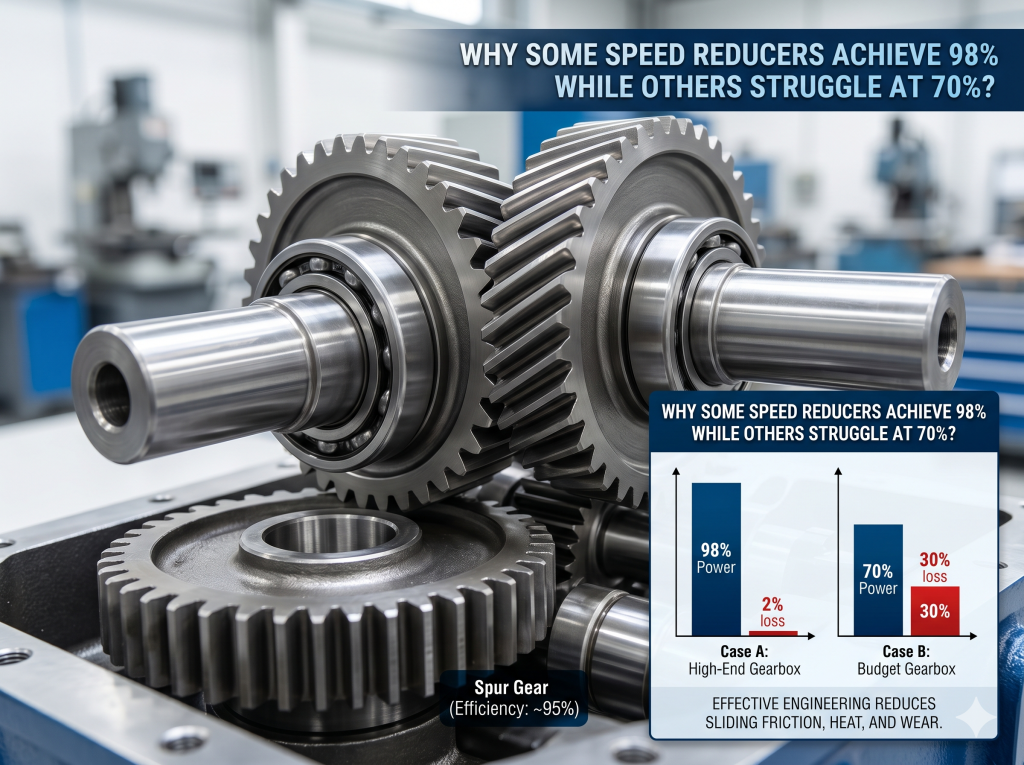
Spur Gears (Efficiency: ~95%)
Spur teeth clash together all at once. The contact line runs straight across the tooth. This leads to a high sliding ratio when the teeth enter and leave contact. You get more impact, more noise, and lower efficiency.
Helical Gears (Efficiency: 97% – 98%)
Helical teeth are cut at an angle. They touch gradually, starting at one point and sliding smoothly across the face. This design cuts down the sliding ratio. It makes the transfer of power smooth. You get quiet running, high precision, and top efficiency.
This is why high-end industrial gearboxes use helical profiles.
5. The Compound Drop: Stacking Gear Stages
Here is a trap that catches many designers.
Efficiency does not add up; it multiplies.
When you chain multiple gear sets together to get a higher reduction ratio, your total efficiency drops fast. The formula is:$$\eta_{\text{total}} = \eta_1 \times \eta_2 \times \dots \times \eta_n$$
Let’s Do the Math:
Say you have a single helical stage that is $97\%$ efficient ($\eta = 0.97$).
- 1-Stage Gearbox: $$\eta_{\text{total}} = 97\%$$
- 2-Stage Gearbox: $$\eta_{\text{total}} = 0.97 \times 0.97 = 94.09\% \approx 94\%$$
- 3-Stage Gearbox: $$\eta_{\text{total}} = 0.97 \times 0.97 \times 0.97 = 91.26\% \approx 91\%$$
This is why planetary gearboxes lose a lot of efficiency when you move to three or more stages.
6. The Exception: Why Worm Gears Drop to 70%
Worm gearboxes are famous for wasting power. Why?
The worm is a screw. The wheel is a helical gear. When they turn, the worm screw slides along the wheel teeth.
It is almost entirely pure sliding friction.
- The Bad: The gearbox gets very hot. Efficiency is terrible, usually between $60\%$ and $75\%$.
- The Good: You get massive gear ratios in a tiny space. They are also self-locking. The output shaft cannot turn the input shaft.
In engineering, physics always dictates your choices.
7. The Real-World Cost: Oversizing Your Motors
Some engineers only look at torque specs when choosing a gearbox. They forget about efficiency.
A low-efficiency gearbox will draw more current, run hot, waste power, and die young.
The Tax on Your Motor: A $50\text{ N}\cdot\text{m}$ Example
Suppose your machine needs exactly $50\text{ N}\cdot\text{m}$ of torque at the output. Look at what happens with two different gearboxes:
Case A: High-End Gearbox ($98\%$ Efficient)
To get $50\text{ N}\cdot\text{m}$ out, your motor must put in: $$\text{Input Torque} = \frac{50\text{ N}\cdot\text{m}}{0.98} \approx 51.02\text{ N}\cdot\text{m}$$
- Result: You need a motor rated for $51\text{ N}\cdot\text{m}$.
Case B: Budget Gearbox ($70\%$ Efficient)
To get the same $50\text{ N}\cdot\text{m}$ out, your motor must put in: $$\text{Input Torque} = \frac{50\text{ N}\cdot\text{m}}{0.70} \approx 71.43\text{ N}\cdot\text{m}$$
- Result: You need a motor rated for $71\text{ N}\cdot\text{m}$.
Because you chose a cheap, inefficient gearbox, you must buy a motor that is one full frame size larger. You pay more for the motor, the drive, the mounting space, and the electricity bills.
8. Key Takeaway: Why Quality Gearboxes Run Cool
When a gearbox runs hot, it is not always because the load is too heavy. Often, you are just paying the tax for sliding friction.
Good gearboxes stay cool because they limit sliding friction. That is how you pack high power density into a small casing without starting a fire.
9. Common Questions (FAQ)
Q1: Why must high-precision, high-efficiency gearboxes limit their stages?
Short Answer: To stop compounding power losses and to keep gear play (backlash) low.
Each stage you add multiplies your power losses. Three stages at 97% drop your overall efficiency to 91%. Plus, every extra gear teeth contact introduces tiny mechanical clearances. These clearances add up to create backlash, which ruins your positioning accuracy. Keep stages low to keep things tight and efficient.
Q2: Why does a worm gearbox get so hot compared to a planetary helical gearbox?
Short Answer: Because worm drives rely almost entirely on sliding friction, which turns up to 40% of input power into heat.
Planetary helical gearboxes rely on rolling contact, which creates very little heat. Worm drives work like a screw sliding against a thread. This continuous sliding action creates massive friction, converting a large chunk of your input power directly into thermal energy.
Q3: What is the best way to improve gearbox efficiency in the field?
Short Answer: Switch to high-quality synthetic oil with the correct viscosity to lower fluid drag and tooth friction.
If you cannot change the gears, change the oil. High-viscosity industrial oil creates fluid drag (churning loss). Upgrading to a premium synthetic oil cuts down both the fluid drag at high speeds and the metal-on-metal sliding friction between the teeth.