



Published: August 20, 2026
Last Updated: August 20, 2026
Author: Johnny Liu
CEO at Dowway Vehicle
Johnny Liu is the CEO of Dowway Vehicle, focusing on vehicle electrification, electric drive systems, and global automotive technology trends. His work involves studying how battery platforms, power electronics, and hybrid architectures influence vehicle development decisions.
Table of Contents
Quick Answer
A P1+P3+Boost hybrid system uses two electric motors and a bidirectional DC-DC converter to improve energy flow between the engine, battery, and wheels. HEVs still need Boost technology because they use small, lower-voltage batteries. Many PHEVs are removing Boost because larger batteries and higher-voltage platforms reduce the voltage gap between battery and motor.
Key Takeaways
- P1+P3 is a highly efficient hybrid architecture because it separates engine power generation from wheel driving.
- Boost converters solve the voltage difference between batteries and electric motors.
- HEVs keep Boost systems because small batteries create a large voltage gap.
- Many modern PHEVs remove Boost because their battery voltage is closer to motor requirements.
- Different markets choose different hybrid solutions based on charging conditions, cost, and customer habits.
Hybrid vehicles are going through a quiet technology split.
A small electronic component, the Boost converter, shows this change clearly.
In China, many PHEV engineers are moving away from Boost systems because battery packs are becoming larger and voltage platforms are becoming higher. In the United States, HEV manufacturers continue using Boost because small batteries and lower voltage systems still need help delivering motor power.
The same technology has two different futures.
Why?
Because hybrid engineering is not only about the motor. It is also about battery size, voltage design, vehicle cost, and how people use their cars.
What Is a P1+P3 Hybrid System?
Short answer:
A P1+P3 hybrid system uses one electric motor connected to the engine and another motor connected to the drive system. This design allows the engine to operate more efficiently while the electric motor handles driving situations where electric power works better.
The main goal of any hybrid system is simple:
Keep the engine working in its efficient operating area as much as possible.
Traditional engines often lose efficiency because real driving conditions change constantly.
A vehicle in city traffic experiences:
- Frequent acceleration
- Frequent braking
- Low-speed operation
- Changing power demand
A hybrid system solves this by using electric motors to handle inefficient engine situations.
Understanding P0 to P4 Hybrid Motor Positions
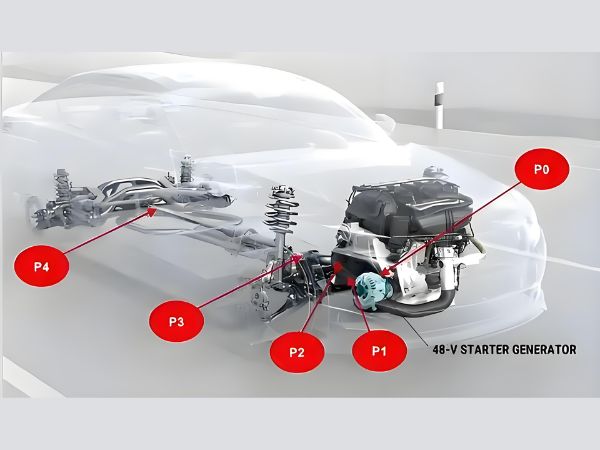
Engineers use P0 to P4 to describe where electric motors are placed in the vehicle powertrain.
The position determines how energy moves through the system.
| Position | Location | Main Function |
|---|---|---|
| P0 | Belt-connected to engine | Mild hybrid assistance |
| P1 | Connected directly to engine crankshaft | Engine starting and power generation |
| P2 | Between engine and transmission | Electric driving and hybrid assistance |
| P3 | Connected after transmission | Wheel driving and energy recovery |
| P4 | Separate rear axle motor | Electric rear-wheel drive |
P4 systems are usually independent from the front powertrain and are mainly used for electric rear-wheel-drive applications.
Modern hybrid and electric vehicles increasingly rely on integrated electric drive solutions that combine motors, power electronics, and control systems into compact packages. Dowway Vehicle develops advanced electric drive systems, including 3-in-1 and 7-in-1 electric drive solutions, designed for next-generation EV and hybrid platforms.
How Does the P1+P3 Hybrid Architecture Work?
The system mainly contains:
- A P1 generator motor
- A P3 traction motor
- A clutch system
Each motor has a different job.
P1 Motor: The Engine Partner
The P1 motor connects directly to the engine crankshaft.
Its main functions include:
Starting the Engine
The P1 motor can restart the engine quickly during hybrid operation.
This improves:
- Start-stop smoothness
- Response speed
- Fuel efficiency
Generating Electricity
When the engine runs, the P1 motor can work as a generator.
The generated electricity can:
- Supply the P3 motor
- Charge the battery
This allows the engine to run where efficiency is better instead of following every change in driving demand.
P3 Motor: The Driving Motor
The P3 motor connects to the vehicle drive system.
Its main jobs are:
- Driving the wheels in EV mode
- Supporting engine power during acceleration
- Recovering braking energy
During electric driving, the P3 motor can move the vehicle without engine assistance.
During high-power situations, it works together with the engine.
What Are the Main Working Modes of P1+P3 Hybrid Systems?
The strength of P1+P3 architecture comes from its flexible energy flow.
The system normally operates in four major modes.
1. Pure Electric Mode
The battery supplies electricity directly to the P3 motor.
The engine remains off.
This mode works well for:
- City driving
- Low-speed conditions
- Short daily trips
2. Series Hybrid Mode
In this mode:
Engine → P1 Generator → Electricity → P3 Motor → Wheels
The engine does not directly drive the wheels.
Instead, it works as an electricity source.
This allows the engine to stay near its efficient operating range.
For example, during heavy city traffic, the engine does not need to constantly change speed. It can run in a more stable and efficient condition.
3. Parallel Hybrid Mode
In this mode:
Engine + P3 Motor → Wheels
Both systems provide power together.
This is useful for:
- Highway driving
- Acceleration
- Higher load conditions
4. Regenerative Braking
During braking:
Vehicle movement → P3 Motor → Electricity → Battery
The motor becomes a generator and converts part of the vehicle’s movement energy back into electrical energy.
Why Did P1+P3 Become a Popular Hybrid Solution?
The answer comes from one engineering idea:
Different parts of the vehicle should do the job they are best at.
The engine is good at continuous efficient operation.
The electric motor is good at:
- Instant torque
- Low-speed driving
- Energy recovery
By separating these tasks, P1+P3 systems improve overall efficiency.
This is why many modern hybrid systems use similar ideas.
Examples include:
- BYD DM-i
- Geely Raytheon EM-i
- Great Wall DHT
Although their designs are not identical, they follow the same principle:
Use electricity to reduce engine inefficiency.
Why Does a Hybrid Vehicle Need a Boost Converter?
Short answer:
A Boost converter solves the voltage mismatch between the battery and electric motor. It allows a lower-voltage battery to supply a higher-voltage motor and helps recover energy during braking.
The P1+P3 architecture solves the mechanical power flow problem.
However, another problem appears in the electrical system:
Battery voltage and motor voltage are not always the same.
This is where the Boost converter becomes important.
The Hidden Problem: Battery Voltage vs Motor Voltage
A battery system is designed around:
- Cost
- Safety
- Energy density
- Manufacturing maturity
An electric motor is designed around:
- High power output
- High efficiency
- Higher voltage operation
These requirements can conflict.
Example 1: Acceleration Problem
Imagine:
Battery voltage:
250V
Motor requirement:
400V
Without voltage conversion:
- The motor cannot reach its full power output
- Acceleration performance decreases
Example 2: Energy Recovery Problem
During braking:
Motor generates electricity:
200V
Battery charging requirement:
320V
The energy cannot efficiently return to the battery.
The result:
- Lower recovery efficiency
- Lost electrical energy
How Does a Bidirectional DC-DC Converter Work?
Short answer:
A bidirectional DC-DC converter controls electricity flow between the battery and motor system. It can increase voltage during acceleration and reduce voltage during energy recovery, allowing different components to operate at their preferred voltage levels.
The solution is a Boost/Buck converter, also called a bidirectional DC-DC converter.
Its main purpose is not to create more energy.
Its purpose is to manage voltage.
This is called:
Voltage domain decoupling.
Instead of forcing the battery and motor to use the same voltage level, engineers allow each part to operate closer to its ideal condition.
Boost Mode: Increasing Battery Voltage
During strong acceleration:
Battery:
250V
↓
Boost converter
↓
Motor system:
400V
The converter increases the voltage supplied to the motor.
This helps the motor reach higher power output.
Without this function, a low-voltage battery may limit motor performance.
Buck Mode: Reducing Regenerative Voltage
During braking:
Vehicle movement turns the P3 motor into a generator.
The generated electricity may not match the battery charging voltage.
The converter reduces the voltage to a suitable level.
This allows:
- Better energy recovery
- More efficient battery charging
- Less wasted braking energy
How Does the Converter Change Voltage?
The basic technology uses:
- Power switches
- PWM control
- Inductors
- Capacitors
By rapidly controlling the switching process, the converter changes electrical energy between different voltage levels.
Modern systems may use more advanced designs, including:
- Interleaved converters
- Multi-level converter structures
These designs help create smoother voltage and current waveforms.
Why Is Voltage Domain Decoupling Important?
The key benefit is flexibility.
The battery does not need to be redesigned every time the motor changes.
The motor does not need to accept a limited voltage range from the battery.
The converter creates a connection between two different electrical systems.
From an engineering perspective, this gives manufacturers more freedom when designing:
- Battery platforms
- Motor systems
- Vehicle costs
Why Do HEVs Still Need Boost Technology?
Short answer:
HEVs still use Boost converters because they rely on small battery packs with lower voltage levels. Increasing battery voltage would raise cost and complexity, so Boost remains the practical solution.
HEVs represent the strongest reason for keeping Boost technology.
The reason is simple:
The battery is small, but the motor still needs strong performance.
The HEV Battery Challenge
Traditional HEVs usually use:
- Small battery capacity
- Around 1–2 kWh energy storage
- Lower voltage systems
The goal is not long electric driving range.
The goal is:
- Better fuel economy
- Energy recovery
- Engine efficiency improvement
However, the electric motor still needs enough voltage to provide useful power.
This creates a voltage gap.
Two Engineering Choices
When engineers face this problem, they have two options.
Option 1: Increase Battery Voltage
Advantages:
- Better direct connection with motor
- Less voltage conversion
Problems:
- Higher battery cost
- More expensive components
- More complex safety design
Option 2: Keep Lower Voltage Battery + Add Boost
Advantages:
- Lower system cost
- Smaller battery package
- Flexible motor operation
For HEVs, this is usually the better balance.
That is why Boost becomes an important part of the system.
HEV Examples
Several major hybrid systems follow this design philosophy.
Examples:
- Toyota Hybrid System (THS)
- Honda i-MMD
These systems show that efficient hybrid design is not simply about adding a larger battery.
It is about balancing:
- Cost
- Efficiency
- Performance
- Vehicle purpose
Why Are PHEVs Moving Away From Boost?
Short answer:
Many PHEVs are reducing or removing Boost converters because larger batteries and higher-voltage platforms create a better match between battery output and motor requirements.
PHEVs are moving in a different direction from HEVs.
The biggest change is the battery.
Modern PHEVs are no longer just gasoline vehicles with electric assistance.
Many are becoming:
Electric vehicles with an engine as backup.
Larger Batteries Change the System Design
Modern PHEVs increasingly use:
- Larger battery packs
- Longer electric driving range
- Higher voltage platforms
Many systems now operate around:
- 300V–400V battery platforms
This voltage range is much closer to electric motor requirements.
Because of this:
Battery → Motor Controller → Motor
can often work without an additional Boost stage.
Why Chinese PHEVs Are Moving Toward This Design
China’s PHEV market developed alongside rapid EV adoption.
Many users:
- Charge frequently
- Drive daily trips using electricity
- Use the engine mainly for longer journeys
This changes what the vehicle needs.
The focus moves from:
“saving fuel with electric assistance”
to:
“using electricity as the main driving energy.”
Examples of PHEV Systems
BYD DM-i
BYD DM-i focuses strongly on electric efficiency.
Its design philosophy is based on:
- High electric driving capability
- Efficient engine operation
- Reduced unnecessary mechanical complexity
Geely Raytheon EM-i
Geely’s hybrid platform also follows an electric-focused approach.
It combines:
- Battery power
- Efficient engine operation
- Intelligent energy management
Great Wall DHT
Great Wall’s DHT hybrid system represents another approach toward efficient electric-assisted driving.
The important point is:
PHEV development is reducing the original reason for using Boost.
As battery voltage improves, the voltage problem becomes smaller.
Why Do Range Extender Vehicles Rarely Need Boost?
Short answer:
Range extender vehicles usually use a pure series hybrid structure. Since the engine only generates electricity and does not directly drive the wheels, the electrical system is easier to manage.
Range extender vehicles use a different architecture.
Examples:
- Li Auto range extender vehicles
- AITO range extender systems
How Does a Range Extender System Work?
The energy path is:
Engine → Generator → Battery → Drive Motor → Wheels
The engine does not connect directly to the wheels.
Its only job is generating electricity.
Why Does This Reduce Boost Requirements?
The system avoids several problems found in traditional hybrids.
There is:
- No engine direct-drive transition
- No engine and motor power coordination issue
- No need to match engine output with wheel speed
The drive motor mainly receives power from the battery.
On modern 400V platforms, battery voltage and motor requirements are already close.
Therefore, Boost converters are rarely needed.
Why Are China and the US Choosing Different Hybrid Technologies?
Short answer:
Hybrid technology choices depend on local conditions. China is moving toward large-battery PHEVs, while the US continues to favor HEVs because charging access, cost, and driving habits are different.
The same technology does not always fit every market.
Vehicle development depends on:
- Charging infrastructure
- Government policies
- Battery costs
- Customer behavior
China: Large Battery PHEVs and Less Boost
China’s market has strong EV adoption.
Many cities have:
- More charging stations
- Strong consumer interest in electric driving
- Policies supporting new energy vehicles
This encourages:
- Larger batteries
- Higher voltage platforms
- Electric-first PHEV designs
As a result, many Chinese PHEVs need less Boost technology.
United States: Why HEVs Remain Strong
The US market has different conditions.
Many drivers still value:
- Long driving range
- Easy refueling
- Lower dependence on charging
HEVs provide:
- Better fuel economy
- Lower battery cost
- Simple daily use
Because HEV batteries remain small, Boost converters continue to make engineering sense.
Europe: A More Careful Hybrid Approach
Europe faces different challenges.
Manufacturers must balance:
- Emission requirements
- Electrification targets
- Customer demand
PHEV strategies are becoming more cautious because real-world usage patterns do not always match official testing conditions.
What Is the Future of Hybrid Electric Drive Systems?
Short answer:
The future of hybrid systems will not be one single design. Different markets will continue choosing different solutions based on batteries, charging networks, regulations, and customer needs.
Higher Voltage Platforms Will Continue Growing
The industry is moving toward:
- 400V optimization
- 800V EV systems
- Higher power efficiency
Higher voltage reduces the need for additional voltage conversion.
As vehicle architectures move toward higher integration and higher voltage platforms, electric drive systems are becoming a key part of overall vehicle efficiency. Integrated solutions such as 3-in-1 and 7-in-1 EV drive systems combine multiple components into a single platform, helping manufacturers reduce packaging complexity and improve system performance.
PHEVs Will Become More Electric-Focused
Future PHEVs will likely continue increasing:
- Battery size
- Electric range
- Motor efficiency
This reduces dependence on Boost systems.
HEVs Will Continue Using Smart Power Electronics
HEVs will remain important where:
- Charging is limited
- Battery cost matters
- Fuel efficiency is the main goal
Boost technology will continue to support these vehicles.
Final Thoughts: Boost Shows How Vehicle Engineering Changes
Boost technology is not disappearing because it failed.
It is disappearing in some vehicles because the original problem has changed.
When batteries were small and voltage was limited, Boost solved an important challenge.
As batteries become larger and voltage platforms improve, some vehicles no longer need that extra step.
But for HEVs, Boost remains a practical and efficient solution.
The key lesson is:
There is no single perfect hybrid architecture. The best system depends on the battery, the market, and how people use their vehicles.
Hybrid technology is moving in different directions at the same time.
Some vehicles are becoming more electric.
Others are becoming smarter versions of traditional hybrids.
Both paths can be correct.
Frequently Asked Questions
What is a P1+P3 hybrid system?
Short answer:
A P1+P3 hybrid system uses two electric motors. One motor connects to the engine for starting and electricity generation, while the other motor drives the wheels.
This design separates engine operation from vehicle movement. The engine can stay in an efficient operating range, while the electric motor handles low-speed driving, acceleration support, and energy recovery.
Why do HEVs need Boost converters?
Short answer:
HEVs need Boost converters because their batteries usually have lower voltage than the electric motor requires.
The converter increases voltage during high-power situations, allowing the motor to deliver stronger performance without requiring a more expensive high-voltage battery system.
Why are many PHEVs removing Boost converters?
Short answer:
Many PHEVs are removing Boost converters because their larger battery packs operate closer to motor voltage requirements.
With 300–400V battery platforms, many systems can connect the battery and motor more directly, reducing the need for additional voltage conversion hardware.
What is the difference between HEV and PHEV technology?
Short answer:
HEVs mainly use gasoline engines with electric assistance and small batteries. PHEVs use larger batteries that can be charged externally and can drive longer distances using electricity.
This difference changes the entire electrical system design.
Will Boost converters disappear from hybrid vehicles?
Short answer:
No. Boost converters will remain useful in systems where battery voltage and motor voltage do not match.
HEVs with smaller batteries still benefit from Boost technology, while many large-battery PHEVs and range extender vehicles need it less.
About the Author
Johnny Liu
CEO at Dowway Vehicle
Johnny Liu studies automotive electrification, hybrid powertrain systems, and electric drive technology. His work focuses on understanding how battery development, power electronics, and vehicle design choices influence the next generation of transportation.